
AIBE 22 Question Papers 2026 Out: Download Set A, B, C & D PDFs with Answer Keys and Solutions
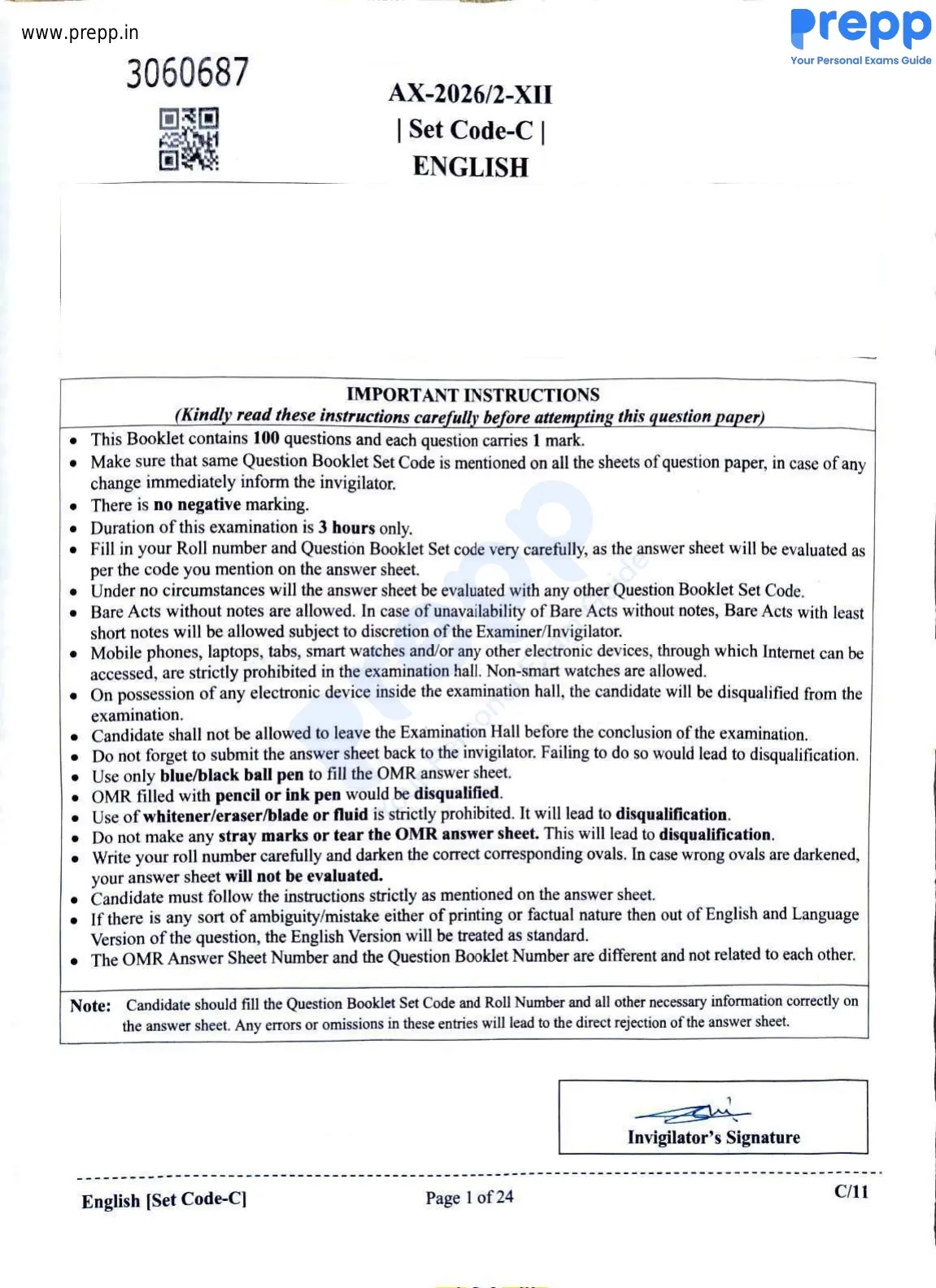
AIBE 22 Question Papers 2026 for Sets A, B, C and D with Answer Keys are available here to download in PDF format. AIBE XXII was held on November 29, 2026, in a single shift from 1:00 PM to 4:00 PM.
AIBE 22 2026 Set-Wise Question Paper and Answer Key PDF
| Question Paper PDF | Answer Key PDF | Detailed Solution |
|---|---|---|
AIBE 22 2026 Question Paper and Answer Key PDF (Set A) |
Download PDF | Attempt Now |
| AIBE 22 2026 Question Paper and Answer Key PDF (Set B) |
Download PDF | Attempt Now |
| AIBE 22 2026 Question Paper and Answer Key PDF (Set C) |
Download PDF | Attempt Now |
| AIBE 22 2026 Question Paper and Answer Key PDF (Set D) |
Download PDF | Attempt Now |
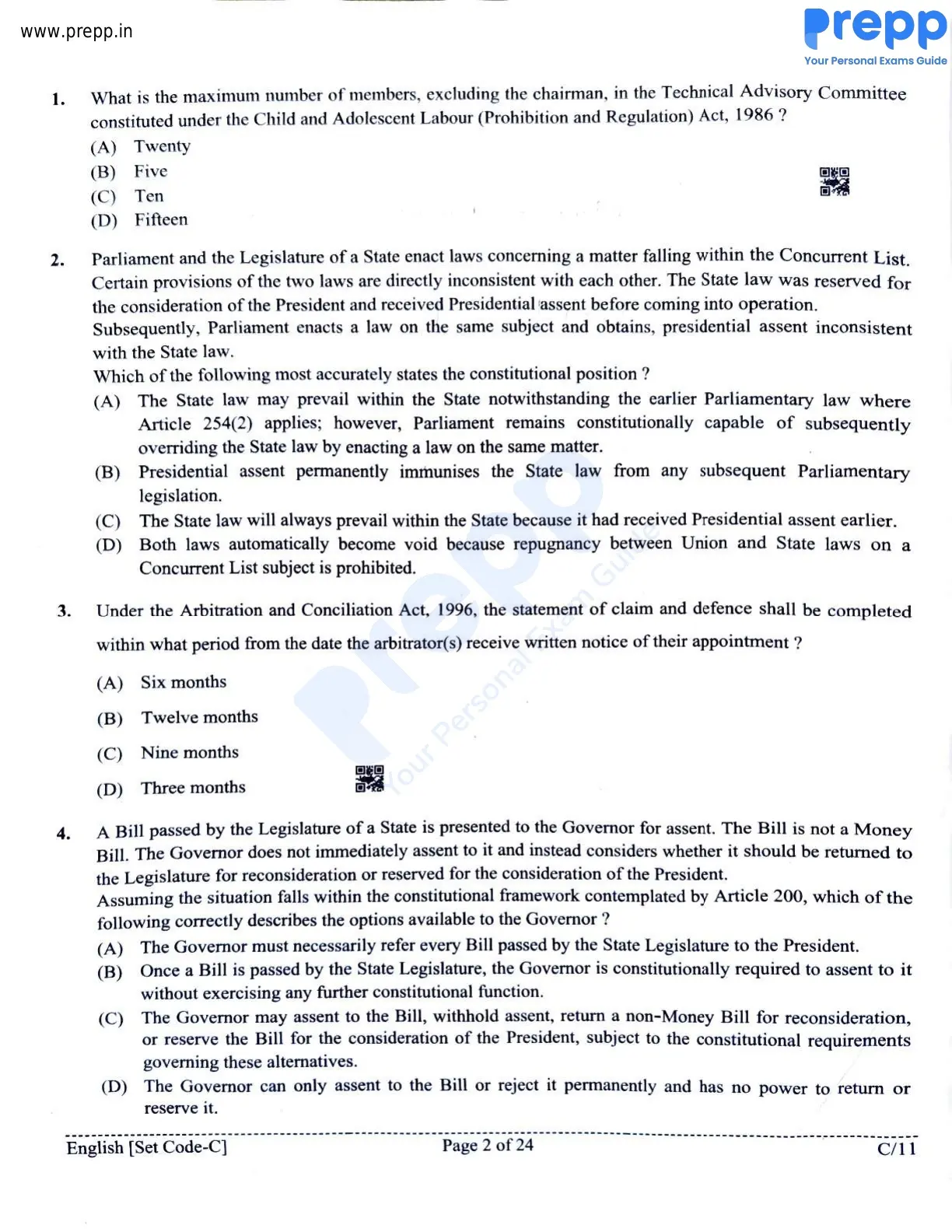
1. What is the maximum number of members, excluding the chairman, in the Technical Advisory Committee constituted under the Child and Adolescent Labour (Prohibition and Regulation) Act, 1986 ?
(A) Twenty
(B) Five
(C) Ten
(D) Fifteen
Check Correct Answer & Solution
2. Parliament and the Legislature of a State enact laws concerning a matter falling within the Concurrent List. Certain provisions of the two laws are directly inconsistent with each other. The State law was reserved for the consideration of the President and received Presidential assent before coming into operation.
Subsequently, Parliament enacts a law on the same subject and obtains, presidential assent inconsistent with the State law.
Which of the following most accurately states the constitutional position ?
(A) The State law may prevail within the State notwithstanding the earlier Parliamentary law where Article 254(2) applies; however, Parliament remains constitutionally capable of subsequently overriding the State law by enacting a law on the same matter.
(B) Presidential assent permanently immunises the State law from any subsequent Parliamentary legislation.
(C) The State law will always prevail within the State because it had received Presidential assent earlier.
(D) Both laws automatically become void because repugnancy between Union and State laws on a Concurrent List subject is prohibited.
Check Correct Answer & Solution
3. Under the Arbitration and Conciliation Act, 1996, the statement of claim and defence shall be completed within what period from the date the arbitrator(s) receive written notice of their appointment ?
(A) Six months
(B) Twelve months
(C) Nine months
(D) Three months
Check Correct Answer & Solution
4. A Bill passed by the Legislature of a State is presented to the Governor for assent. The Bill is not a Money Bill. The Governor does not immediately assent to it and instead considers whether it should be returned to the Legislature for reconsideration or reserved for the consideration of the President.
Assuming the situation falls within the constitutional framework contemplated by Article 200, which of the following correctly describes the options available to the Governor ?
(A) The Governor must necessarily refer every Bill passed by the State Legislature to the President.
(B) Once a Bill is passed by the State Legislature, the Governor is constitutionally required to assent to it without exercising any further constitutional function.
(C) The Governor may assent to the Bill, withhold assent, return a non-Money Bill for reconsideration, or reserve the Bill for the consideration of the President, subject to the constitutional requirements governing these alternatives.
(D) The Governor can only assent to the Bill or reject it permanently and has no power to return or reserve it.
Check Correct Answer & Solution
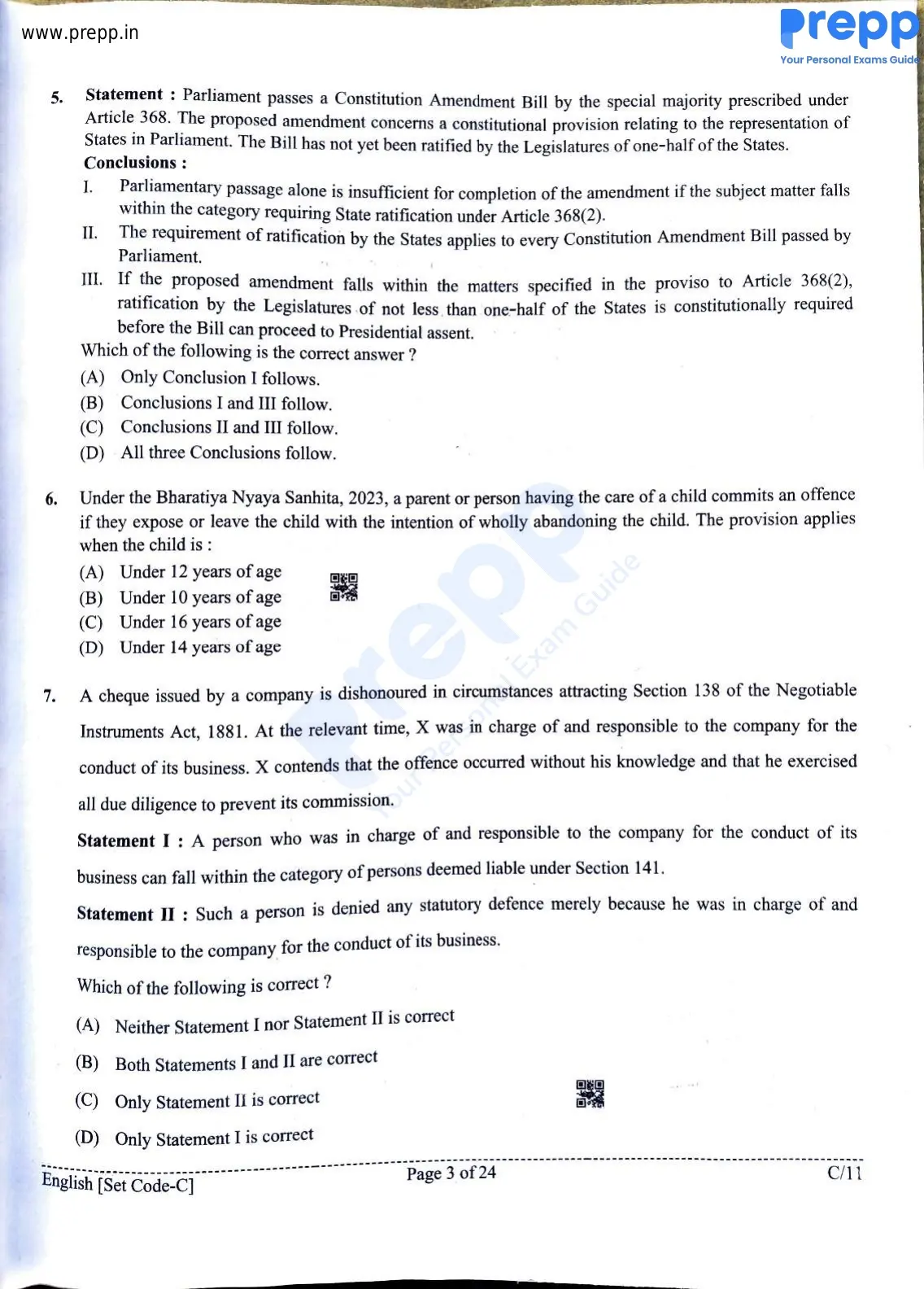
5. Statement : Parliament passes a Constitution Amendment Bill by the special majority prescribed under Article 368. The proposed amendment concerns a constitutional provision relating to the representation of States in Parliament. The Bill has not yet been ratified by the Legislatures of one-half of the States.
Conclusions :
I. Parliamentary passage alone is insufficient for completion of the amendment if the subject matter falls within the category requiring State ratification under Article 368(2).
II. The requirement of ratification by the States applies to every Constitution Amendment Bill passed by Parliament.
III. If the proposed amendment falls within the matters specified in the proviso to Article 368(2), ratification by the Legislatures of not less than one-half of the States is constitutionally required before the Bill can proceed to Presidential assent.
Which of the following is the correct answer ?
(A) Only Conclusion I follows.
(B) Conclusions I and III follow.
(C) Conclusions II and III follow.
(D) All three Conclusions follow.
Check Correct Answer & Solution
6. Under the Bharatiya Nyaya Sanhita, 2023, a parent or person having the care of a child commits an offence if they expose or leave the child with the intention of wholly abandoning the child. The provision applies when the child is :
(A) Under 12 years of age
(B) Under 10 years of age
(C) Under 16 years of age
(D) Under 14 years of age
Check Correct Answer & Solution
7. A cheque issued by a company is dishonoured in circumstances attracting Section 138 of the Negotiable Instruments Act, 1881. At the relevant time, X was in charge of and responsible to the company for the conduct of its business. X contends that the offence occurred without his knowledge and that he exercised all due diligence to prevent its commission.
Statement I : A person who was in charge of and responsible to the company for the conduct of its business can fall within the category of persons deemed liable under Section 141.
Statement II : Such a person is denied any statutory defence merely because he was in charge of and responsible to the company for the conduct of its business.
Which of the following is correct ?
(A) Neither Statement I nor Statement II is correct
(B) Both Statements I and II are correct
(C) Only Statement II is correct
(D) Only Statement I is correct
Check Correct Answer & Solution
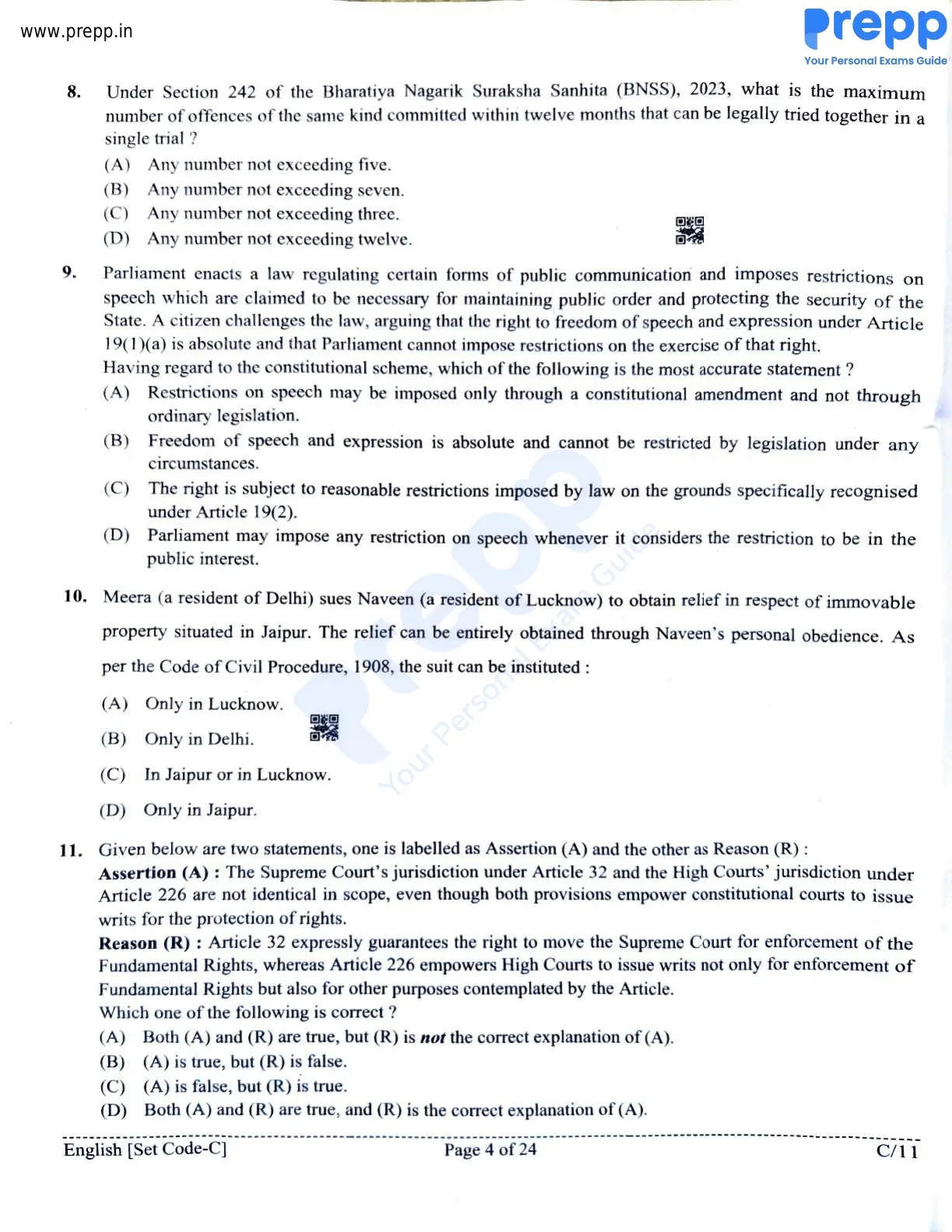
8. Under Section 242 of the Bharatiya Nagarik Suraksha Sanhita (BNSS), 2023, what is the maximum number of offences of the same kind committed within twelve months that can be legally tried together in a single trial ?
(A) Any number not exceeding five.
(B) Any number not exceeding seven.
(C) Any number not exceeding three.
(D) Any number not exceeding twelve.
Check Correct Answer & Solution
9. Parliament enacts a law regulating certain forms of public communication and imposes restrictions on speech which are claimed to be necessary for maintaining public order and protecting the security of the State. A citizen challenges the law, arguing that the right to freedom of speech and expression under Article 19(1)(a) is absolute and that Parliament cannot impose restrictions on the exercise of that right.
Having regard to the constitutional scheme, which of the following is the most accurate statement ?
(A) Restrictions on speech may be imposed only through a constitutional amendment and not through ordinary legislation.
(B) Freedom of speech and expression is absolute and cannot be restricted by legislation under any circumstances.
(C) The right is subject to reasonable restrictions imposed by law on the grounds specifically recognised under Article 19(2).
(D) Parliament may impose any restriction on speech whenever it considers the restriction to be in the public interest.
Check Correct Answer & Solution
10. Meera (a resident of Delhi) sues Naveen (a resident of Lucknow) to obtain relief in respect of immovable property situated in Jaipur. The relief can be entirely obtained through Naveen’s personal obedience. As per the Code of Civil Procedure, 1908, the suit can be instituted :
(A) Only in Lucknow.
(B) Only in Delhi.
(C) In Jaipur or in Lucknow.
(D) Only in Jaipur.
Check Correct Answer & Solution
11. Given below are two statements, one is labelled as Assertion (A) and the other as Reason (R) :
Assertion (A) : The Supreme Court’s jurisdiction under Article 32 and the High Courts’ jurisdiction under Article 226 are not identical in scope, even though both provisions empower constitutional courts to issue writs for the protection of rights.
Reason (R) : Article 32 expressly guarantees the right to move the Supreme Court for enforcement of the Fundamental Rights, whereas Article 226 empowers High Courts to issue writs not only for enforcement of Fundamental Rights but also for other purposes contemplated by the Article.
Which one of the following is correct ?
(A) Both (A) and (R) are true, but (R) is not the correct explanation of (A).
(B) (A) is true, but (R) is false.
(C) (A) is false, but (R) is true.
(D) Both (A) and (R) are true, and (R) is the correct explanation of (A).
Check Correct Answer & Solution
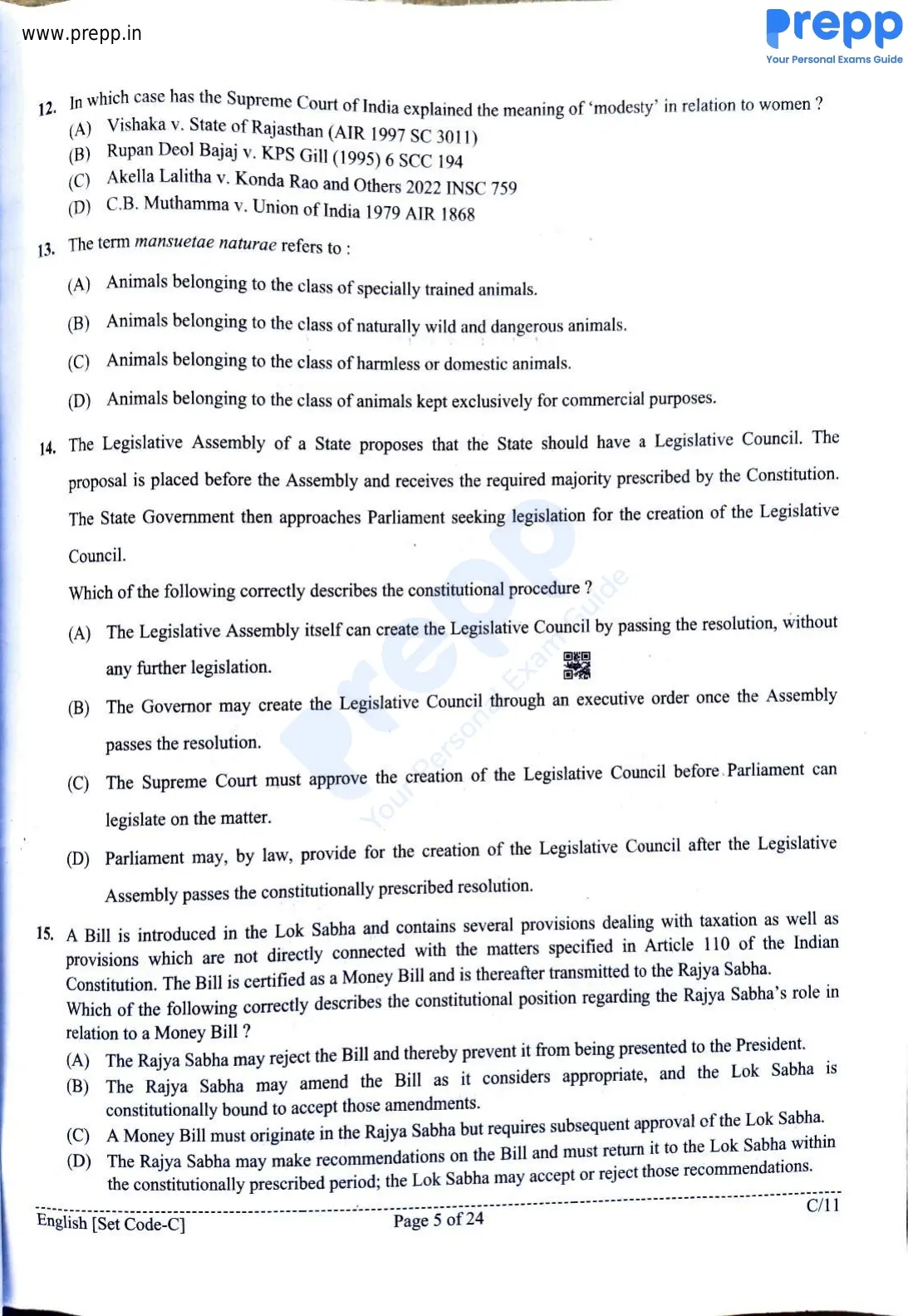
12. In which case has the Supreme Court of India explained the meaning of ‘modesty’ in relation to women ?
(A) Vishaka v. State of Rajasthan (AIR 1997 SC 3011)
(B) Rupan Deol Bajaj v. KPS Gill (1995) 6 SCC 194
(C) Akella Lalitha v. Konda Rao and Others 2022 INSC 759
(D) C.B. Muthamma v. Union of India 1979 AIR 1868
Check Correct Answer & Solution
13. The term mansuetae naturae refers to :
(A) Animals belonging to the class of specially trained animals.
(B) Animals belonging to the class of naturally wild and dangerous animals.
(C) Animals belonging to the class of harmless or domestic animals.
(D) Animals belonging to the class of animals kept exclusively for commercial purposes.
Check Correct Answer & Solution
14. The Legislative Assembly of a State proposes that the State should have a Legislative Council. The proposal is placed before the Assembly and receives the required majority prescribed by the Constitution. The State Government then approaches Parliament seeking legislation for the creation of the Legislative Council.
Which of the following correctly describes the constitutional procedure ?
(A) The Legislative Assembly itself can create the Legislative Council by passing the resolution, without any further legislation.
(B) The Governor may create the Legislative Council through an executive order once the Assembly passes the resolution.
(C) The Supreme Court must approve the creation of the Legislative Council before Parliament can legislate on the matter.
(D) Parliament may, by law, provide for the creation of the Legislative Council after the Legislative Assembly passes the constitutionally prescribed resolution.
Check Correct Answer & Solution
15. A Bill is introduced in the Lok Sabha and contains several provisions dealing with taxation as well as provisions which are not directly connected with the matters specified in Article 110 of the Indian Constitution. The Bill is certified as a Money Bill and is thereafter transmitted to the Rajya Sabha.
Which of the following correctly describes the constitutional position regarding the Rajya Sabha’s role in relation to a Money Bill ?
(A) The Rajya Sabha may reject the Bill and thereby prevent it from being presented to the President.
(B) The Rajya Sabha may amend the Bill as it considers appropriate, and the Lok Sabha is constitutionally bound to accept those amendments.
(C) A Money Bill must originate in the Rajya Sabha but requires subsequent approval of the Lok Sabha.
(D) The Rajya Sabha may make recommendations on the Bill and must return it to the Lok Sabha within the constitutionally prescribed period; the Lok Sabha may accept or reject those recommendations.
Check Correct Answer & Solution
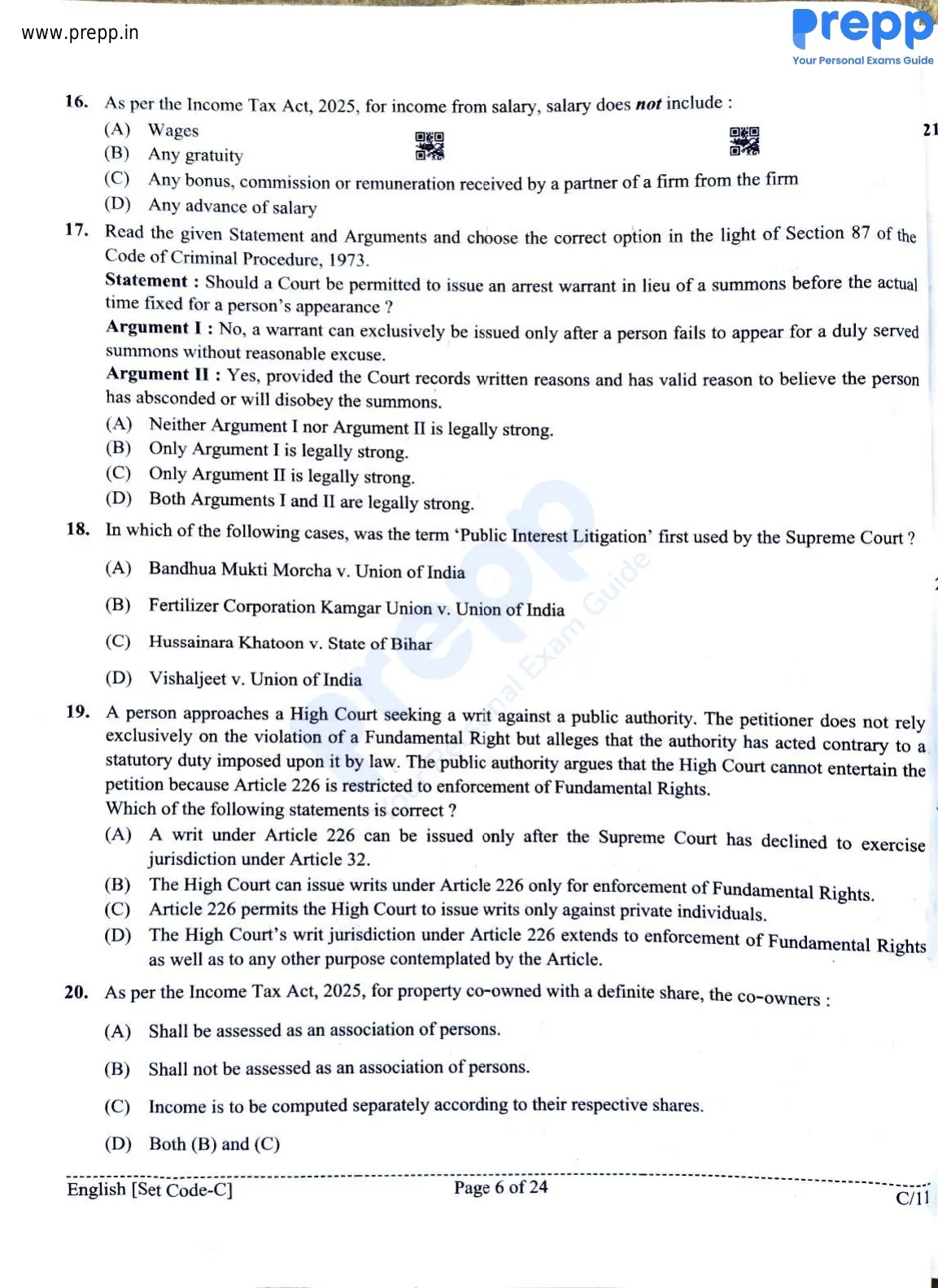
16. As per the Income Tax Act, 2025, for income from salary, salary does not include :
(A) Wages
(B) Any gratuity
(C) Any bonus, commission or remuneration received by a partner of a firm from the firm
(D) Any advance of salary
Check Correct Answer & Solution
17. Read the given Statement and Arguments and choose the correct option in the light of Section 87 of the Code of Criminal Procedure, 1973.
Statement : Should a Court be permitted to issue an arrest warrant in lieu of a summons before the actual time fixed for a person’s appearance ?
Argument I : No, a warrant can exclusively be issued only after a person fails to appear for a duly served summons without reasonable excuse.
Argument II : Yes, provided the Court records written reasons and has valid reason to believe the person has absconded or will disobey the summons.
(A) Neither Argument I nor Argument II is legally strong.
(B) Only Argument I is legally strong.
(C) Only Argument II is legally strong.
(D) Both Arguments I and II are legally strong.
Check Correct Answer & Solution
18. In which of the following cases, was the term ‘Public Interest Litigation’ first used by the Supreme Court ?
(A) Bandhua Mukti Morcha v. Union of India
(B) Fertilizer Corporation Kamgar Union v. Union of India
(C) Hussainara Khatoon v. State of Bihar
(D) Vishaljeet v. Union of India
Check Correct Answer & Solution
19. A person approaches a High Court seeking a writ against a public authority. The petitioner does not rely exclusively on the violation of a Fundamental Right but alleges that the authority has acted contrary to a statutory duty imposed upon it by law. The public authority argues that the High Court cannot entertain the petition because Article 226 is restricted to enforcement of Fundamental Rights.
Which of the following statements is correct ?
(A) A writ under Article 226 can be issued only after the Supreme Court has declined to exercise jurisdiction under Article 32.
(B) The High Court can issue writs under Article 226 only for enforcement of Fundamental Rights.
(C) Article 226 permits the High Court to issue writs only against private individuals.
(D) The High Court’s writ jurisdiction under Article 226 extends to enforcement of Fundamental Rights as well as to any other purpose contemplated by the Article.
Check Correct Answer & Solution
20. As per the Income Tax Act, 2025, for property co-owned with a definite share, the co-owners :
(A) Shall be assessed as an association of persons.
(B) Shall not be assessed as an association of persons.
(C) Income is to be computed separately according to their respective shares.
(D) Both (B) and (C)
Check Correct Answer & Solution
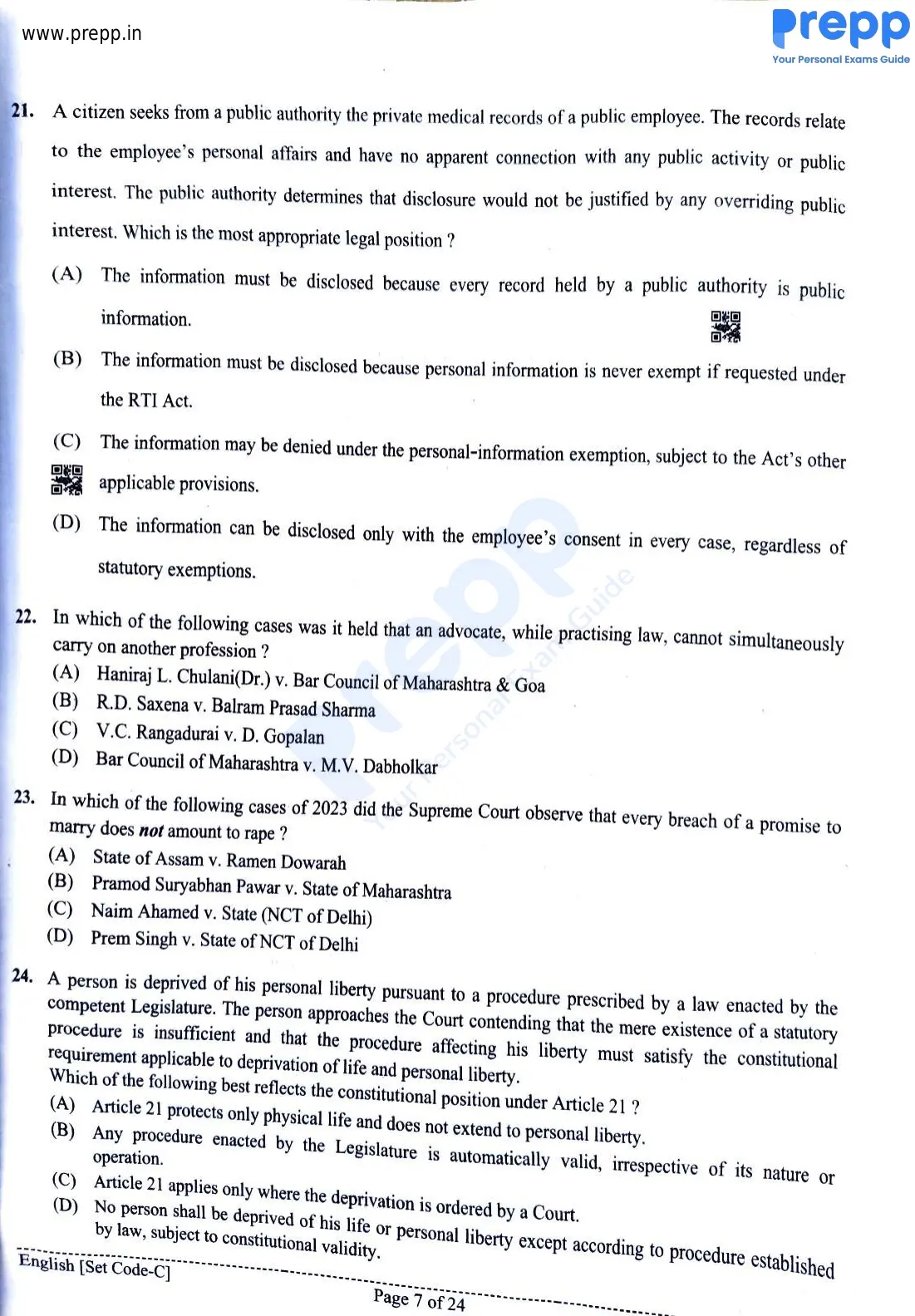
21. A citizen seeks from a public authority the private medical records of a public employee. The records relate to the employee’s personal affairs and have no apparent connection with any public activity or public interest. The public authority determines that disclosure would not be justified by any overriding public interest. Which is the most appropriate legal position ?
(A) The information must be disclosed because every record held by a public authority is public information.
(B) The information must be disclosed because personal information is never exempt if requested under the RTI Act.
(C) The information may be denied under the personal-information exemption, subject to the Act’s other applicable provisions.
(D) The information can be disclosed only with the employee’s consent in every case, regardless of statutory exemptions.
Check Correct Answer & Solution
22. In which of the following cases was it held that an advocate, while practising law, cannot simultaneously carry on another profession ?
(A) Haniraj L. Chulani(Dr.) v. Bar Council of Maharashtra & Goa
(B) R.D. Saxena v. Balram Prasad Sharma
(C) V.C. Rangadurai v. D. Gopalan
(D) Bar Council of Maharashtra v. M.V. Dabholkar
Check Correct Answer & Solution
23. In which of the following cases of 2023 did the Supreme Court observe that every breach of a promise to marry does not amount to rape ?
(A) State of Assam v. Ramen Dowarah
(B) Pramod Suryabhan Pawar v. State of Maharashtra
(C) Naim Ahamed v. State (NCT of Delhi)
(D) Prem Singh v. State of NCT of Delhi
Check Correct Answer & Solution
24. A person is deprived of his personal liberty pursuant to a procedure prescribed by a law enacted by the competent Legislature. The person approaches the Court contending that the mere existence of a statutory procedure is insufficient and that the procedure affecting his liberty must satisfy the constitutional requirement applicable to deprivation of life and personal liberty.
Which of the following best reflects the constitutional position under Article 21 ?
(A) Article 21 protects only physical life and does not extend to personal liberty.
(B) Any procedure enacted by the Legislature is automatically valid, irrespective of its nature or operation.
(C) Article 21 applies only where the deprivation is ordered by a Court.
(D) No person shall be deprived of his life or personal liberty except according to procedure established by law, subject to constitutional validity.
Check Correct Answer & Solution
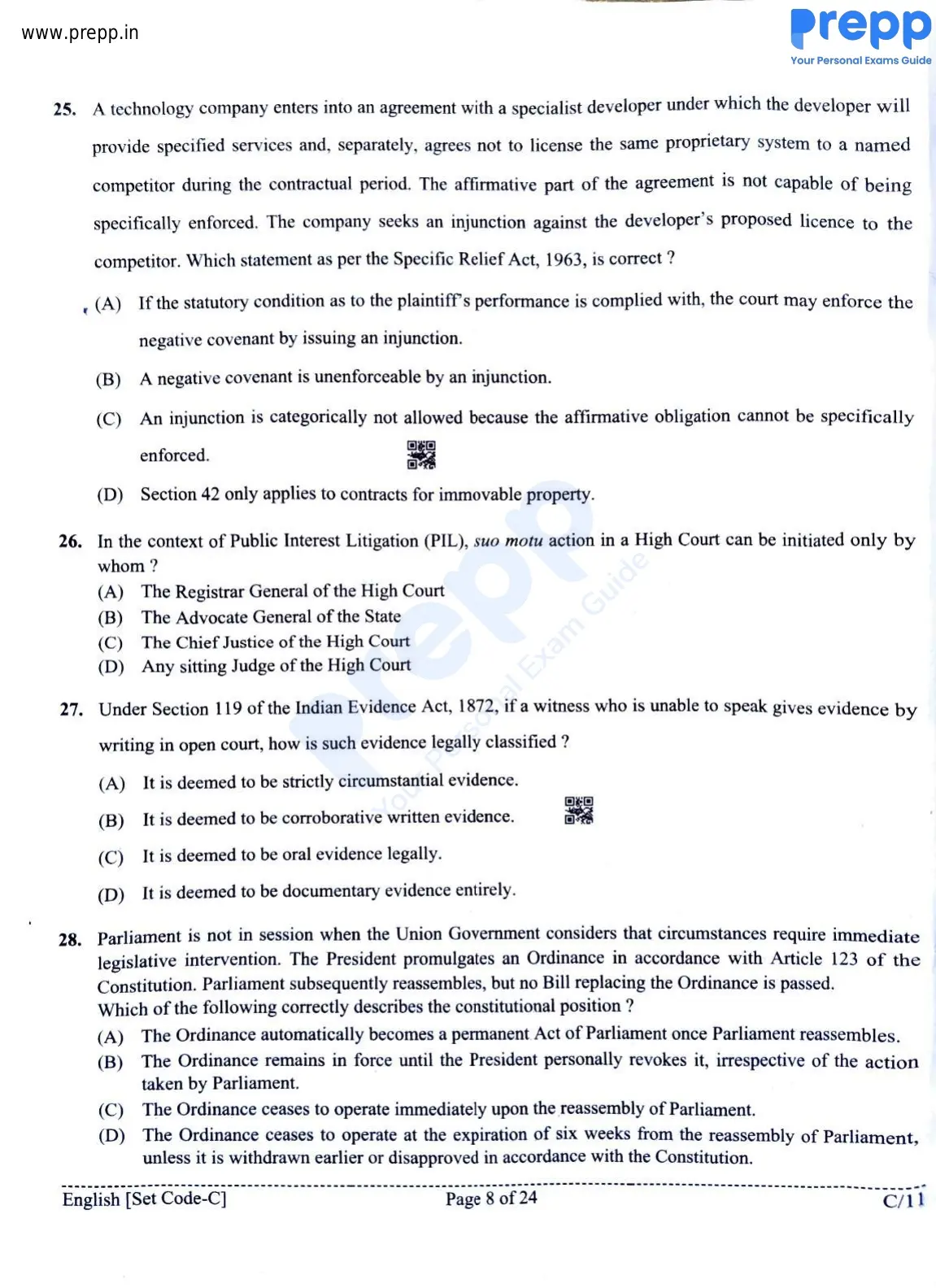
25. A technology company enters into an agreement with a specialist developer under which the developer will provide specified services and, separately, agrees not to license the same proprietary system to a named competitor during the contractual period. The affirmative part of the agreement is not capable of being specifically enforced. The company seeks an injunction against the developer’s proposed licence to the competitor. Which statement as per the Specific Relief Act, 1963, is correct ?
(A) If the statutory condition as to the plaintiff’s performance is complied with, the court may enforce the negative covenant by issuing an injunction.
(B) A negative covenant is unenforceable by an injunction.
(C) An injunction is categorically not allowed because the affirmative obligation cannot be specifically enforced.
(D) Section 42 only applies to contracts for immovable property.
Check Correct Answer & Solution
26. In the context of Public Interest Litigation (PIL), suo motu action in a High Court can be initiated only by whom ?
(A) The Registrar General of the High Court
(B) The Advocate General of the State
(C) The Chief Justice of the High Court
(D) Any sitting Judge of the High Court
Check Correct Answer & Solution
27. Under Section 119 of the Indian Evidence Act, 1872, if a witness who is unable to speak gives evidence by writing in open court, how is such evidence legally classified ?
(A) It is deemed to be strictly circumstantial evidence.
(B) It is deemed to be corroborative written evidence.
(C) It is deemed to be oral evidence legally.
(D) It is deemed to be documentary evidence entirely.
Check Correct Answer & Solution
28. Parliament is not in session when the Union Government considers that circumstances require immediate legislative intervention. The President promulgates an Ordinance in accordance with Article 123 of the Constitution. Parliament subsequently reassembles, but no Bill replacing the Ordinance is passed.
Which of the following correctly describes the constitutional position ?
(A) The Ordinance automatically becomes a permanent Act of Parliament once Parliament reassembles.
(B) The Ordinance remains in force until the President personally revokes it, irrespective of the action taken by Parliament.
(C) The Ordinance ceases to operate immediately upon the reassembly of Parliament.
(D) The Ordinance ceases to operate at the expiration of six weeks from the reassembly of Parliament, unless it is withdrawn earlier or disapproved in accordance with the Constitution.
Check Correct Answer & Solution
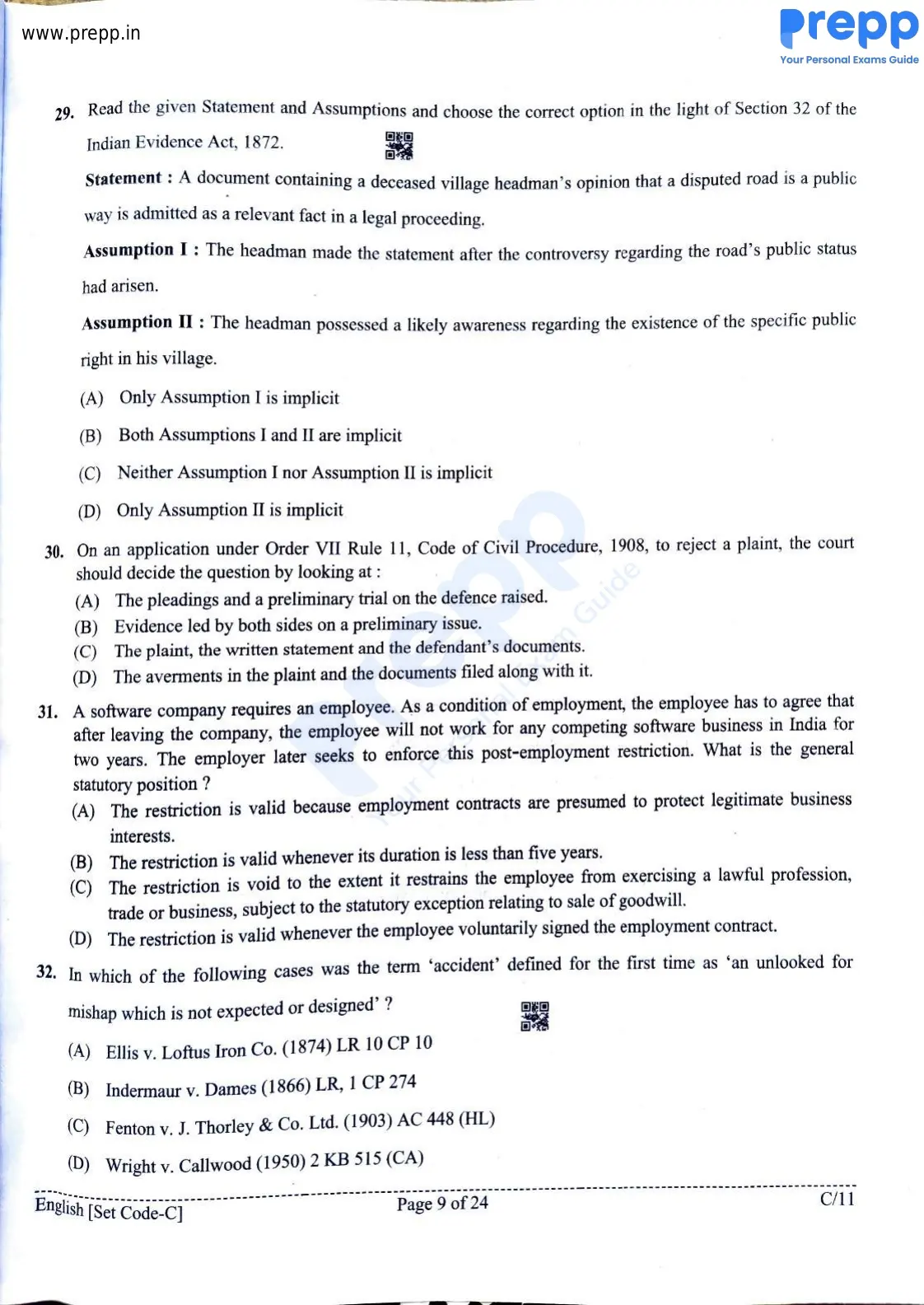
29. Read the given Statement and Assumptions and choose the correct option in the light of Section 32 of the Indian Evidence Act, 1872.
Statement : A document containing a deceased village headman’s opinion that a disputed road is a public way is admitted as a relevant fact in a legal proceeding.
Assumption I : The headman made the statement after the controversy regarding the road’s public status had arisen.
Assumption II : The headman possessed a likely awareness regarding the existence of the specific public right in his village.
(A) Only Assumption I is implicit
(B) Both Assumptions I and II are implicit
(C) Neither Assumption I nor Assumption II is implicit
(D) Only Assumption II is implicit
Check Correct Answer & Solution
30. On an application under Order VII Rule 11, Code of Civil Procedure, 1908, to reject a plaint, the court should decide the question by looking at :
(A) The pleadings and a preliminary trial on the defence raised.
(B) Evidence led by both sides on a preliminary issue.
(C) The plaint, the written statement and the defendant’s documents.
(D) The averments in the plaint and the documents filed along with it.
Check Correct Answer & Solution
31. A software company requires an employee. As a condition of employment, the employee has to agree that after leaving the company, the employee will not work for any competing software business in India for two years. The employer later seeks to enforce this post-employment restriction. What is the general statutory position ?
(A) The restriction is valid because employment contracts are presumed to protect legitimate business interests.
(B) The restriction is valid whenever its duration is less than five years.
(C) The restriction is void to the extent it restrains the employee from exercising a lawful profession, trade or business, subject to the statutory exception relating to sale of goodwill.
(D) The restriction is valid whenever the employee voluntarily signed the employment contract.
Check Correct Answer & Solution
32. In which of the following cases was the term ‘accident’ defined for the first time as ‘an unlooked for mishap which is not expected or designed’ ?
(A) Ellis v. Loftus Iron Co. (1874) LR 10 CP 10
(B) Indermaur v. Dames (1866) LR, 1 CP 274
(C) Fenton v. J. Thorley & Co. Ltd. (1903) AC 448 (HL)
(D) Wright v. Callwood (1950) 2 KB 515 (CA)
Check Correct Answer & Solution
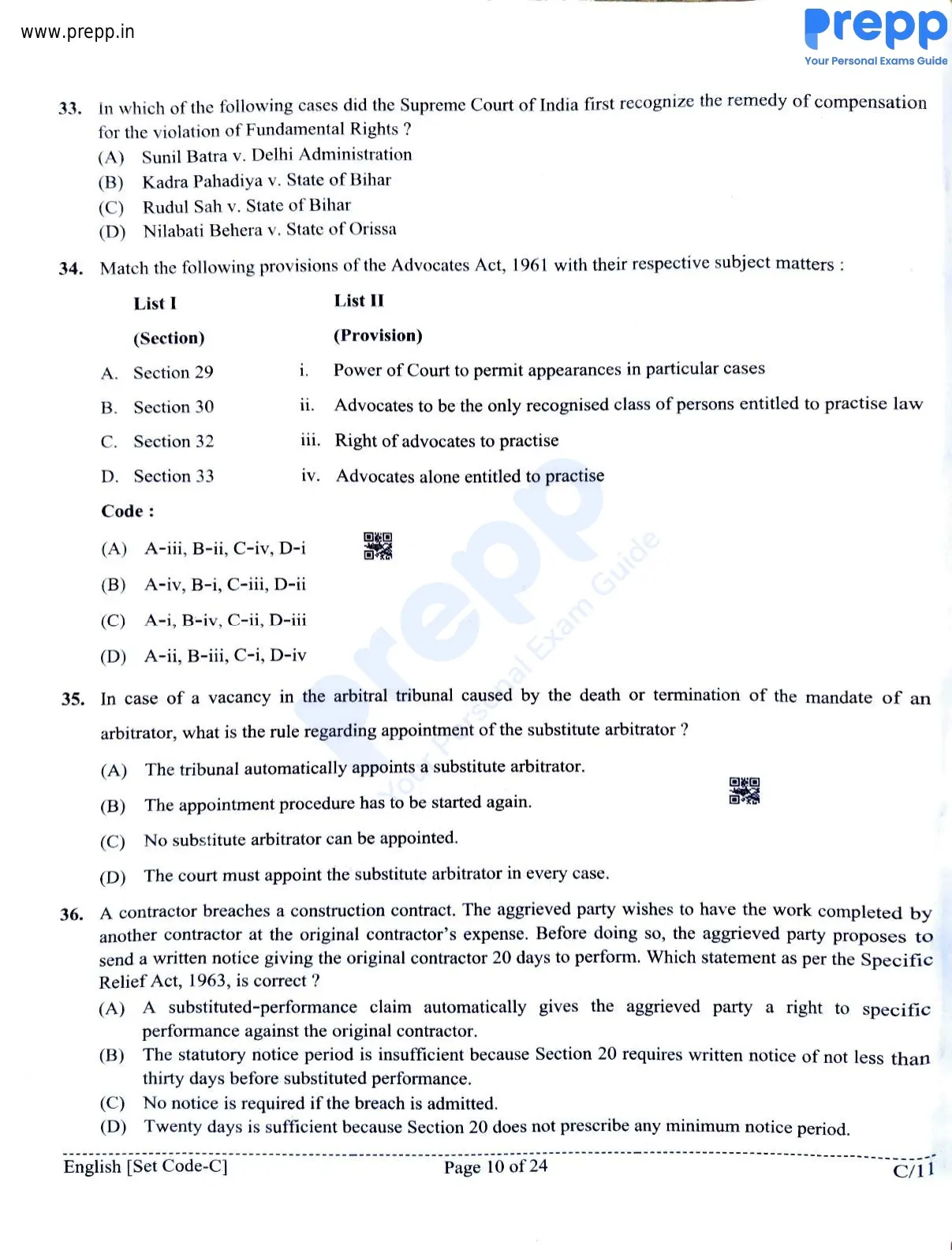
33. In which of the following cases did the Supreme Court of India first recognize the remedy of compensation for the violation of Fundamental Rights ?
(A) Sunil Batra v. Delhi Administration
(B) Kadra Pahadiya v. State of Bihar
(C) Rudul Sah v. State of Bihar
(D) Nilabati Behera v. State of Orissa
Check Correct Answer & Solution
34. Match the following provisions of the Advocates Act, 1961 with their respective subject matters :
Code :
(A) A-iii, B-ii, C-iv, D-i
(B) A-iv, B-i, C-iii, D-ii
(C) A-i, B-iv, C-ii, D-iii
(D) A-ii, B-iii, C-i, D-iv
Check Correct Answer & Solution
35. In case of a vacancy in the arbitral tribunal caused by the death or termination of the mandate of an arbitrator, what is the rule regarding appointment of the substitute arbitrator ?
(A) The tribunal automatically appoints a substitute arbitrator.
(B) The appointment procedure has to be started again.
(C) No substitute arbitrator can be appointed.
(D) The court must appoint the substitute arbitrator in every case.
Check Correct Answer & Solution
36. A contractor breaches a construction contract. The aggrieved party wishes to have the work completed by another contractor at the original contractor’s expense. Before doing so, the aggrieved party proposes to send a written notice giving the original contractor 20 days to perform. Which statement as per the Specific Relief Act, 1963, is correct ?
(A) A substituted-performance claim automatically gives the aggrieved party a right to specific performance against the original contractor.
(B) The statutory notice period is insufficient because Section 20 requires written notice of not less than thirty days before substituted performance.
(C) No notice is required if the breach is admitted.
(D) Twenty days is sufficient because Section 20 does not prescribe any minimum notice period.
Check Correct Answer & Solution
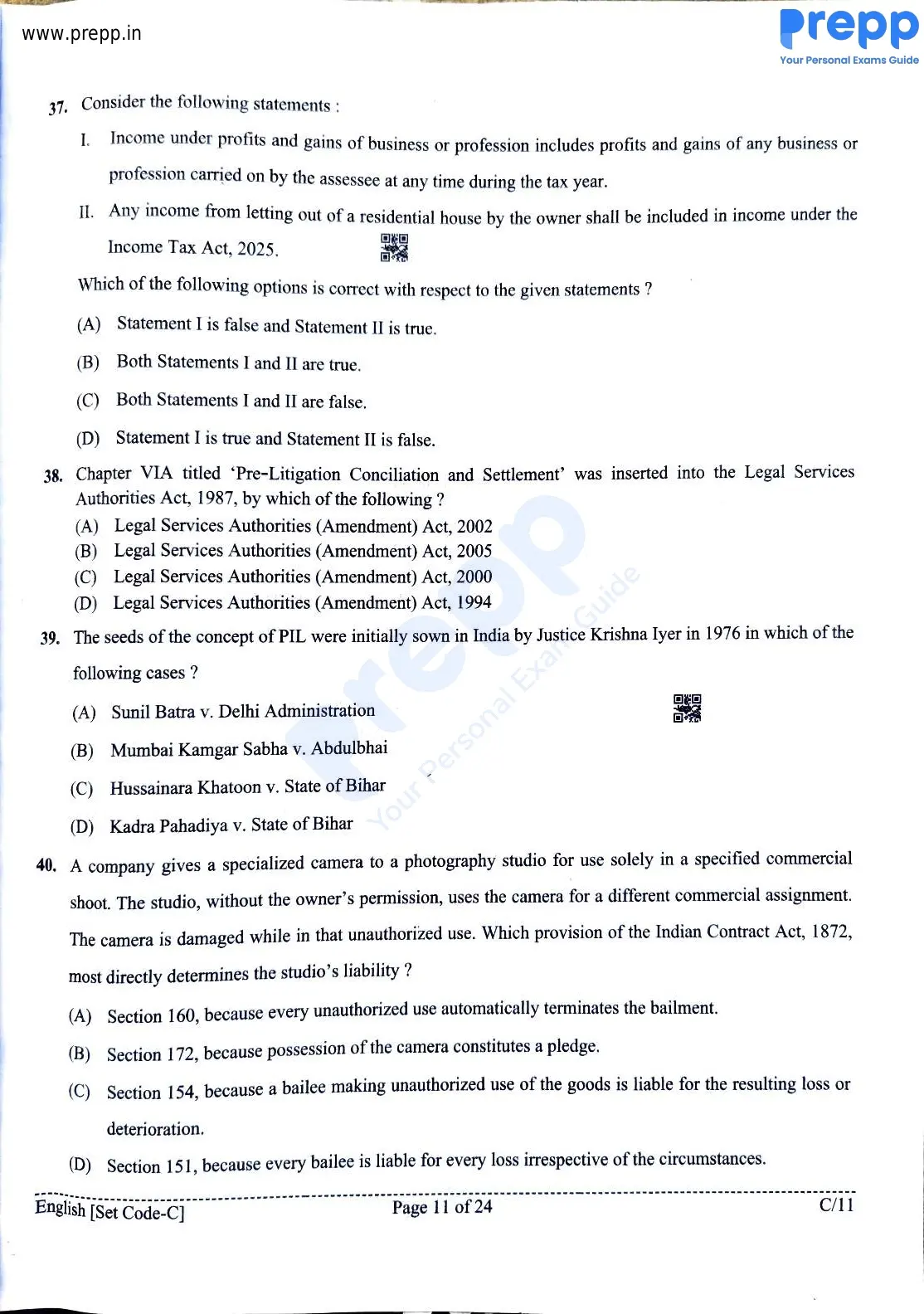
37. Consider the following statements :
I. Income under profits and gains of business or profession includes profits and gains of any business or profession carried on by the assessee at any time during the tax year.
II. Any income from letting out of a residential house by the owner shall be included in income under the Income Tax Act, 2025.
Which of the following options is correct with respect to the given statements ?
(A) Statement I is false and Statement II is true.
(B) Both Statements I and II are true.
(C) Both Statements I and II are false.
(D) Statement I is true and Statement II is false.
Check Correct Answer & Solution
38. Chapter VIA titled ‘Pre-Litigation Conciliation and Settlement’ was inserted into the Legal Services Authorities Act, 1987, by which of the following ?
(A) Legal Services Authorities (Amendment) Act, 2002
(B) Legal Services Authorities (Amendment) Act, 2005
(C) Legal Services Authorities (Amendment) Act, 2000
(D) Legal Services Authorities (Amendment) Act, 1994
Check Correct Answer & Solution
39. The seeds of the concept of PIL were initially sown in India by Justice Krishna Iyer in 1976 in which of the following cases ?
(A) Sunil Batra v. Delhi Administration
(B) Mumbai Kamgar Sabha v. Abdulbhai
(C) Hussainara Khatoon v. State of Bihar
(D) Kadra Pahadiya v. State of Bihar
Check Correct Answer & Solution
40. A company gives a specialized camera to a photography studio for use solely in a specified commercial shoot. The studio, without the owner’s permission, uses the camera for a different commercial assignment. The camera is damaged while in that unauthorized use. Which provision of the Indian Contract Act, 1872, most directly determines the studio’s liability ?
(A) Section 160, because every unauthorized use automatically terminates the bailment.
(B) Section 172, because possession of the camera constitutes a pledge.
(C) Section 154, because a bailee making unauthorized use of the goods is liable for the resulting loss or deterioration.
(D) Section 151, because every bailee is liable for every loss irrespective of the circumstances.
Check Correct Answer & Solution
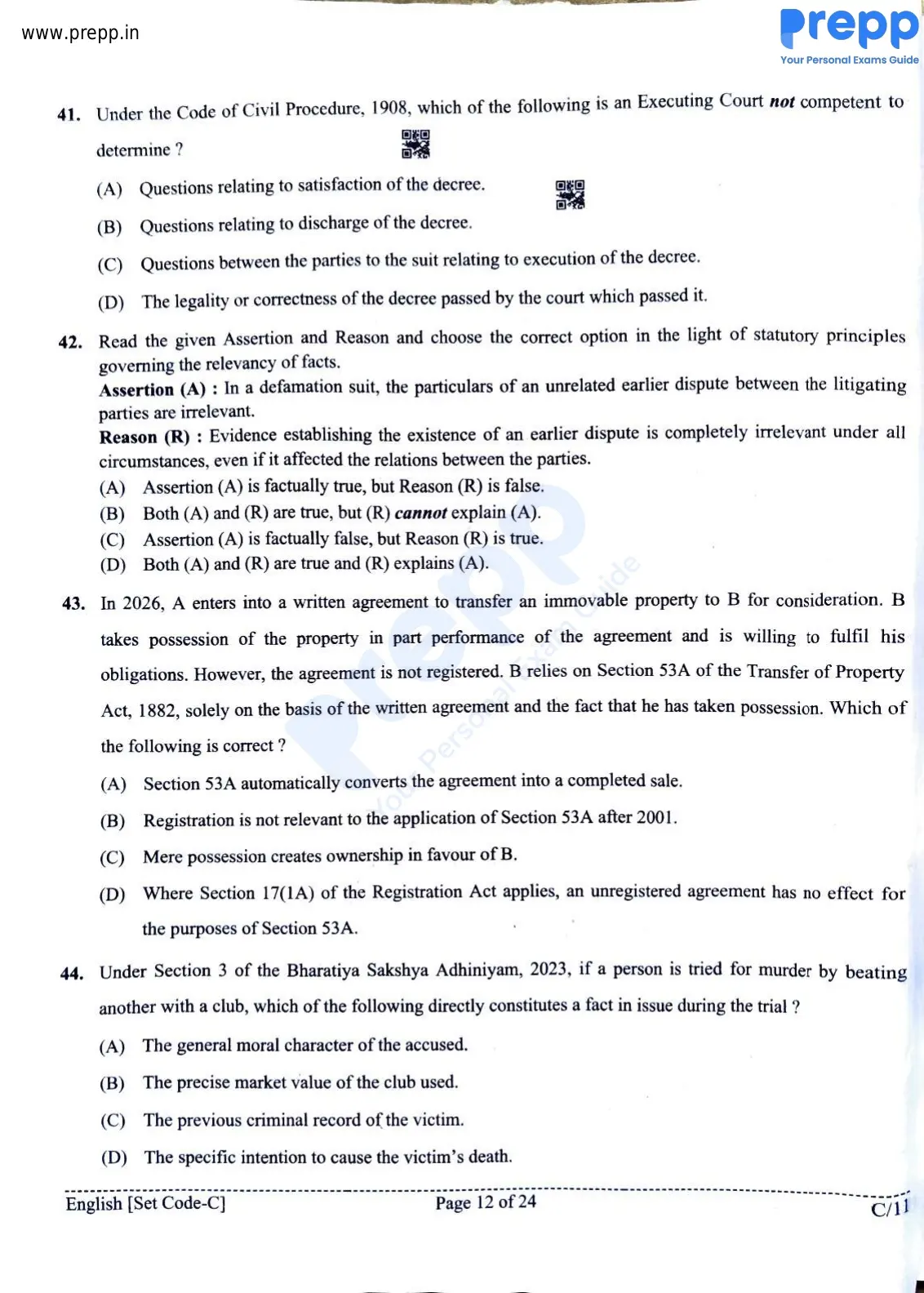
41. Under the Code of Civil Procedure, 1908, which of the following is an Executing Court not competent to determine ?
(A) Questions relating to satisfaction of the decree.
(B) Questions relating to discharge of the decree.
(C) Questions between the parties to the suit relating to execution of the decree.
(D) The legality or correctness of the decree passed by the court which passed it.
Check Correct Answer & Solution
42. Read the given Assertion and Reason and choose the correct option in the light of statutory principles governing the relevancy of facts.
Assertion (A) : In a defamation suit, the particulars of an unrelated earlier dispute between the litigating parties are irrelevant.
Reason (R) : Evidence establishing the existence of an earlier dispute is completely irrelevant under all circumstances, even if it affected the relations between the parties.
(A) Assertion (A) is factually true, but Reason (R) is false.
(B) Both (A) and (R) are true, but (R) cannot explain (A).
(C) Assertion (A) is factually false, but Reason (R) is true.
(D) Both (A) and (R) are true and (R) explains (A).
Check Correct Answer & Solution
43. In 2026, A enters into a written agreement to transfer an immovable property to B for consideration. B takes possession of the property in part performance of the agreement and is willing to fulfil his obligations. However, the agreement is not registered. B relies on Section 53A of the Transfer of Property Act, 1882, solely on the basis of the written agreement and the fact that he has taken possession. Which of the following is correct ?
(A) Section 53A automatically converts the agreement into a completed sale.
(B) Registration is not relevant to the application of Section 53A after 2001.
(C) Mere possession creates ownership in favour of B.
(D) Where Section 17(1A) of the Registration Act applies, an unregistered agreement has no effect for the purposes of Section 53A.
Check Correct Answer & Solution
44. Under Section 3 of the Bharatiya Sakshya Adhiniyam, 2023, if a person is tried for murder by beating another with a club, which of the following directly constitutes a fact in issue during the trial ?
(A) The general moral character of the accused.
(B) The precise market value of the club used.
(C) The previous criminal record of the victim.
(D) The specific intention to cause the victim’s death.
Check Correct Answer & Solution
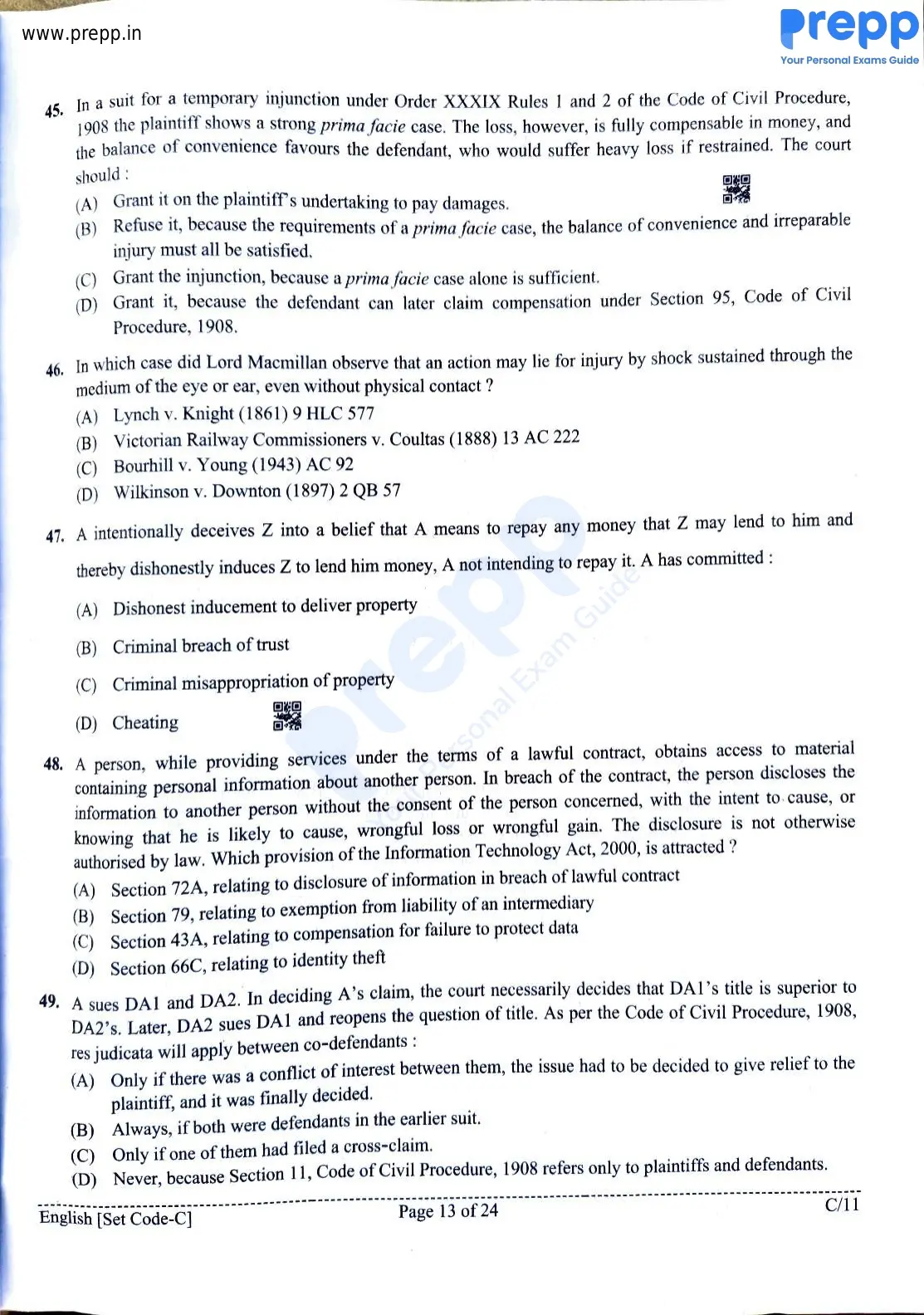
45. In a suit for a temporary injunction under Order XXXIX Rules 1 and 2 of the Code of Civil Procedure, 1908 the plaintiff shows a strong prima facie case. The loss, however, is fully compensable in money, and the balance of convenience favours the defendant, who would suffer heavy loss if restrained. The court should :
(A) Grant it on the plaintiff’s undertaking to pay damages.
(B) Refuse it, because the requirements of a prima facie case, the balance of convenience and irreparable injury must all be satisfied.
(C) Grant the injunction, because a prima facie case alone is sufficient.
(D) Grant it, because the defendant can later claim compensation under Section 95, Code of Civil Procedure, 1908.
Check Correct Answer & Solution
46. In which case did Lord Macmillan observe that an action may lie for injury by shock sustained through the medium of the eye or ear, even without physical contact ?
(A) Lynch v. Knight (1861) 9 HLC 577
(B) Victorian Railway Commissioners v. Coultas (1888) 13 AC 222
(C) Bourhill v. Young (1943) AC 92
(D) Wilkinson v. Downton (1897) 2 QB 57
Check Correct Answer & Solution
47. A intentionally deceives Z into a belief that A means to repay any money that Z may lend to him and thereby dishonestly induces Z to lend him money, A not intending to repay it. A has committed :
(A) Dishonest inducement to deliver property
(B) Criminal breach of trust
(C) Criminal misappropriation of property
(D) Cheating
Check Correct Answer & Solution
48. A person, while providing services under the terms of a lawful contract, obtains access to material containing personal information about another person. In breach of the contract, the person discloses the information to another person without the consent of the person concerned, with the intent to cause, or knowing that he is likely to cause, wrongful loss or wrongful gain. The disclosure is not otherwise authorised by law. Which provision of the Information Technology Act, 2000, is attracted ?
(A) Section 72A, relating to disclosure of information in breach of lawful contract
(B) Section 79, relating to exemption from liability of an intermediary
(C) Section 43A, relating to compensation for failure to protect data
(D) Section 66C, relating to identity theft
Check Correct Answer & Solution
49. A sues DA1 and DA2. In deciding A’s claim, the court necessarily decides that DA1’s title is superior to DA2’s. Later, DA2 sues DA1 and reopens the question of title. As per the Code of Civil Procedure, 1908, res judicata will apply between co-defendants :
(A) Only if there was a conflict of interest between them, the issue had to be decided to give relief to the plaintiff, and it was finally decided.
(B) Always, if both were defendants in the earlier suit.
(C) Only if one of them had filed a cross-claim.
(D) Never, because Section 11, Code of Civil Procedure, 1908 refers only to plaintiffs and defendants.
Check Correct Answer & Solution
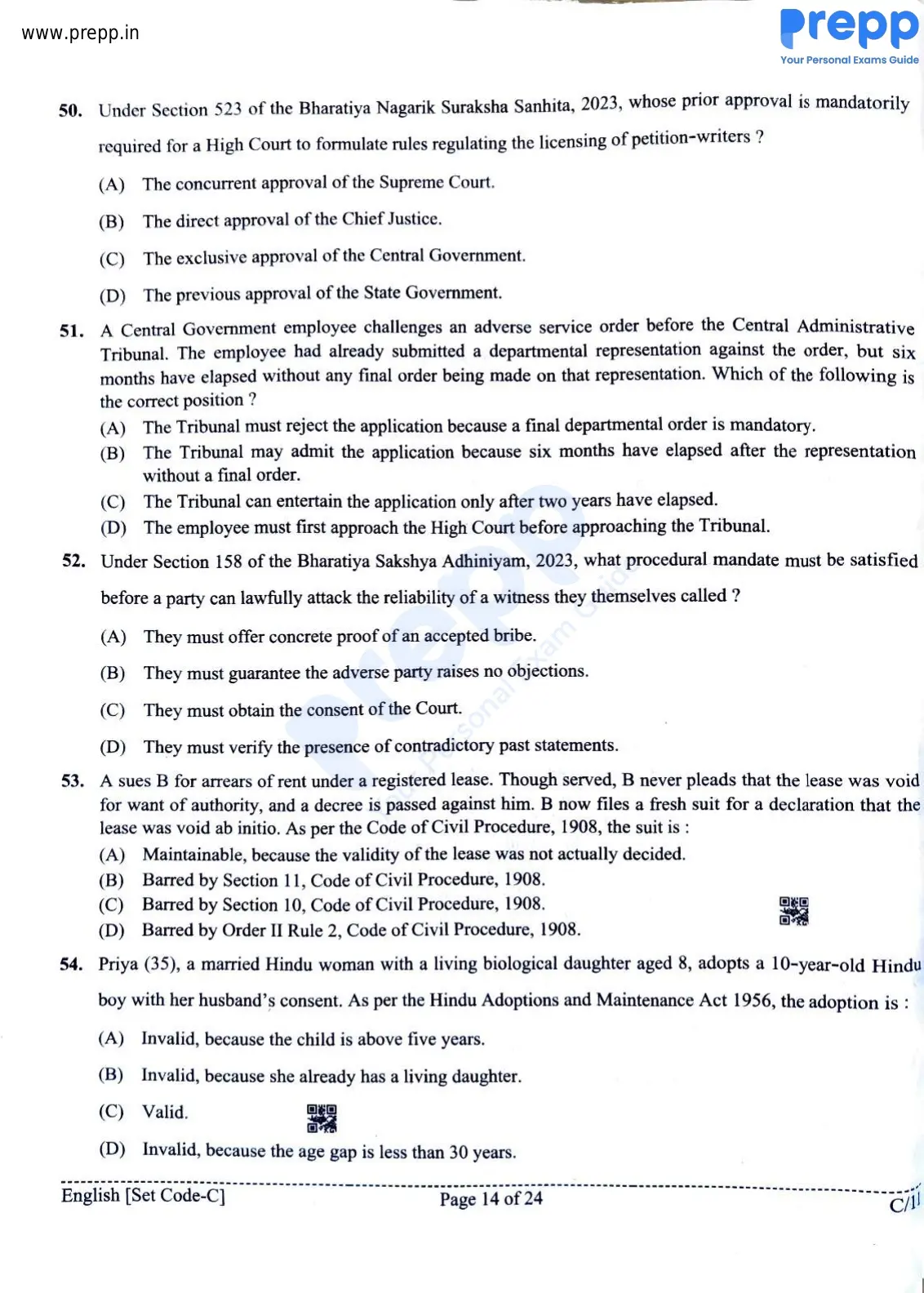
50. Under Section 523 of the Bharatiya Nagarik Suraksha Sanhita, 2023, whose prior approval is mandatorily required for a High Court to formulate rules regulating the licensing of petition-writers ?
(A) The concurrent approval of the Supreme Court.
(B) The direct approval of the Chief Justice.
(C) The exclusive approval of the Central Government.
(D) The previous approval of the State Government.
Check Correct Answer & Solution
51. A Central Government employee challenges an adverse service order before the Central Administrative Tribunal. The employee had already submitted a departmental representation against the order, but six months have elapsed without any final order being made on that representation. Which of the following is the correct position ?
(A) The Tribunal must reject the application because a final departmental order is mandatory.
(B) The Tribunal may admit the application because six months have elapsed after the representation without a final order.
(C) The Tribunal can entertain the application only after two years have elapsed.
(D) The employee must first approach the High Court before approaching the Tribunal.
Check Correct Answer & Solution
52. Under Section 158 of the Bharatiya Sakshya Adhiniyam, 2023, what procedural mandate must be satisfied before a party can lawfully attack the reliability of a witness they themselves called ?
(A) They must offer concrete proof of an accepted bribe.
(B) They must guarantee the adverse party raises no objections.
(C) They must obtain the consent of the Court.
(D) They must verify the presence of contradictory past statements.
Check Correct Answer & Solution
53. A sues B for arrears of rent under a registered lease. Though served, B never pleads that the lease was void for want of authority, and a decree is passed against him. B now files a fresh suit for a declaration that the lease was void ab initio. As per the Code of Civil Procedure, 1908, the suit is :
(A) Maintainable, because the validity of the lease was not actually decided.
(B) Barred by Section 11, Code of Civil Procedure, 1908.
(C) Barred by Section 10, Code of Civil Procedure, 1908.
(D) Barred by Order II Rule 2, Code of Civil Procedure, 1908.
Check Correct Answer & Solution
54. Priya (35), a married Hindu woman with a living biological daughter aged 8, adopts a 10-year-old Hindu boy with her husband’s consent. As per the Hindu Adoptions and Maintenance Act 1956, the adoption is :
(A) Invalid, because the child is above five years.
(B) Invalid, because she already has a living daughter.
(C) Valid.
(D) Invalid, because the age gap is less than 30 years.
Check Correct Answer & Solution
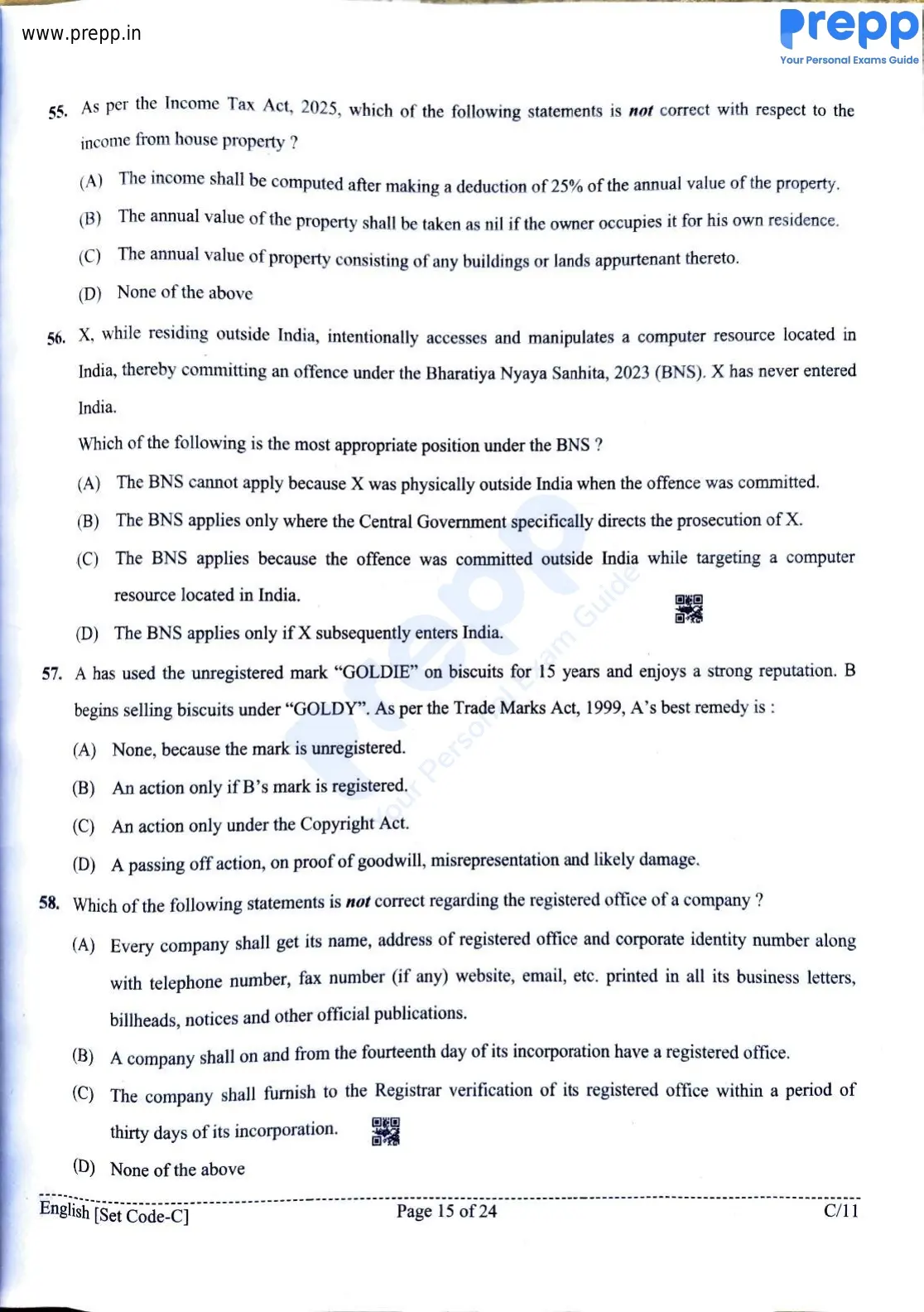
55. As per the Income Tax Act, 2025, which of the following statements is not correct with respect to the income from house property ?
(A) The income shall be computed after making a deduction of 25% of the annual value of the property.
(B) The annual value of the property shall be taken as nil if the owner occupies it for his own residence.
(C) The annual value of property consisting of any buildings or lands appurtenant thereto.
(D) None of the above
Check Correct Answer & Solution
56. X, while residing outside India, intentionally accesses and manipulates a computer resource located in India, thereby committing an offence under the Bharatiya Nyaya Sanhita, 2023 (BNS). X has never entered India.
Which of the following is the most appropriate position under the BNS ?
(A) The BNS cannot apply because X was physically outside India when the offence was committed.
(B) The BNS applies only where the Central Government specifically directs the prosecution of X.
(C) The BNS applies because the offence was committed outside India while targeting a computer resource located in India.
(D) The BNS applies only if X subsequently enters India.
Check Correct Answer & Solution
57. A has used the unregistered mark “GOLDIE” on biscuits for 15 years and enjoys a strong reputation. B begins selling biscuits under “GOLDY”. As per the Trade Marks Act, 1999, A’s best remedy is :
(A) None, because the mark is unregistered.
(B) An action only if B’s mark is registered.
(C) An action only under the Copyright Act.
(D) A passing off action, on proof of goodwill, misrepresentation and likely damage.
Check Correct Answer & Solution
58. Which of the following statements is not correct regarding the registered office of a company ?
(A) Every company shall get its name, address of registered office and corporate identity number along with telephone number, fax number (if any) website, email, etc. printed in all its business letters, billheads, notices and other official publications.
(B) A company shall on and from the fourteenth day of its incorporation have a registered office.
(C) The company shall furnish to the Registrar verification of its registered office within a period of thirty days of its incorporation.
(D) None of the above
Check Correct Answer & Solution
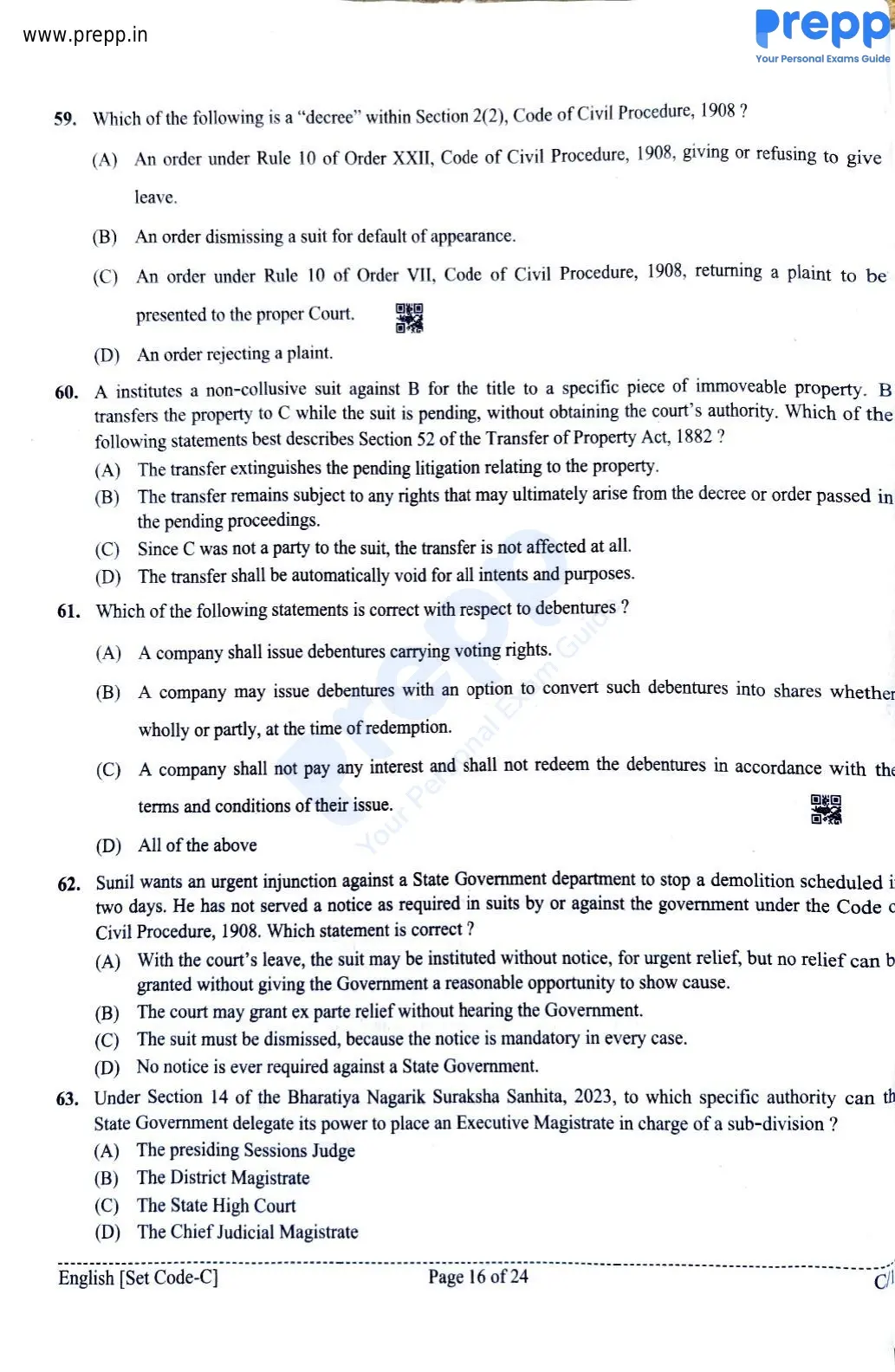
59. Which of the following is a “decree” within Section 2(2), Code of Civil Procedure, 1908 ?
(A) An order under Rule 10 of Order XXII, Code of Civil Procedure, 1908, giving or refusing to give leave.
(B) An order dismissing a suit for default of appearance.
(C) An order under Rule 10 of Order VII, Code of Civil Procedure, 1908, returning a plaint to be presented to the proper Court.
(D) An order rejecting a plaint.
Check Correct Answer & Solution
60. A institutes a non-collusive suit against B for the title to a specific piece of immoveable property. B transfers the property to C while the suit is pending, without obtaining the court’s authority. Which of the following statements best describes Section 52 of the Transfer of Property Act, 1882 ?
(A) The transfer extinguishes the pending litigation relating to the property.
(B) The transfer remains subject to any rights that may ultimately arise from the decree or order passed in the pending proceedings.
(C) Since C was not a party to the suit, the transfer is not affected at all.
(D) The transfer shall be automatically void for all intents and purposes.
Check Correct Answer & Solution
61. Which of the following statements is correct with respect to debentures ?
(A) A company shall issue debentures carrying voting rights.
(B) A company may issue debentures with an option to convert such debentures into shares whether wholly or partly, at the time of redemption.
(C) A company shall not pay any interest and shall not redeem the debentures in accordance with the terms and conditions of their issue.
(D) All of the above
Check Correct Answer & Solution
62. Sunil wants an urgent injunction against a State Government department to stop a demolition scheduled in two days. He has not served a notice as required in suits by or against the government under the Code of Civil Procedure, 1908. Which statement is correct ?
(A) With the court’s leave, the suit may be instituted without notice, for urgent relief, but no relief can be granted without giving the Government a reasonable opportunity to show cause.
(B) The court may grant ex parte relief without hearing the Government.
(C) The suit must be dismissed, because the notice is mandatory in every case.
(D) No notice is ever required against a State Government.
Check Correct Answer & Solution
63. Under Section 14 of the Bharatiya Nagarik Suraksha Sanhita, 2023, to which specific authority can the State Government delegate its power to place an Executive Magistrate in charge of a sub-division ?
(A) The presiding Sessions Judge
(B) The District Magistrate
(C) The State High Court
(D) The Chief Judicial Magistrate
Check Correct Answer & Solution
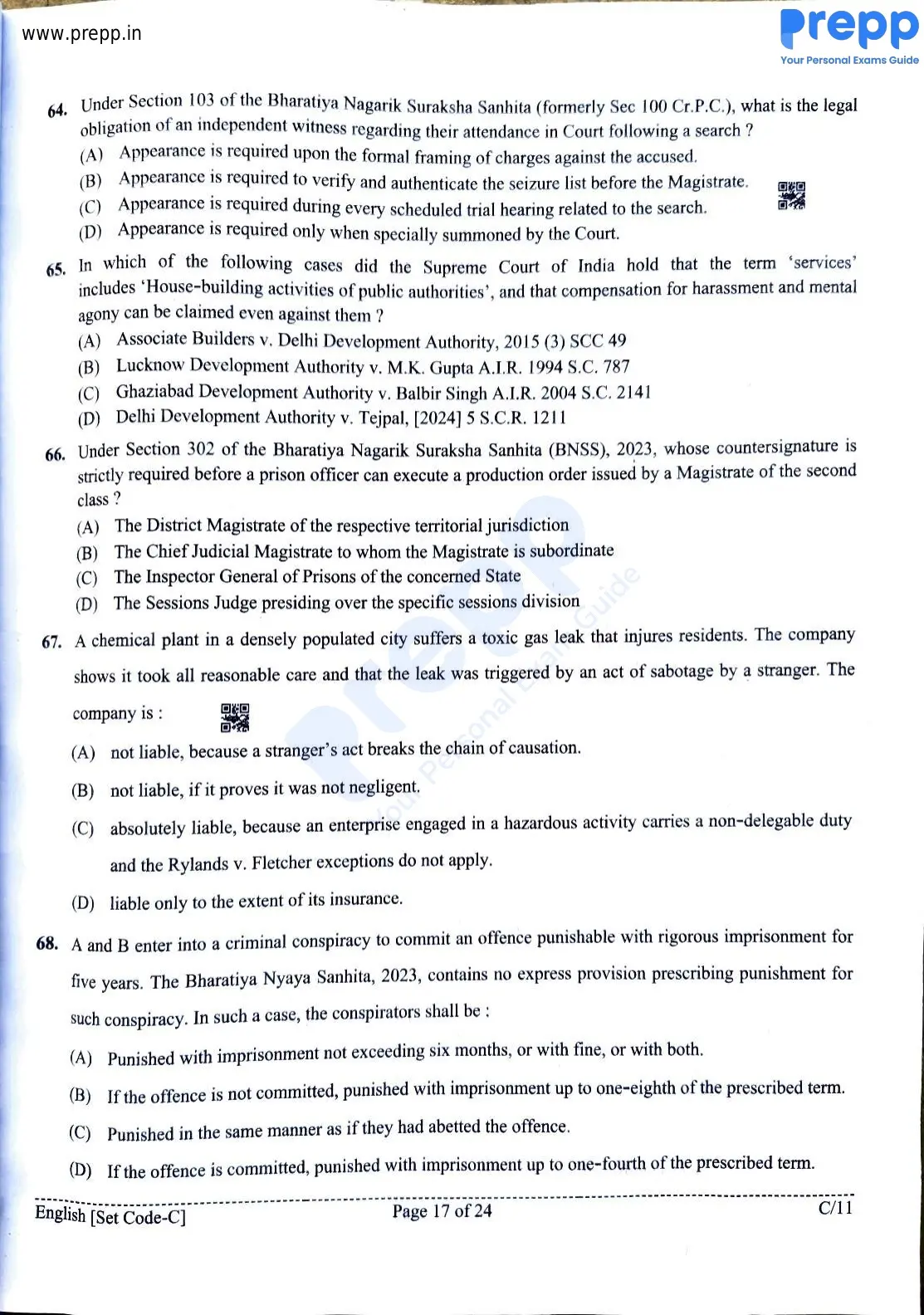
64. Under Section 103 of the Bharatiya Nagarik Suraksha Sanhita (formerly Sec 100 Cr.P.C.), what is the legal obligation of an independent witness regarding their attendance in Court following a search ?
(A) Appearance is required upon the formal framing of charges against the accused.
(B) Appearance is required to verify and authenticate the seizure list before the Magistrate.
(C) Appearance is required during every scheduled trial hearing related to the search.
(D) Appearance is required only when specially summoned by the Court.
Check Correct Answer & Solution
65. In which of the following cases did the Supreme Court of India hold that the term ‘services’ includes ‘House-building activities of public authorities’, and that compensation for harassment and mental agony can be claimed even against them ?
(A) Associate Builders v. Delhi Development Authority, 2015 (3) SCC 49
(B) Lucknow Development Authority v. M.K. Gupta A.I.R. 1994 S.C. 787
(C) Ghaziabad Development Authority v. Balbir Singh A.I.R. 2004 S.C. 2141
(D) Delhi Development Authority v. Tejpal, [2024] 5 S.C.R. 1211
Check Correct Answer & Solution
66. Under Section 302 of the Bharatiya Nagarik Suraksha Sanhita (BNSS), 2023, whose countersignature is strictly required before a prison officer can execute a production order issued by a Magistrate of the second class ?
(A) The District Magistrate of the respective territorial jurisdiction
(B) The Chief Judicial Magistrate to whom the Magistrate is subordinate
(C) The Inspector General of Prisons of the concerned State
(D) The Sessions Judge presiding over the specific sessions division
Check Correct Answer & Solution
67. A chemical plant in a densely populated city suffers a toxic gas leak that injures residents. The company shows it took all reasonable care and that the leak was triggered by an act of sabotage by a stranger. The company is :
(A) not liable, because a stranger’s act breaks the chain of causation.
(B) not liable, if it proves it was not negligent.
(C) absolutely liable, because an enterprise engaged in a hazardous activity carries a non-delegable duty and the Rylands v. Fletcher exceptions do not apply.
(D) liable only to the extent of its insurance.
Check Correct Answer & Solution
68. A and B enter into a criminal conspiracy to commit an offence punishable with rigorous imprisonment for five years. The Bharatiya Nyaya Sanhita, 2023, contains no express provision prescribing punishment for such conspiracy. In such a case, the conspirators shall be :
(A) Punished with imprisonment not exceeding six months, or with fine, or with both.
(B) If the offence is not committed, punished with imprisonment up to one-eighth of the prescribed term.
(C) Punished in the same manner as if they had abetted the offence.
(D) If the offence is committed, punished with imprisonment up to one-fourth of the prescribed term.
Check Correct Answer & Solution
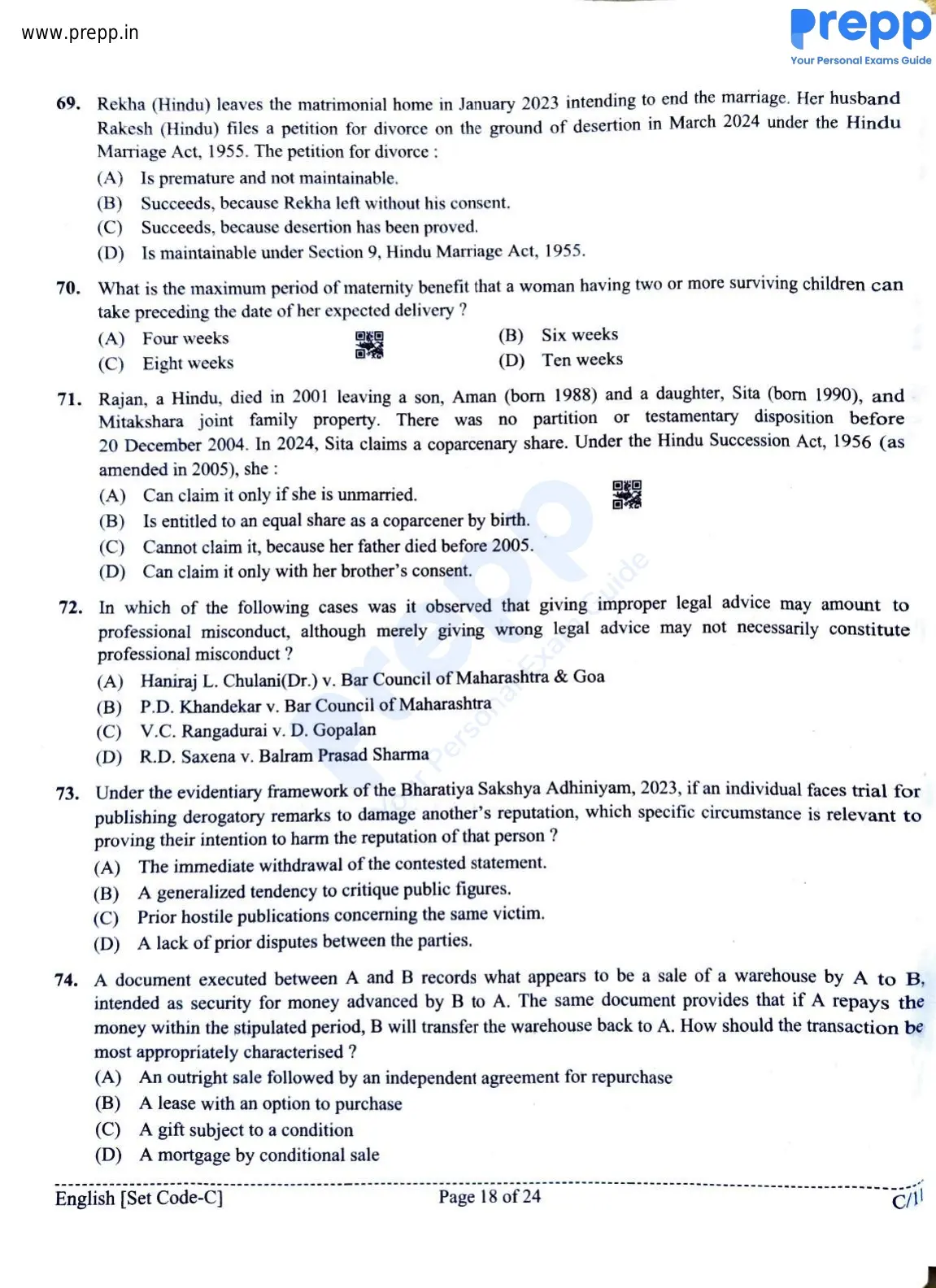
69. Rekha (Hindu) leaves the matrimonial home in January 2023 intending to end the marriage. Her husband Rakesh (Hindu) files a petition for divorce on the ground of desertion in March 2024 under the Hindu Marriage Act, 1955. The petition for divorce :
(A) Is premature and not maintainable.
(B) Succeeds, because Rekha left without his consent.
(C) Succeeds, because desertion has been proved.
(D) Is maintainable under Section 9, Hindu Marriage Act, 1955.
Check Correct Answer & Solution
70. What is the maximum period of maternity benefit that a woman having two or more surviving children can take preceding the date of her expected delivery ?
(A) Four weeks
(B) Six weeks
(C) Eight weeks
(D) Ten weeks
Check Correct Answer & Solution
71. Rajan, a Hindu, died in 2001 leaving a son, Aman (born 1988) and a daughter, Sita (born 1990), and Mitakshara joint family property. There was no partition or testamentary disposition before 20 December 2004. In 2024, Sita claims a coparcenary share. Under the Hindu Succession Act, 1956 (as amended in 2005), she :
(A) Can claim it only if she is unmarried.
(B) Is entitled to an equal share as a coparcener by birth.
(C) Cannot claim it, because her father died before 2005.
(D) Can claim it only with her brother’s consent.
Check Correct Answer & Solution
72. In which of the following cases was it observed that giving improper legal advice may amount to professional misconduct, although merely giving wrong legal advice may not necessarily constitute professional misconduct ?
(A) Haniraj L. Chulani(Dr.) v. Bar Council of Maharashtra & Goa
(B) P.D. Khandekar v. Bar Council of Maharashtra
(C) V.C. Rangadurai v. D. Gopalan
(D) R.D. Saxena v. Balram Prasad Sharma
Check Correct Answer & Solution
73. Under the evidentiary framework of the Bharatiya Sakshya Adhiniyam, 2023, if an individual faces trial for publishing derogatory remarks to damage another’s reputation, which specific circumstance is relevant to proving their intention to harm the reputation of that person ?
(A) The immediate withdrawal of the contested statement.
(B) A generalized tendency to critique public figures.
(C) Prior hostile publications concerning the same victim.
(D) A lack of prior disputes between the parties.
Check Correct Answer & Solution
74. A document executed between A and B records what appears to be a sale of a warehouse by A to B, intended as security for money advanced by B to A. The same document provides that if A repays the money within the stipulated period, B will transfer the warehouse back to A. How should the transaction be most appropriately characterised ?
(A) An outright sale followed by an independent agreement for repurchase
(B) A lease with an option to purchase
(C) A gift subject to a condition
(D) A mortgage by conditional sale
Check Correct Answer & Solution
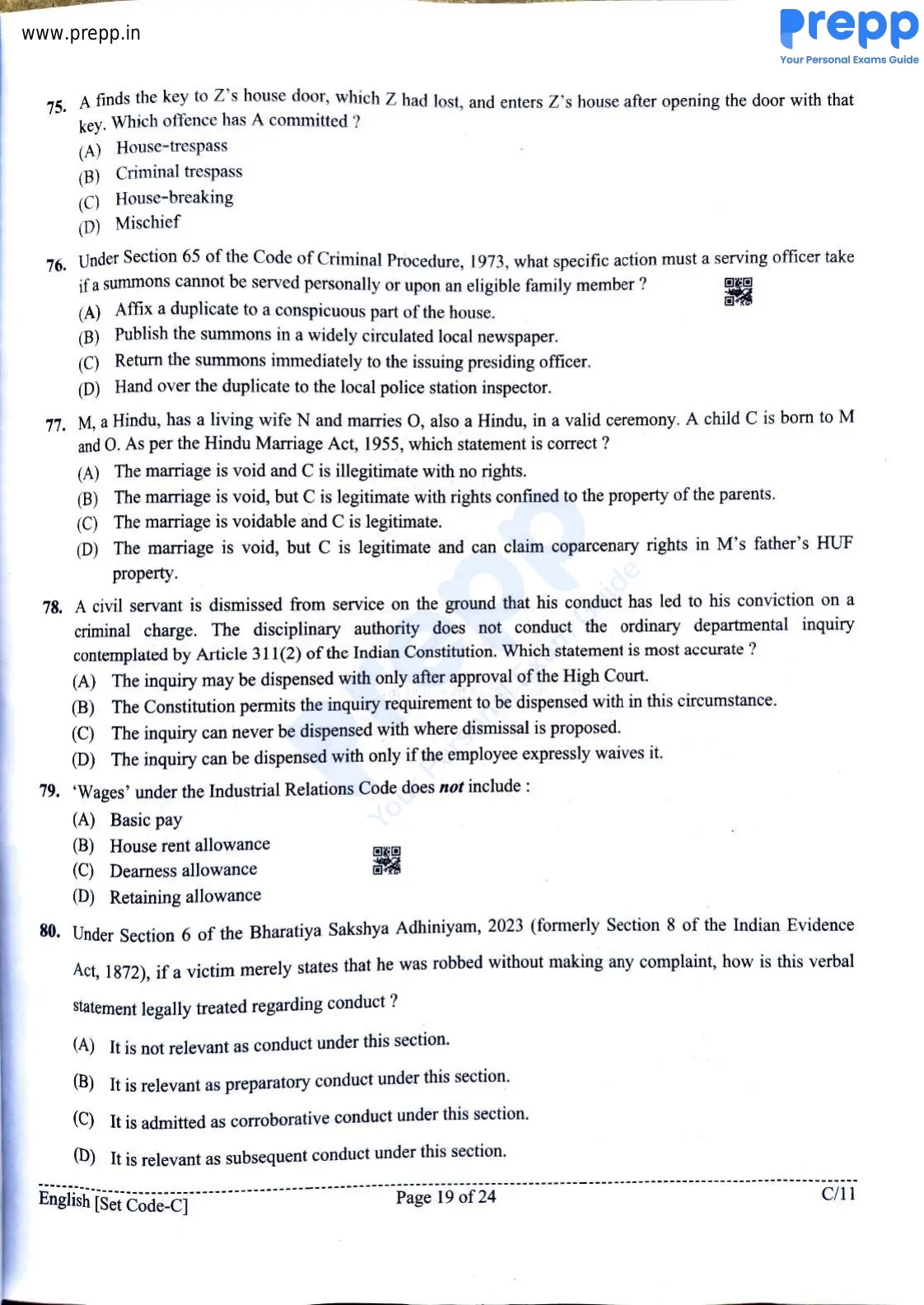
75. A finds the key to Z’s house door, which Z had lost, and enters Z’s house after opening the door with that key. Which offence has A committed ?
(A) House-trespass
(B) Criminal trespass
(C) House-breaking
(D) Mischief
Check Correct Answer & Solution
76. Under Section 65 of the Code of Criminal Procedure, 1973, what specific action must a serving officer take if a summons cannot be served personally or upon an eligible family member ?
(A) Affix a duplicate to a conspicuous part of the house.
(B) Publish the summons in a widely circulated local newspaper.
(C) Return the summons immediately to the issuing presiding officer.
(D) Hand over the duplicate to the local police station inspector.
Check Correct Answer & Solution
77. M, a Hindu, has a living wife N and marries O, also a Hindu, in a valid ceremony. A child C is born to M and O. As per the Hindu Marriage Act, 1955, which statement is correct ?
(A) The marriage is void and C is illegitimate with no rights.
(B) The marriage is void, but C is legitimate with rights confined to the property of the parents.
(C) The marriage is voidable and C is legitimate.
(D) The marriage is void, but C is legitimate and can claim coparcenary rights in M’s father’s HUF property.
Check Correct Answer & Solution
78. A civil servant is dismissed from service on the ground that his conduct has led to his conviction on a criminal charge. The disciplinary authority does not conduct the ordinary departmental inquiry contemplated by Article 311(2) of the Indian Constitution. Which statement is most accurate ?
(A) The inquiry may be dispensed with only after approval of the High Court.
(B) The Constitution permits the inquiry requirement to be dispensed with in this circumstance.
(C) The inquiry can never be dispensed with where dismissal is proposed.
(D) The inquiry can be dispensed with only if the employee expressly waives it.
Check Correct Answer & Solution
79. ‘Wages’ under the Industrial Relations Code does not include :
(A) Basic pay
(B) House rent allowance
(C) Dearness allowance
(D) Retaining allowance
Check Correct Answer & Solution
80. Under Section 6 of the Bharatiya Sakshya Adhiniyam, 2023 (formerly Section 8 of the Indian Evidence Act, 1872), if a victim merely states that he was robbed without making any complaint, how is this verbal statement legally treated regarding conduct ?
(A) It is not relevant as conduct under this section.
(B) It is relevant as preparatory conduct under this section.
(C) It is admitted as corroborative conduct under this section.
(D) It is relevant as subsequent conduct under this section.
Check Correct Answer & Solution
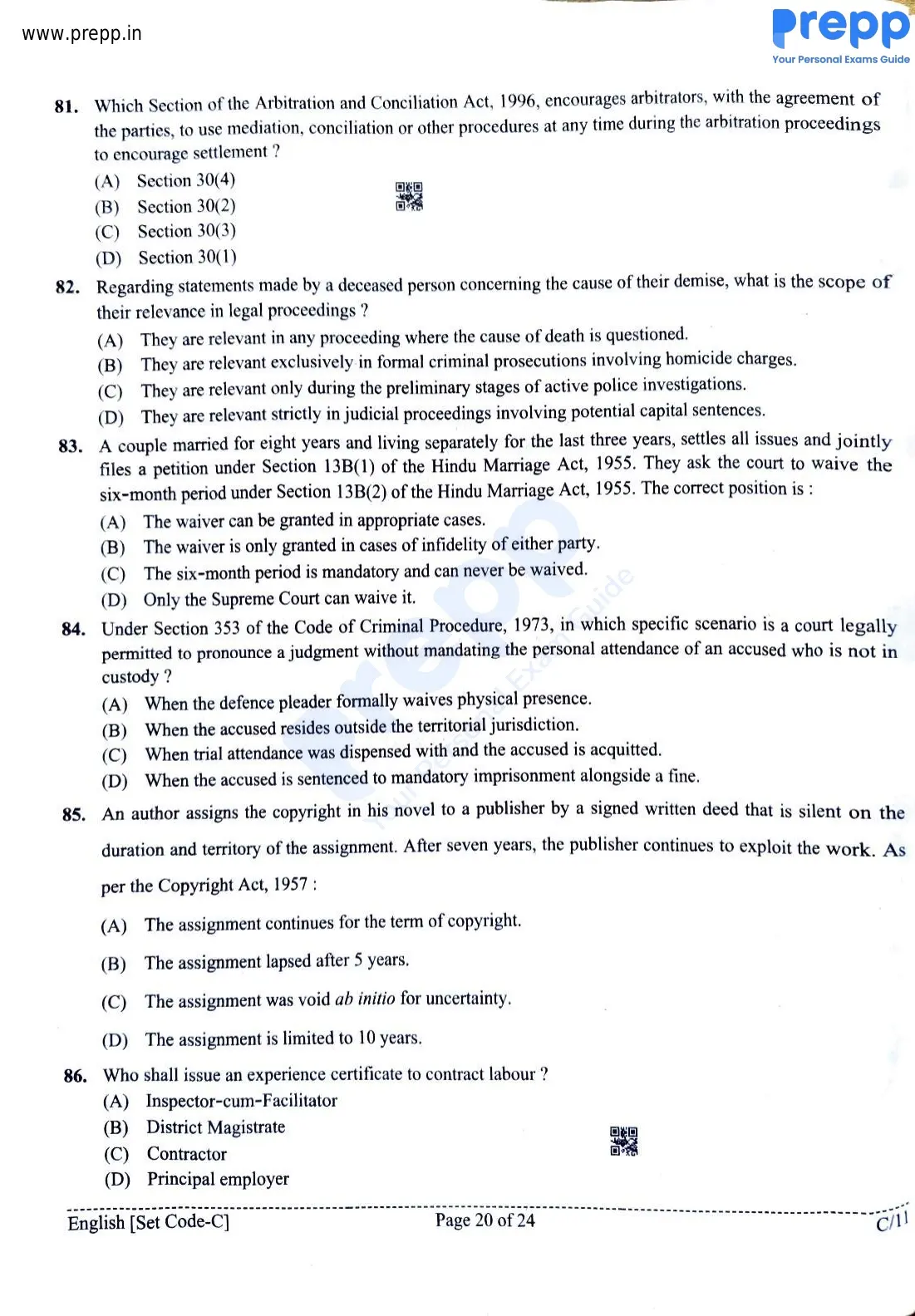
81. Which Section of the Arbitration and Conciliation Act, 1996, encourages arbitrators, with the agreement of the parties, to use mediation, conciliation or other procedures at any time during the arbitration proceedings to encourage settlement ?
(A) Section 30(4)
(B) Section 30(2)
(C) Section 30(3)
(D) Section 30(1)
Check Correct Answer & Solution
82. Regarding statements made by a deceased person concerning the cause of their demise, what is the scope of their relevance in legal proceedings ?
(A) They are relevant in any proceeding where the cause of death is questioned.
(B) They are relevant exclusively in formal criminal prosecutions involving homicide charges.
(C) They are relevant only during the preliminary stages of active police investigations.
(D) They are relevant strictly in judicial proceedings involving potential capital sentences.
Check Correct Answer & Solution
83. A couple married for eight years and living separately for the last three years, settles all issues and jointly files a petition under Section 13B(1) of the Hindu Marriage Act, 1955. They ask the court to waive the six-month period under Section 13B(2) of the Hindu Marriage Act, 1955. The correct position is :
(A) The waiver can be granted in appropriate cases.
(B) The waiver is only granted in cases of infidelity of either party.
(C) The six-month period is mandatory and can never be waived.
(D) Only the Supreme Court can waive it.
Check Correct Answer & Solution
84. Under Section 353 of the Code of Criminal Procedure, 1973, in which specific scenario is a court legally permitted to pronounce a judgment without mandating the personal attendance of an accused who is not in custody ?
(A) When the defence pleader formally waives physical presence.
(B) When the accused resides outside the territorial jurisdiction.
(C) When trial attendance was dispensed with and the accused is acquitted.
(D) When the accused is sentenced to mandatory imprisonment alongside a fine.
Check Correct Answer & Solution
85. An author assigns the copyright in his novel to a publisher by a signed written deed that is silent on the duration and territory of the assignment. After seven years, the publisher continues to exploit the work. As per the Copyright Act, 1957 :
(A) The assignment continues for the term of copyright.
(B) The assignment lapsed after 5 years.
(C) The assignment was void ab initio for uncertainty.
(D) The assignment is limited to 10 years.
Check Correct Answer & Solution
86. Who shall issue an experience certificate to contract labour ?
(A) Inspector-cum-Facilitator
(B) District Magistrate
(C) Contractor
(D) Principal employer
Check Correct Answer & Solution
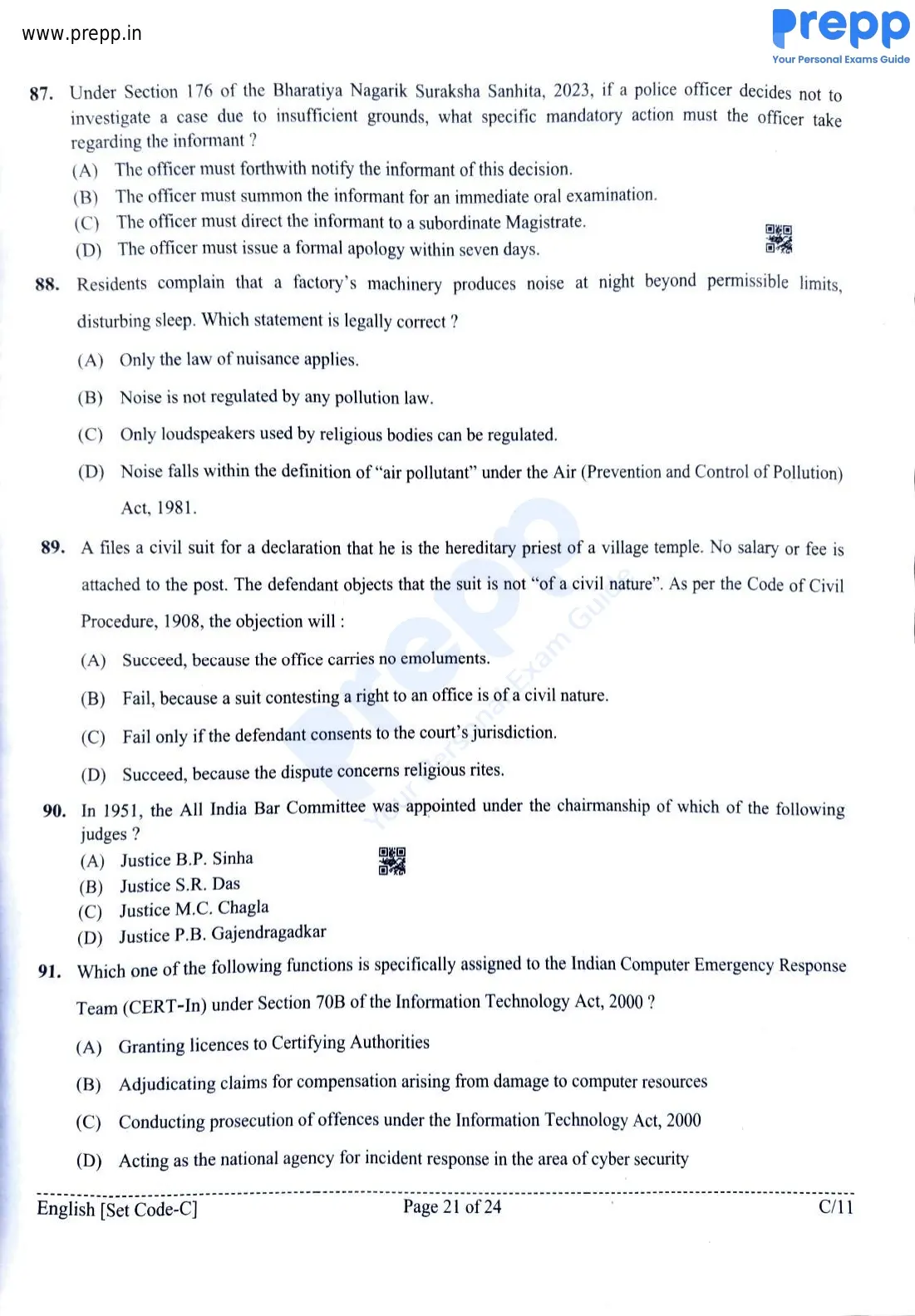
87. Under Section 176 of the Bharatiya Nagarik Suraksha Sanhita, 2023, if a police officer decides not to investigate a case due to insufficient grounds, what specific mandatory action must the officer take regarding the informant ?
(A) The officer must forthwith notify the informant of this decision.
(B) The officer must summon the informant for an immediate oral examination.
(C) The officer must direct the informant to a subordinate Magistrate.
(D) The officer must issue a formal apology within seven days.
Check Correct Answer & Solution
88. Residents complain that a factory’s machinery produces noise at night beyond permissible limits, disturbing sleep. Which statement is legally correct ?
(A) Only the law of nuisance applies.
(B) Noise is not regulated by any pollution law.
(C) Only loudspeakers used by religious bodies can be regulated.
(D) Noise falls within the definition of “air pollutant” under the Air (Prevention and Control of Pollution) Act, 1981.
Check Correct Answer & Solution
89. A files a civil suit for a declaration that he is the hereditary priest of a village temple. No salary or fee is attached to the post. The defendant objects that the suit is not “of a civil nature”. As per the Code of Civil Procedure, 1908, the objection will :
(A) Succeed, because the office carries no emoluments.
(B) Fail, because a suit contesting a right to an office is of a civil nature.
(C) Fail only if the defendant consents to the court’s jurisdiction.
(D) Succeed, because the dispute concerns religious rites.
Check Correct Answer & Solution
90. In 1951, the All India Bar Committee was appointed under the chairmanship of which of the following judges ?
(A) Justice B.P. Sinha
(B) Justice S.R. Das
(C) Justice M.C. Chagla
(D) Justice P.B. Gajendragadkar
Check Correct Answer & Solution
91. Which one of the following functions is specifically assigned to the Indian Computer Emergency Response Team (CERT-In) under Section 70B of the Information Technology Act, 2000 ?
(A) Granting licences to Certifying Authorities
(B) Adjudicating claims for compensation arising from damage to computer resources
(C) Conducting prosecution of offences under the Information Technology Act, 2000
(D) Acting as the national agency for incident response in the area of cyber security
Check Correct Answer & Solution
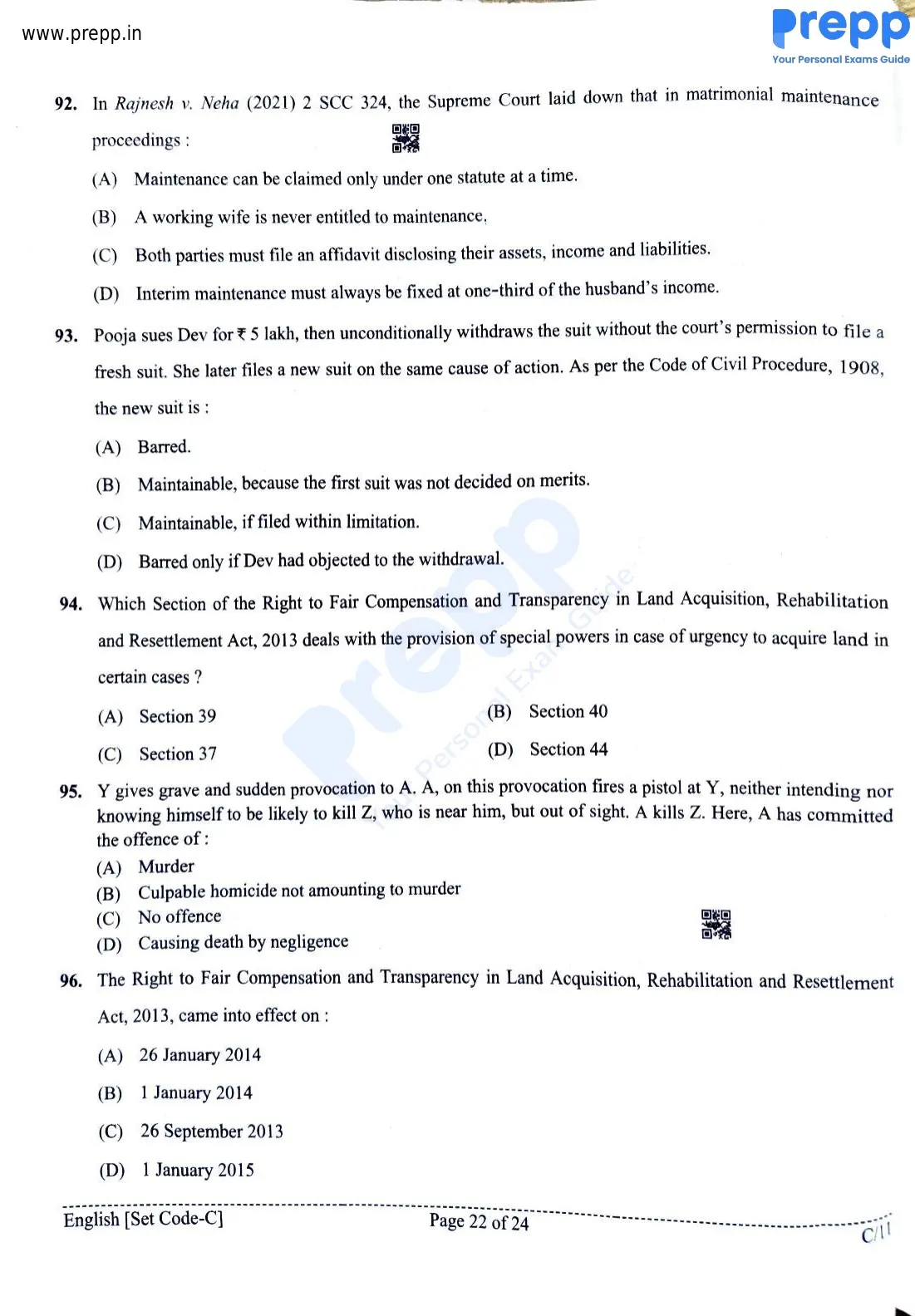
92. In Rajnesh v. Neha (2021) 2 SCC 324, the Supreme Court laid down that in matrimonial maintenance proceedings :
(A) Maintenance can be claimed only under one statute at a time.
(B) A working wife is never entitled to maintenance.
(C) Both parties must file an affidavit disclosing their assets, income and liabilities.
(D) Interim maintenance must always be fixed at one-third of the husband’s income.
Check Correct Answer & Solution
93. Pooja sues Dev for ₹ 5 lakh, then unconditionally withdraws the suit without the court’s permission to file a fresh suit. She later files a new suit on the same cause of action. As per the Code of Civil Procedure, 1908, the new suit is :
(A) Barred.
(B) Maintainable, because the first suit was not decided on merits.
(C) Maintainable, if filed within limitation.
(D) Barred only if Dev had objected to the withdrawal.
Check Correct Answer & Solution
94. Which Section of the Right to Fair Compensation and Transparency in Land Acquisition, Rehabilitation and Resettlement Act, 2013 deals with the provision of special powers in case of urgency to acquire land in certain cases ?
(A) Section 39
(B) Section 40
(C) Section 37
(D) Section 44
Check Correct Answer & Solution
95. Y gives grave and sudden provocation to A. A, on this provocation fires a pistol at Y, neither intending nor knowing himself to be likely to kill Z, who is near him, but out of sight. A kills Z. Here, A has committed the offence of :
(A) Murder
(B) Culpable homicide not amounting to murder
(C) No offence
(D) Causing death by negligence
Check Correct Answer & Solution
96. The Right to Fair Compensation and Transparency in Land Acquisition, Rehabilitation and Resettlement Act, 2013, came into effect on :
(A) 26 January 2014
(B) 1 January 2014
(C) 26 September 2013
(D) 1 January 2015
Check Correct Answer & Solution
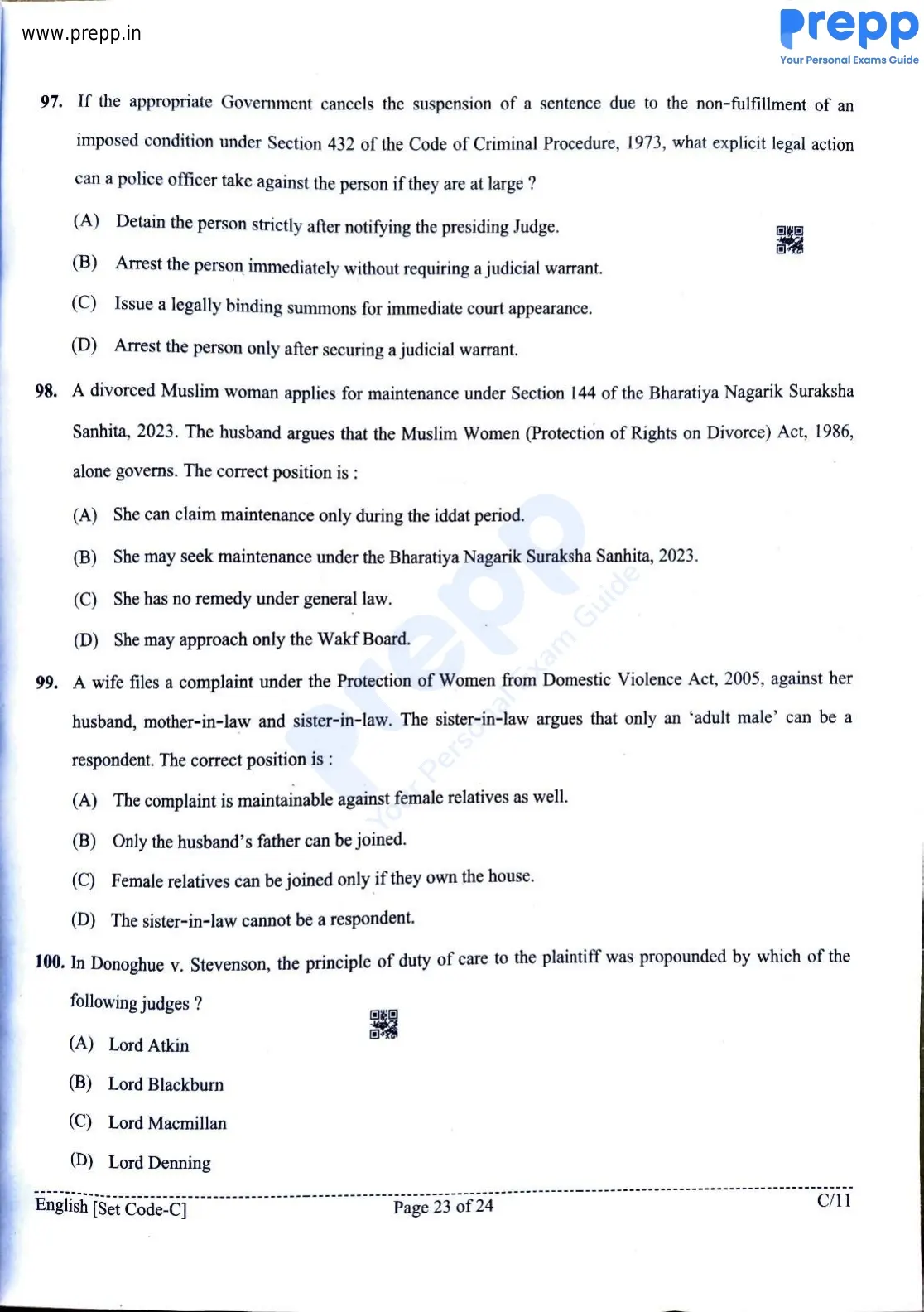
97. If the appropriate Government cancels the suspension of a sentence due to the non-fulfillment of an imposed condition under Section 432 of the Code of Criminal Procedure, 1973, what explicit legal action can a police officer take against the person if they are at large ?
(A) Detain the person strictly after notifying the presiding Judge.
(B) Arrest the person immediately without requiring a judicial warrant.
(C) Issue a legally binding summons for immediate court appearance.
(D) Arrest the person only after securing a judicial warrant.
Check Correct Answer & Solution
98. A divorced Muslim woman applies for maintenance under Section 144 of the Bharatiya Nagarik Suraksha Sanhita, 2023. The husband argues that the Muslim Women (Protection of Rights on Divorce) Act, 1986, alone governs. The correct position is :
(A) She can claim maintenance only during the iddat period.
(B) She may seek maintenance under the Bharatiya Nagarik Suraksha Sanhita, 2023.
(C) She has no remedy under general law.
(D) She may approach only the Wakf Board.
Check Correct Answer & Solution
99. A wife files a complaint under the Protection of Women from Domestic Violence Act, 2005, against her husband, mother-in-law and sister-in-law. The sister-in-law argues that only an ‘adult male’ can be a respondent. The correct position is :
(A) The complaint is maintainable against female relatives as well.
(B) Only the husband’s father can be joined.
(C) Female relatives can be joined only if they own the house.
(D) The sister-in-law cannot be a respondent.
Check Correct Answer & Solution
100. In Donoghue v. Stevenson, the principle of duty of care to the plaintiff was propounded by which of the following judges ?
(A) Lord Atkin
(B) Lord Blackburn
(C) Lord Macmillan
(D) Lord Denning
Check Correct Answer & Solution
Question 1:
Parliament and the Legislature of a State enact laws concerning a matter falling within the Concurrent List. Certain provisions of the two laws are directly inconsistent with each other. The State law was reserved for the consideration of the President and received Presidential assent before coming into operation. Subsequently, Parliament enacts a law on the same subject and obtains presidential assent inconsistent with the State law.
Which of the following most accurately states the constitutional position?
(A) Both laws automatically become void because repugnancy between Union and State laws on a Concurrent List subject is prohibited.
(B) The State law will always prevail within the State because it had received Presidential assent earlier.
(C) Presidential assent permanently immunises the State law from any subsequent Parliamentary legislation.
(D) The State law may prevail within the State notwithstanding the earlier Parliamentary law where Article 254(2) applies; however, Parliament remains constitutionally capable of subsequently overriding the State law by enacting a law on the same matter.
Question 2:
What is the maximum number of members, excluding the chairman, in the Technical Advisory Committee constituted under the Child and Adolescent Labour (Prohibition and Regulation) Act, 1986?
(A) Twenty
(B) Ten
(C) Fifteen
(D) Five
Question 3:
A Bill passed by the Legislature of a State is presented to the Governor for assent. The Bill is not a Money Bill. The Governor does not immediately assent to it and instead considers whether it should be returned to the Legislature for reconsideration or reserved for the consideration of the President.
Assuming the situation falls within the constitutional framework contemplated by Article 200, which of the following correctly describes the options available to the Governor?
(A) Once a Bill is passed by the State Legislature, the Governor is constitutionally required to assent to it without exercising any further constitutional function.
(B) The Governor can only assent to the Bill or reject it permanently and has no power to return or reserve it.
(C) The Governor must necessarily refer every Bill passed by the State Legislature to the President.
(D) The Governor may assent to the Bill, withhold assent, return a non-Money Bill for reconsideration, or reserve the Bill for the consideration of the President, subject to the constitutional requirements governing these alternatives.
Question 4:
Under the Arbitration and Conciliation Act, 1996, the statement of claim and defence shall be completed within what period from the date the arbitrator(s) receive written notice of their appointment?
(A) Nine months
(B) Three months
(C) Six months
(D) Twelve months
Question 5:
Statement: Parliament passes a Constitution Amendment Bill by the special majority prescribed under Article 368. The proposed amendment concerns a constitutional provision relating to the representation of States in Parliament. The Bill has not yet been ratified by the Legislatures of one-half of the States.
Conclusions:
I. Parliamentary passage alone is insufficient for completion of the amendment if the subject matter falls within the category requiring State ratification under Article 368(2).
II. The requirement of ratification by the States applies to every Constitution Amendment Bill passed by Parliament.
III. If the proposed amendment falls within the matters specified in the proviso to Article 368(2), ratification by the Legislatures of not less than one-half of the States is constitutionally required before the Bill can proceed to Presidential assent.
Which of the following is the correct answer?
(A) Conclusions I and III follow.
(B) Conclusions II and III follow.
(C) All three Conclusions follow.
(D) Only Conclusion I follows.
Download: AIBE 21 2026 Question Paper and Answer Key PDF with Detailed Solutions
 Never Miss an Exam Update! Get instant notifications and exam news right inside your chat.
 Click here to join Prepp on WhatsApp
 Boost Your Preparation with Free Resources! Get daily quizzes, current affairs PDFs, and study notes directly on Telegram. Click here to join Prepp on Telegram
Also Check: AIBE 22 Exam Analysis 2026 (Nov 29): Difficulty Level, Good Attempts and Subject-Wise Paper Review
AIBE 22 2026 Exam Analysis
AIBE 22 2026 question papers were designed to assess candidates' understanding of legal provisions, statutory laws, judicial principles and their practical application. The detailed analysis of Sets A, B, C and D helps candidates understand the difficulty level, nature of questions and important topics covered in the examination.
| Particulars | Details |
|---|---|
| Overall Difficulty Level | To be Updated |
| Examination Mode | Offline – OMR Based |
| Question Paper Sets | Set A, Set B, Set C and Set D |
| Total Questions | 100 |
| Total Marks | 100 |
| Question Type | Multiple Choice Questions |
| Concept-Based Questions | To be Updated |
| Bare Act-Based Questions | To be Updated |
| Case Law-Based Questions | To be Updated |
| Application-Based Questions | To be Updated |
| Marks for Each Correct Answer | 1 Mark |
| Negative Marking | No |
Candidates can review all four AIBE 22 question paper sets to understand the types of legal questions asked in the examination. The detailed exam analysis will be updated after reviewing the questions related to statutory provisions, landmark judgments, legal procedures, constitutional principles and professional ethics.
AIBE 22 2026 Subject-Wise Questions and Weightage
AIBE 22 2026 covered various law subjects to assess candidates' legal knowledge and professional competency. The subject-wise weightage helps candidates understand the distribution of questions prescribed in the syllabus and identify important areas for preparation.
| Subject | Number of Questions | Weightage |
|---|---|---|
| Constitutional Law | 10 | 10% |
| Indian Penal Code and Bharatiya Nyaya Sanhita | 8 | 8% |
| Criminal Procedure Code and Bharatiya Nagarik Suraksha Sanhita | 10 | 10% |
| Code of Civil Procedure | 10 | 10% |
| Evidence Act and Bharatiya Sakshya Adhiniyam | 8 | 8% |
| Alternative Dispute Resolution Including Arbitration Act | 4 | 4% |
| Family Law | 8 | 8% |
| Public Interest Litigation | 4 | 4% |
| Administrative Law | 3 | 3% |
| Professional Ethics and Professional Misconduct | 4 | 4% |
| Company Law | 2 | 2% |
| Environmental Law | 2 | 2% |
| Cyber Law | 2 | 2% |
| Labour and Industrial Law | 4 | 4% |
| Law of Tort, Motor Vehicles Act and Consumer Protection Law | 5 | 5% |
| Taxation Law | 4 | 4% |
| Contract Law, Specific Relief, Property Law and Negotiable Instruments Act | 8 | 8% |
| Land Acquisition Act | 2 | 2% |
| Intellectual Property Laws | 2 | 2% |
| Total | 100 | 100% |
The above distribution is based on the syllabus pattern. Constitutional Law, Criminal Procedure and Civil Procedure carry significant weightage in the AIBE examination. Candidates should also familiarise themselves with the provisions of newly introduced criminal laws.
AIBE 22 2026 question papers and answer keys for Sets A, B, C and D are available for candidates to evaluate their examination performance and calculate expected scores. Aspirants preparing for upcoming examinations can also practise AIBE previous year question papers with answer keys to understand important legal concepts, question patterns and subject-wise trends.
| Relevant Links | ||
|---|---|---|
| AIBE Result | AIBE Cutoff | AIBE Previous Year Papers |
| AIBE Answer Key | AIBE Eligibility Criteria | AIBE Latest Updates |
AIBE 22 2026 Question Paper FAQs
Ques: Are all four sets of AIBE 22 2026 question papers available for download?
Ans: Yes, candidates can download AIBE 22 question papers for Sets A, B, C and D along with their respective answer keys in PDF format.
Ques: Can I use AIBE 22 Set A answer key to evaluate Set B question paper?
Ans: Candidates should use the answer key corresponding to their question paper set, as the sequence of questions and options may differ across sets.
Ques: What happens if two options in the AIBE 22 question paper are legally correct?
Ans: Candidates can challenge such questions during the answer key objection window by providing relevant statutory provisions or supporting legal documents.
Ques: Will withdrawn questions affect AIBE 22 2026 qualifying marks?
Ans: If BCI withdraws questions from the final answer key, the total evaluable marks and corresponding qualifying marks may be revised.
Ques: Can candidates challenge multiple answers in the AIBE 22 provisional answer key?
Ans: Candidates can raise objections against multiple answers by following the prescribed objection guidelines and submitting supporting evidence.
Download the PREPP App and attempt FREE AIBE Mock Tests and get complete study material!


Comments