
JEE Advanced 2026 Question Papers and Answer Keys; Download PDF
JEE Advanced 2026 is conducted by IIT Roorkee on May 17, 2026, in CBT mode for admission into undergraduate programs across the IITs. JEE Advanced consists of two compulsory papers covering Physics, Chemistry, and Mathematics, with a total of 102 questions across multiple formats, including MCQs, numerical-value, and multiple-correct questions.
JEE Advanced 2026 Question Paper and Answer Key PDFs
| Question Paper PDF | Answer Key PDF | Detailed Solution |
|---|---|---|
JEE Advanced 2026 Paper 1 Question Paper and Answer Key PDF (English) (May 17, 2026) |
Download PDF | Available Soon |
| JEE Advanced 2026 Paper 1 Question Paper and Answer Key PDF (Hindi ) (May 17, 2026) |
Available Soon | Available Soon |
| JEE Advanced 2026 Paper 2 Question Paper and Answer Key PDF (English) (May 17, 2026) |
Download PDF | Available Soon |
| JEE Advanced 2026 Paper 2 Question Paper and Answer Key PDF (Hindi ) (May 17, 2026) |
Available Soon | Available Soon |
AAT is an optional aptitude test conducted after JEE Advanced, meant only for B.Arch admission in IITs, and it has no impact on the rank.
JEE Advanced 2026 AAT Question Paper and Answer Key PDF
| Question Paper PDF | Answer Key PDF |
|---|---|
| JEE Advanced 2026 AAT Question Paper and Answer Key PDF (Jun 04, 2026) |
Available Soon |
JEE Advanced 2026 Shift Timings
JEE Advanced 2026 was conducted in May, consisting of two compulsory papers in online mode for admission into undergraduate programs across the IITs. Both papers included questions from Physics, Chemistry, and Mathematics in multiple formats such as MCQs, numerical values, and multiple-correct questions.
| Paper | Duration | Start Time | End Time |
|---|---|---|---|
| JEE Advanced 2026 Paper 1 | 3 Hours | 09:00 AM | 12:00 PM |
| JEE Advanced 2026 Paper 2 | 3 Hours | 02:30 PM | 05:30 PM |
JEE Advanced 2026 Exam Pattern
JEE Advanced 2026 exam took place in an online mode as a test for admissions into undergraduate courses in several IITs across India. The test consisted of two papers that covered Physics, Chemistry, and Mathematics. Both Paper 1 and Paper 2 had three hours each and consisted of a range of question types including single-choice, multiple-choice questions, multiple-choice questions with multiple correct answers, numerical answer type questions, and match-the-following type questions.
Students can have an insight into the pattern and marking scheme of the recent question paper by attempting 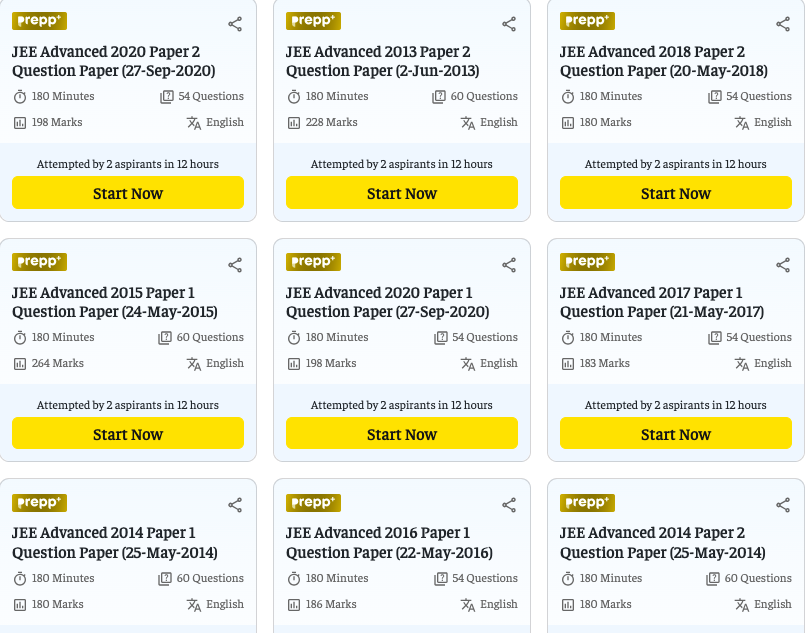
JEE Advanced 2026 Important Topics and Weightage
The topic-wise weightage below is based on recent JEE Advanced paper trends, memory-based analyses, and previous years’ Paper 1 and Paper 2 question distribution.
JEE Advanced 2026 Subject-wise Expected Weightage
| Subject | Expected Weightage | Important Topics for JEE Advanced 2026 |
|---|---|---|
| Physics | 30–38 questions | Mechanics, Rotation, Electrodynamics, Current Electricity, Modern Physics, SHM & Waves, Thermodynamics, Optics |
| Chemistry | 28–36 questions | Organic Reaction Mechanisms, Chemical Bonding, Coordination Compounds, Electrochemistry, Thermodynamics, p-Block Chemistry, Biomolecules |
| Mathematics | 30–38 questions | Calculus, Coordinate Geometry, Probability, Matrices & Determinants, Complex Numbers, Functions, Vectors & 3D Geometry |
JEE Advanced 2026 Paper-wise Important Areas
| Paper | Expected Focus Areas | Important Topics |
|---|---|---|
| Paper 1 | Concept-based and analytical questions | Mixed-concept Physics problems, Organic Chemistry mechanisms, Differential Calculus, Coordinate Geometry, Numerical-value questions |
| Paper 2 | Lengthy and multi-step problem solving | Electrodynamics, Inorganic Chemistry reactions, Integral Calculus, Probability, Matrix Match and Multiple Correct questions |
The exact number of questions and chapter-wise distribution may vary across both papers. Candidates can also understand the latest question structure and topic trends more effectively through JEE Advanced 2026 mock tests and previous year papers.
JEE Advanced 2026 Paper Analysis (Expected)
JEE Advanced 2026 focused on conceptual application and multi-topic problem solving rather than direct formula-based questions. Physics and Mathematics were relatively tougher, while Chemistry remained more balanced and scoring.
JEE Advanced 2026 Paper-wise Expected Analysis
| Paper | Expected Difficulty Level | Expected Highlights |
|---|---|---|
| Paper 1 | Moderate to Tough | Physics may include lengthy numerical problems and mixed-concept questions. Chemistry is expected to remain balanced across Organic, Physical, and Inorganic sections, while Mathematics may focus heavily on Calculus and Coordinate Geometry with calculation-intensive problems. |
| Paper 2 | Tough | Paper 2 is expected to feature more analytical and multi-step questions with higher emphasis on conceptual clarity. Multiple-correct and matrix-match questions may increase overall difficulty, especially in Mathematics and Physics sections. |
Subject-wise Expected Difficulty
| Subject | Expected Difficulty | Expected Focus Areas |
|---|---|---|
| Physics | Moderate to Tough | Mechanics, Electrodynamics, Modern Physics, Thermodynamics |
| Chemistry | Moderate | Organic Mechanisms, Coordination Compounds, Electrochemistry, Chemical Bonding |
| Mathematics | Tough and Lengthy | Calculus, Probability, Complex Numbers, Vectors & 3D Geometry |
The exact difficulty level and question pattern may vary across both papers. Candidates can also understand the latest exam trends and question formats more effectively through JEE Advanced 2026 mock tests and previous year papers.
What After JEE Advanced 2026 Results?
After the declaration of JEE Advanced 2026 results, qualified candidates will be eligible to participate in the JoSAA counselling process for admission into IITs and other participating institutes. The result will include subject-wise marks, aggregate marks, Common Rank List (CRL) rank, and category rank based on candidate performance across both papers.
What Happens After Result Declaration?
| Stage | Details |
|---|---|
| Rank List Release | Candidates who meet the subject-wise and aggregate cutoff will receive a rank in the Common Rank List (CRL). |
| JoSAA Registration | Qualified candidates must register for JoSAA counselling to participate in seat allocation rounds. |
| Choice Filling | Candidates can select preferred IITs, branches, and institutes during counselling. |
| Seat Allotment | Seats are allotted based on rank, category, preferences filled, and seat availability. |
| Document Verification | Candidates must complete online reporting and document verification after seat allotment. |
| Final Admission | Admission is confirmed after fee payment and successful verification by the allotted institute. |
Candidates can also use JEE Advanced 2026 opening and closing ranks along with previous year cutoff trends to estimate admission chances across different IITs and branches.
Top Colleges Accepting JEE Advanced 2026 Scores
JEE Advanced 2026 scores are accepted primarily for admission into the Indian Institutes of Technology (IITs). Admission to these institutes is conducted through the JoSAA counselling process based on candidate rank, category, seat availability, and branch preferences.
| Institute | Popular Branches |
|---|---|
| IIT Bombay | Computer Science Engineering, Electrical Engineering, Mechanical Engineering |
| IIT Delhi | Computer Science Engineering, Mathematics & Computing, Electrical Engineering |
| IIT Madras | Computer Science Engineering, AI & Data Science, Mechanical Engineering |
| IIT Kanpur | Computer Science Engineering, Electrical Engineering, Aerospace Engineering |
| IIT Kharagpur | Computer Science Engineering, Electronics Engineering, Mechanical Engineering |
| IIT Roorkee | Computer Science Engineering, Data Science, Electrical Engineering |
| IIT Guwahati | Computer Science Engineering, Electronics & Communication, Mathematics & Computing |
| IIT Hyderabad | AI, Computer Science Engineering, Electrical Engineering |
| IIT BHU Varanasi | Computer Science Engineering, Electronics Engineering, Mechanical Engineering |
| IIT Indore | Computer Science Engineering, Electrical Engineering, Mathematics & Computing |
It is expected that JEE Advanced 2026 will be testing the candidate’s ability to comprehend concepts and apply analytical thinking in order to solve complex problems in both Papers. The domains with high weightage include Calculus, Mechanics, Electrodynamics, Organic Chemistry, Coordinate Geometry, and Probability; thus, these areas can make a significant part of the exam structure. In view of the fact that there might be differences between the test format and marks allocation depending on the topic, consistent preparation is required.
JEE ADVANCED 2026 FAQs
Ques: How many papers are there in JEE Advanced 2026?
Ans: JEE Advanced 2026 is conducted in two papers: Paper 1 and Paper 2. Both are held on the same day, and students need to appear for each paper because skipping one can affect the final result.
Ques: Does JEE Advanced 2026 include negative marking?
Ans: Yes, JEE Advanced 2026 has negative marking in some sections. The marking scheme is usually different for different question types, so students have to read the instructions carefully before attempting the paper.
Ques: Is it compulsory to attempt both papers in JEE Advanced 2026?
Ans: Yes, appearing in both Paper 1 and Paper 2 is compulsory. The final scores are calculated by combining marks from both papers together, not separately.
Ques: What kind of questions are asked in JEE Advanced 2026?
Ans: The paper generally includes different types of questions like MCQs, numerical-value questions, multiple-correct answer questions, and sometimes match-based formats from Physics, Chemistry, and Mathematics. The pattern can feel a little unpredictable at times.
Ques: Why do students practice previous year JEE Advanced papers?
Ans: Previous year papers give students a clearer idea of the actual exam difficulty, the style of questions asked, and which chapters are asked more often. They also help in improving speed, accuracy, and overall exam understanding with regular practice.
Download the PREPP App and attempt FREE JEE Advanced Mock Tests and get complete study material!


Comments