Territorial Army 2026 Question Paper with Answer Key; Download Solution PDF
Territorial Army 2026 Question Paper will be available after the examination along with the answer key and detailed solutions. Territorial Army Commission Examination 2026 is scheduled to be conducted on July 12, 2026, in Computer-Based Test mode. The examination will consist of 100 multiple-choice questions carrying 100 marks, and candidates will be given two hours to complete the paper.
Territorial Army 2026 Question Paper and Answer Key PDF
| Question Paper PDF | Answer Key | Detailed Solution |
|---|---|---|
Territorial Army 2026 Question Paper and Answer Key PDF (Jul 12, 2026) |
Available Soon | Available Soon |
Territorial Army Exam Pattern 2026
The revised paper includes three sections. Reasoning carries the highest number of questions, while General Knowledge and English have equal weightage.
| Section | Questions | Marks | Weightage |
|---|---|---|---|
| Reasoning | 40 | 40 | 40% |
| General Knowledge | 30 | 30 | 30% |
| English | 30 | 30 | 30% |
| Total | 100 | 100 | 100% |
Each correct answer carries one mark. A deduction of one-third mark applies to every incorrect response, while unanswered questions do not attract any penalty.
Key Change in the Territorial Army Exam Pattern
In earlier papers, the examination generally included Reasoning, Elementary Mathematics, General Knowledge and English. The 2026 paper has removed Mathematics and redistributed the emphasis towards the remaining subjects.
Reasoning now contributes 40% of the total marks, making it the most important section. Candidates referring to older papers should therefore focus mainly on Reasoning, General Knowledge and English.
Territorial Army 2026 Exam Analysis
The actual analysis will be available after the examination. However, previous Territorial Army papers indicate that the overall difficulty level is usually moderate.
The revised pattern may benefit candidates who are less comfortable with Mathematics. At the same time, the increased Reasoning weightage and the wide General Knowledge syllabus may make accuracy and time management more important.
Territorial Army Reasoning Analysis
The Reasoning section generally includes short logical questions along with a few time-consuming puzzles and arrangements.
Common topics include:
- Number and alphabet series
- Coding-decoding
- Analogy and classification
- Blood relations
- Direction sense
- Ranking and order
- Seating arrangements
- Box-based puzzles
- Mathematical operations
- Figure and non-verbal reasoning
Questions from series, analogy and coding-decoding are usually manageable. Seating arrangements and multi-step puzzles often require more time and careful calculation.
Expected difficulty level: Easy to Moderate
Scoring potential: High with regular practice
Territorial Army General Knowledge Analysis
The General Knowledge section covers a combination of static topics and current affairs. Previous papers included questions from history, geography, polity, science, economics, defence and national developments.
Candidates may expect questions from areas such as:
- Indian Constitution and polity
- History and culture
- Indian and world geography
- General science
- Economy and financial institutions
- Government schemes
- Defence exercises and technology
- National and international current affairs
- Important appointments
- Space and scientific developments
Since the syllabus is broad, this section may be more unpredictable than Reasoning or English.
Expected difficulty level: Moderate to Difficult
Scoring potential: Moderate
Territorial Army English Analysis
The English section evaluates grammar, vocabulary and reading comprehension.
Important question types may include:
- Reading comprehension
- Cloze test
- Synonyms and antonyms
- Idioms and phrases
- One-word substitution
- Fill in the blanks
- Sentence rearrangement
- Spelling correction
- Grammar usage
- Contextual vocabulary
Comprehension and cloze-test questions may account for a noticeable portion of the section. Vocabulary-based questions can be challenging if candidates are unfamiliar with advanced words or expressions.
Expected difficulty level: Moderate
Scoring potential: High for candidates with strong language skills
Territorial Army 2026 Difficulty Level
| Section | Expected Difficulty | Nature of Questions |
|---|---|---|
| Reasoning | Easy to Moderate | Series, coding, puzzles and logical reasoning |
| General Knowledge | Moderate to Difficult | Static GK and current affairs |
| English | Moderate | Grammar, vocabulary and comprehension |
| Overall | Moderate | Accuracy and time management will be crucial |
Territorial Army 2026 Section-Wise Weightage
Reasoning Weightage
Reasoning carries 40 marks and forms the largest part of the examination.
| Topic | Expected Questions |
|---|---|
| Series, analogy and classification | 8–10 |
| Coding-decoding and letter logic | 6–8 |
| Seating arrangements and puzzles | 6–8 |
| Blood relations, ranking and directions | 4–6 |
| Number logic and operations | 4–5 |
| Non-verbal reasoning | 2–4 |
| Other logical questions | 3–5 |
The exact distribution may vary, but candidates should prioritise high-frequency topics and short-answer questions.
General Knowledge Weightage
General Knowledge carries 30 marks. Candidates should prepare both static subjects and recent events.
| Area | Expected Questions |
|---|---|
| Current affairs | Around 15 |
| Indian polity and Constitution | 3–4 |
| History and culture | 3–4 |
| Geography | 3–4 |
| General science | 2–3 |
| Economy, defence and institutions | 2–4 |
Regular revision of current events is essential because many questions may be based on recent national and international developments.
English Weightage
| Topic | Expected Questions |
|---|---|
| Reading comprehension and cloze test | 10–12 |
| Vocabulary | 5–7 |
| Grammar and fill in the blanks | 5–6 |
| Idioms and one-word substitution | 3–4 |
| Sentence arrangement | 2–3 |
| Spelling and usage | 2–3 |
Common Mistakes in the Territorial Army Exam
- Following the Old Exam Pattern: Candidates may continue preparing Mathematics based on older papers and overlook the revised distribution. The 2026 paper does not include Mathematics, while Reasoning now carries the highest weightage.
- Guessing Answers Without Elimination: Negative marking can reduce the final score. Candidates should avoid random attempts and answer uncertain questions only when they can eliminate incorrect options.
- Spending Too Long on Difficult Puzzles: Lengthy seating arrangements and multi-step puzzles can affect overall time management. Short questions from series, analogy, coding and vocabulary should generally be attempted first.
- Ignoring Current Affairs: Preparing only static General Knowledge may not be sufficient. Candidates should revise defence news, appointments, government programmes, economic updates and major national and international events.
- Misreading Comprehension Passages: Some candidates rely on outside knowledge instead of selecting answers based on the passage. Comprehension questions should be answered strictly according to the information provided in the text.
- Leaving Marked Questions Unchecked: Questions marked for review may remain unanswered if candidates do not revisit them. The final few minutes should be used to check incomplete or flagged questions.
Territorial Army 2026 Question Paper FAQs
Ques. What is the Territorial Army Exam Pattern 2026?
Ans. The paper consists of 100 questions for 100 marks. Reasoning has 40 questions, while General Knowledge and English contain 30 questions each.
Ques. Is Mathematics included in the Territorial Army 2026 exam?
Ans. No. Elementary Mathematics has been removed from the 2026 written examination.
Ques. Is there negative marking in the Territorial Army exam?
Ans. Yes. One-third mark is deducted for every incorrect answer. No marks are deducted for unattempted questions.
Ques. Are previous-year Territorial Army papers useful for the 2026 exam?
Ans. Yes. They are useful for understanding recurring question types and difficulty levels. However, candidates should skip or separately practise the Mathematics portion because it is not part of the revised 2026 pattern.
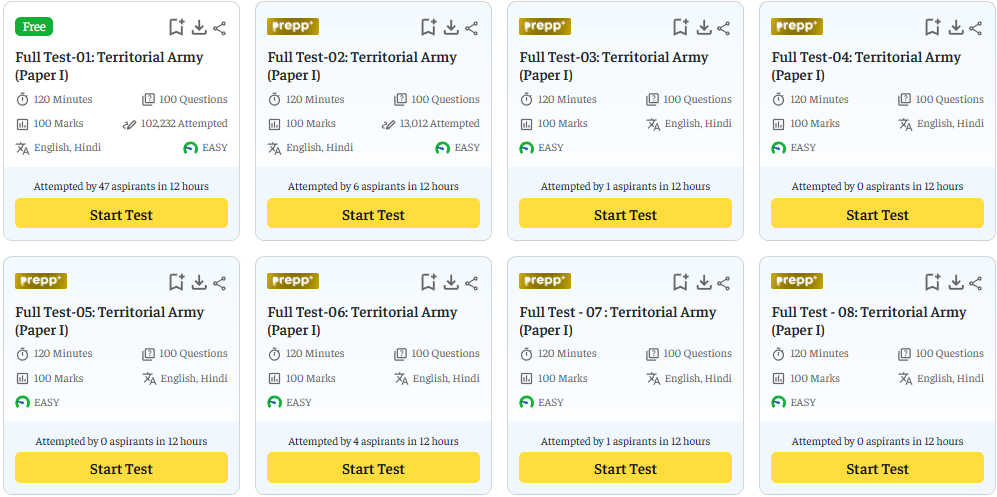
Download the PREPP App and attempt FREE Territorial Army Mock Tests and get complete study material!

French revolution
Full Test - 08 : Territorial Army (Paper II)
Territorial Army (Paper - II) 2022 (25-Sep-2022) Previous Year Paper
Territorial Army (Paper - I) 2022 (25-Sep-2022) Previous Year Paper

17 February 2025 | The Hindu Must Read Articles | Current Affairs

16 February 2026 | The Hindu Must Read Articles | Current Affairs

13 February 2026 | The Hindu Must Read Articles | Current Affairs









Comments