
You have the following substances: NH3, O2, Pt, and H2O. Arrange the following equations for the preparation of N2O from these compounds: A. Choose the correct answer from the options given below:
B. NH3(g) + HNO3(aq) → NH4NO3(aq)
C. 3NO2(g) + H2O(l) → 2HNO3(aq) + NO(g)
D. 2NO(g) + O2(g) → 2NO2(g)
E. 
E, D, C, B, A
The correct answer is (a) E, D, C, B, A. Here's the reasoning:
1. E: The reaction 4NH3(g) + 5O2(g) → 4NO(g) + 6H2O(l) occurs at 1100K in the presence of platinum. This is the first step in the process of preparing NO, which is then used in the subsequent steps.
2. D: The reaction 2NO(g) + O2(g) → 2NO2(g) represents the oxidation of NO to NO2, which is an intermediate in the preparation of N2O.
3. C: The reaction 3NO2(g) + H2O(l) → 2HNO3(aq) + NO(g) produces nitric acid and NO, which are part of the process.
4. B: The reaction NH3(g) + HNO3(aq) → NH4NO3(aq) forms ammonium nitrate, which is essential in the preparation process.
5. A: Finally, NH4NO3(aq) → N2O(g) + 2H2O(s) at 523K via vacuum evaporation produces N2O, which is the final product.
Important Questions from Chemical Kinetics
A reaction takes 30 minutes to complete 50% of the reaction and takes 45 minutes to complete 75% of the reaction. The order of the reaction is:
Ferric oxide in blast furnace's upper half is mainly reduced by:
If time taken for a first-order reaction to get 90% complete is 24 min, its t99.9% will be:
Match the Items List-I and List-II:
List-I List-II (A) Instantaneous Rate (I) Rate constant (B) Average Rate (II) Rate law (C) Mathematical expression for rate of reaction in terms of concentration of reactants (III) Short interval of time (D) Rate of reaction for zero-order reaction is equal to (IV) Long direction of time Choose the correct answer from the options given below:
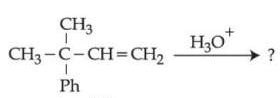 product formed is:


