
Which two signs need to be interchanged to make the following equation correct? 5 × 4 + 12 - 3 ÷ 6 = 18
÷ and -
Solving Equation by Interchanging Signs
The problem asks us to find which pair of signs, when swapped in the given equation, makes the equation correct. The original equation is:
\(5 \times 4 + 12 - 3 \div 6 = 18\)
Let's evaluate the original equation to see if it is already correct using the BODMAS/PEMDAS rule (Brackets, Orders/Exponents, Division, Multiplication, Addition, Subtraction):
\(5 \times 4 + 12 - 3 \div 6\)
First, perform Multiplication and Division from left to right:
\((5 \times 4) + 12 - (3 \div 6)\)
\(20 + 12 - 0.5\)
Next, perform Addition and Subtraction from left to right:
\(32 - 0.5\)
\(31.5\)
Since \(31.5 \neq 18\), the original equation is not correct. We need to test each option by interchanging the specified signs and re-evaluating the equation.
Testing Option 1: Interchange + and -
If we swap the '+' and '-' signs, the equation becomes:
\(5 \times 4 - 12 + 3 \div 6\)
Evaluate using BODMAS:
Multiplication and Division:
\((5 \times 4) - 12 + (3 \div 6)\)
\(20 - 12 + 0.5\)
Addition and Subtraction:
\(8 + 0.5\)
\(8.5\)
Since \(8.5 \neq 18\), interchanging '+' and '-' does not make the equation correct.
Testing Option 2: Interchange ÷ and -
If we swap the '÷' and '-' signs, the equation becomes:
\(5 \times 4 + 12 \div 3 - 6\)
Evaluate using BODMAS:
Multiplication and Division:
\((5 \times 4) + (12 \div 3) - 6\)
\(20 + 4 - 6\)
Addition and Subtraction:
\(24 - 6\)
\(18\)
Since \(18 = 18\), interchanging '÷' and '-' makes the equation correct.
Testing Option 3: Interchange ÷ and ×
If we swap the '÷' and '×' signs, the equation becomes:
\(5 \div 4 + 12 - 3 \times 6\)
Evaluate using BODMAS:
Multiplication and Division:
\((5 \div 4) + 12 - (3 \times 6)\)
\(1.25 + 12 - 18\)
Addition and Subtraction:
\(13.25 - 18\)
\(-4.75\)
Since \(-4.75 \neq 18\), interchanging '÷' and '×' does not make the equation correct.
Testing Option 4: Interchange × and +
If we swap the '×' and '+' signs, the equation becomes:
\(5 + 4 \times 12 - 3 \div 6\)
Evaluate using BODMAS:
Multiplication and Division:
\(5 + (4 \times 12) - (3 \div 6)\)
\(5 + 48 - 0.5\)
Addition and Subtraction:
\(53 - 0.5\)
\(52.5\)
Since \(52.5 \neq 18\), interchanging '×' and '+' does not make the equation correct.
Based on the evaluation of each option, interchanging the '÷' and '-' signs is the correct choice to make the equation true.
The final answer is Option 2: ÷ and -.
Revision Table: Evaluating Sign Interchanges
| Option | Signs Interchanged | New Equation | Evaluation (Step-by-step) | Result | Correct? |
|---|---|---|---|---|---|
| Original | None | \(5 \times 4 + 12 - 3 \div 6\) | \(20 + 12 - 0.5 = 32 - 0.5 = 31.5\) | \(31.5\) | No |
| 1 | + and - | \(5 \times 4 - 12 + 3 \div 6\) | \(20 - 12 + 0.5 = 8 + 0.5 = 8.5\) | \(8.5\) | No |
| 2 | ÷ and - | \(5 \times 4 + 12 \div 3 - 6\) | \(20 + 4 - 6 = 24 - 6 = 18\) | \(18\) | Yes |
| 3 | ÷ and × | \(5 \div 4 + 12 - 3 \times 6\) | \(1.25 + 12 - 18 = 13.25 - 18 = -4.75\) | \(-4.75\) | No |
| 4 | × and + | \(5 + 4 \times 12 - 3 \div 6\) | \(5 + 48 - 0.5 = 53 - 0.5 = 52.5\) | \(52.5\) | No |
Additional Information: Order of Operations (BODMAS/PEMDAS)
When solving mathematical equations with multiple operations, it is crucial to follow a specific order to ensure the correct result. This order is commonly remembered using acronyms like BODMAS or PEMDAS.
- BODMAS:
- Brackets (Parentheses)
- Orders (Exponents, Roots)
- Division and Multiplication (from left to right)
- Addition and Subtraction (from left to right)
- PEMDAS:
- Parentheses
- Exponents
- Multiplication and Division (from left to right)
- Addition and Subtraction (from left to right)
Both acronyms represent the same order of operations. Division and Multiplication have the same priority, as do Addition and Subtraction. When operations of the same priority appear in an expression, you perform them from left to right.
In this problem, we applied the BODMAS/PEMDAS rule each time we evaluated the equation after interchanging the signs. This systematic approach is essential for solving such arithmetic puzzles accurately.
Important Questions from Problem Solving
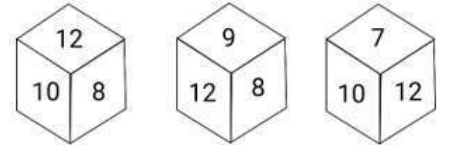
Six numbers, 7, 8, 9, 10, 11 and 12 are written on different faces of a dice. Three positions of this dice are shown here. Find the number on the face opposite 12.
Select the set in which the numbers are related in the same way as are the numbers of the following sets.
(NOTE: Operations should be performed on the whole numbers, without breaking down the numbers into its constituent digits. E.g. 13 - Operations on 13 such as adding/subtracting/multiplying etc. to 13 can be performed. Breaking down 13 into 1 and 3 and then performing mathematical operations on 1 and 3 is not allowed.)
(84, 73, 157) (96, 88, 184)
Rahul invests his savings, which is Rs. 25,000 in his bank that pays 7 per cent annual interest. How much will he earn by way of interest in one year?
In a company there are 3 departments - IT, HR and Help Desk. In the IT department there are 125 employees and in the HR department the number of employees is 1/5th of IT. The helpdesk department has 20 employees less than total employees in IT and HR together. What is the total number of employees working in all three departments?
People who are closest to information technology agree with the observation that benefits of screens as a learning tool are overblown and the risks for addiction and stunting development seems high. Screens are said to be beyond personal control and we situate them in pleasure centres of the developing brains. As a responsible parent you will


