
Which phenomenon proves the particle nature of photons?
Photoelectric effect
Understanding the Nature of Light: Wave vs. Particle
Light exhibits a dual nature, meaning it can behave as both a wave and a particle, depending on the phenomenon being observed. Certain experiments and phenomena can only be explained by considering light as a wave, while others require us to think of light as consisting of tiny packets of energy called photons, which represent its particle nature.
Which Phenomenon Proves the Particle Nature of Photons? Analyzing the Options
Let's look at the given options and determine which one provides evidence for the particle nature of photons.
- Interference: Interference is a phenomenon where two or more waves combine to form a new wave pattern. This effect, such as observed in Young's double-slit experiment, is a classic demonstration of the wave nature of light.
- Diffraction: Diffraction is the bending of waves as they pass around the edge of an obstacle or through a narrow opening. Like interference, diffraction is a characteristic property of waves and is explained by the wave nature of light.
- Polarisation: Polarisation is the phenomenon where the oscillations of a transverse wave are restricted to a specific direction. Light can be polarised, which demonstrates that light waves are transverse waves. This is also explained by the wave nature of light.
- Photoelectric effect: The photoelectric effect is the emission of electrons from a metal surface when light shines on it. This effect cannot be explained by the wave theory of light. According to the particle theory, light consists of discrete energy packets called photons. When a photon with sufficient energy strikes an electron in the metal, it can transfer its energy to the electron, allowing the electron to escape from the surface. This explanation, proposed by Einstein, successfully accounts for the experimental observations of the photoelectric effect, such as the existence of a threshold frequency and the immediate emission of electrons.
Detailed Explanation of the Photoelectric Effect
The photoelectric effect strongly supports the idea that light is made up of particles (photons). Here's why:
- Existence of Threshold Frequency: For electron emission to occur, the incident light must have a minimum frequency, called the threshold frequency ($\nu_0$). If the frequency is below this value, no electrons are emitted, no matter how intense the light is or how long it shines. The wave theory cannot explain this, as it predicts that electron emission should eventually occur if the light intensity is high enough, allowing energy to build up over time. The particle theory explains that a single photon must have enough energy ($E = h\nu$) to overcome the binding energy (work function, $\phi$) of the electron. If $\nu < \nu_0$, then $h\nu < \phi$, and the photon's energy is insufficient to eject the electron.
- Kinetic Energy of Emitted Electrons: The maximum kinetic energy of the emitted electrons depends on the frequency of the incident light, not its intensity. According to the particle theory, the energy of a photon is proportional to its frequency ($E = h\nu$). If a photon of energy $h\nu$ ejects an electron with work function $\phi$, the excess energy becomes the kinetic energy of the electron: $K_{max} = h\nu - \phi$. Increasing the intensity means increasing the number of photons, which increases the number of emitted electrons (photoelectric current), but not the energy of individual electrons. The wave theory predicts that increasing intensity should increase the energy absorbed by each electron, leading to higher kinetic energy, which is not observed.
- Instantaneous Emission: Electron emission is almost instantaneous, occurring within $10^{-9}$ seconds after light strikes the surface, even at low intensities. The wave theory predicts a delay in emission at low intensities, as electrons would need time to absorb enough energy from the distributed wave. The particle theory explains this as a single interaction between a photon and an electron, which is instantaneous.
Because the photoelectric effect can only be explained by considering light as discrete packets of energy (photons), it provides strong evidence for the particle nature of photons.
| Phenomenon | Nature Supported |
|---|---|
| Interference | Wave Nature |
| Diffraction | Wave Nature |
| Polarisation | Wave Nature |
| Photoelectric Effect | Particle Nature |
Revision Table: Key Concepts in Photoelectric Effect
| Term | Description |
|---|---|
| Photon | A quantum (discrete packet) of light energy. Energy $E = h\nu$. |
| Work Function ($\phi$) | The minimum energy required to remove an electron from a metal surface. |
| Threshold Frequency ($\nu_0$) | The minimum frequency of incident light required for photoelectric emission. $h\nu_0 = \phi$. |
| Photoelectric Current | The flow of emitted electrons. Proportional to the intensity of incident light above the threshold frequency. |
| Stopping Potential ($V_0$) | The minimum negative potential applied to the anode needed to stop the most energetic emitted electrons. $eV_0 = K_{max}$. |
Additional Information on Light's Dual Nature
The dual nature of light is a fundamental concept in quantum mechanics. While phenomena like interference, diffraction, and polarisation demonstrate the wave nature of light, the photoelectric effect and Compton effect demonstrate its particle nature. Both aspects are necessary for a complete understanding of light's behaviour.
Quantum mechanics suggests that particles, like electrons, can also exhibit wave-like properties (de Broglie hypothesis), and waves, like light, can exhibit particle-like properties. This wave-particle duality is not limited to light but applies to all matter and energy at the quantum level.
Important Questions from Electromagnetic Induction
The half-life period of a radioactive element 'X' is same as the mean life of another radioactive element Y. Initially both of them have the same no. of atoms, then:
A. X and Y have the same decay rate initially.
B. X and Y decay at the same rate always.
C. Y will decay at a faster rate than X.
D. X will decay at a faster rate than Y.
Choose the correct answer from the options given below:
The wire loop PQRSP formed by joining two semicircular wires of radii R1 & R2 carries a current I as shown in the figure. The magnitude of the magnetic field at the centre 'C' is:

A Neutron is moving with a velocity of V in a non-uniform magnetic field as shown in the figure.
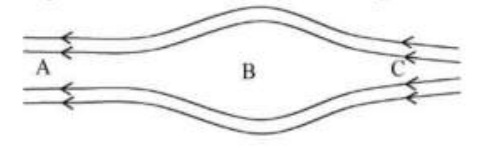
Velocity v̅ of neutron would be:
The graph between resistivity and temperature given below can be for the material:
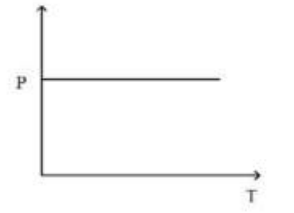
A semiconductor device is connected in series circuit with a battery and resistance. A current is found to pass through the circuit. If the polarity of the battery is reversed, the current chops at almost zero. The device may be:


