
Understanding Lever Classification
Levers are fundamental simple machines. They consist of a rigid bar pivoting around a fixed point called the fulcrum. Forces applied are the effort (input force) and the load (resistance or output force). Levers are categorized into three classes based on the relative positions of these three components: Fulcrum (F), Effort (E), and Load (L).
- Class 1 Lever: Fulcrum is between the Effort and Load (e.g., E-F-L).
- Class 2 Lever: Load is between the Fulcrum and Effort (F-L-E).
- Class 3 Lever: Effort is between the Fulcrum and Load (F-E-L).
Identifying the Second-Class Lever Sketch
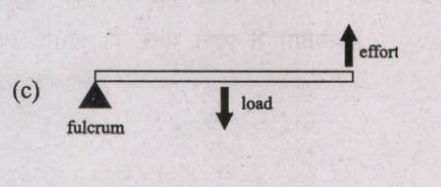
The question requires identifying the sketch that accurately depicts a second-class lever. The defining feature of a second-class lever is the arrangement where the Load is situated between the Fulcrum and the Effort. This configuration is represented as F-L-E.
Detailed Analysis of Option 3
Let's examine the diagram presented in Option 3:
In this sketch:
- The Fulcrum (F) is clearly marked at one end of the lever (left side).
- The Effort (E) is applied at the opposite end of the lever (right side).
- The Load (L), representing the resistance, is positioned in the space between the Fulcrum and the Effort.
This arrangement perfectly matches the definition of a second-class lever (F-L-E).
Comparing with Other Options
The other options represent different lever classes:
- Option 4 shows the Effort applied at one end, the Fulcrum in the middle, and the Load at the other end (E-F-L), which is characteristic of a first-class lever.
- Options 1 and 2 also depict lever systems, but Option 3 is the specific representation identified as correct for a second-class lever.
Therefore, the sketch in Option 3 correctly describes a second-class lever.
Similar Questions
- The energy, E, of a photon can be expressed as E=hf where \(f\) is the frequency and \(h\) is Planck's constant. The dimensions of \(h\) are the same as that of
There is a ball of mass 320 g. It has 625 J potential energy when released freely from a height. The speed with which it will hit the ground is
Important Questions from Work, Power & Energy (D)
- The energy, E, of a photon can be expressed as E=hf where \(f\) is the frequency and \(h\) is Planck's constant. The dimensions of \(h\) are the same as that of
- Assume 'A' does 500 J of work in 'x' minutes and 'B' does 1000 J of work in 20 minutes. If the power delivered by 'A' is \(P_1\) and 'B' is \(P_2\) and \(P_1 = 2P_2\), then 'x', in minutes is:
There is a ball of mass 320 g. It has 625 J potential energy when released freely from a height. The speed with which it will hit the ground is



