
Which one of the following National Parks has a climate that varies from tropical to subtropical, temperate and arctic?
Namdapha National Park
Identifying National Parks with Diverse Climate Zones
The question asks us to identify a National Park in India that experiences a wide range of climate zones, specifically from tropical to subtropical, temperate, and even arctic-like conditions. This kind of climatic diversity is usually linked to a significant variation in altitude within the park.
Analyzing the Options
Let's look at the given options and consider their geographical locations and typical climates:
- Khangchendzonga National Park: Located in Sikkim, this park is in the high Himalayas. Its climate ranges from subtropical to alpine and tundra, reaching very high altitudes near Mount Kangchenjunga.
- Nanda Devi National Park: Situated in Uttarakhand, this park is also in the high altitudes of the Western Himalayas. It primarily experiences an alpine climate.
- Neora Valley National Park: Located in West Bengal, this park is in the Eastern Himalayas but at comparatively lower to moderate altitudes. Its climate is generally subtropical to temperate.
- Namdapha National Park: Located in Arunachal Pradesh in the Eastern Himalayas, this park is known for its significant altitudinal variation, ranging from about 200 meters to over 4,500 meters above sea level.
Why Namdapha National Park Fits the Description
Due to its vast altitudinal range, Namdapha National Park encompasses several distinct climatic zones:
- Tropical and Subtropical: Found in the lower valleys and areas (around 200-800 meters).
- Temperate: Experienced at mid-altitudes (around 800-3500 meters).
- Alpine and near-Arctic: Found at the highest reaches of the park (above 3500-4500 meters and beyond), where temperatures are very low, and conditions can be harsh, similar to arctic environments.
This unique altitudinal spread allows Namdapha National Park to harbour incredible biodiversity across these varied climates.
Comparison of National Parks and Climate Zones
| National Park | Location | Typical Climate Range | Altitudinal Range |
|---|---|---|---|
| Khangchendzonga | Sikkim | Subtropical to Alpine/Tundra | Ranges significantly, but mostly high altitude |
| Nanda Devi | Uttarakhand | Alpine | High altitude valley |
| Neora Valley | West Bengal | Subtropical to Temperate | Lower to moderate altitude |
| Namdapha | Arunachal Pradesh | Tropical to Subtropical, Temperate, Alpine/near-Arctic | Approx. 200m to >4500m |
Based on this comparison and the information about the altitudinal range, Namdapha National Park is the park among the options that most accurately fits the description of having a climate that varies from tropical to subtropical, temperate, and arctic.
Revision Table: Key National Parks & Climate
| National Park | State | Key Climate Feature | Biodiversity Significance |
|---|---|---|---|
| Namdapha National Park | Arunachal Pradesh | Wide range: Tropical to Arctic due to altitude | Biodiversity hotspot, various species |
| Khangchendzonga National Park | Sikkim | Subtropical to Alpine/Tundra | World Heritage Site, unique Himalayan ecosystem |
| Nanda Devi National Park | Uttarakhand | Alpine | World Heritage Site, high altitude flora/fauna |
| Neora Valley National Park | West Bengal | Subtropical to Temperate | Rich in biodiversity, important bird area |
Additional Information: Altitude and Climate Diversity in National Parks
The primary reason a national park can have a climate ranging from tropical to arctic is a significant difference in elevation from its lowest points to its highest peaks. This phenomenon is known as altitudinal zonation.
- As altitude increases, temperature generally decreases. This is why low-lying areas can be tropical or subtropical, while high mountain areas can be alpine or even have conditions similar to arctic regions.
- Factors like latitude, proximity to water bodies, and prevailing winds also influence the specific climate zones present within a park.
- National Parks with large altitudinal variations, like Namdapha, serve as crucial refuges for species adapted to different climates and play a vital role in conservation across multiple ecosystems.
- These diverse climate zones support a wide variety of flora and fauna, making such parks biodiversity hotspots.
Important Questions from National Parks of India
Consider the following pairs:
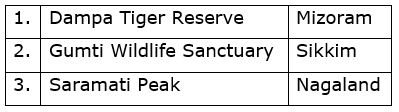
Which of the above pairs is/are correctly matched?
Consider the following pairs:
1. Nokrek Biosphere Reserve Garo Hills
2. Logtak (Loktak) Lake Barail Range
3. Namdapha National Park Dafla Hills
Which of the above pairs is/are correctly matched?
Consider the following pairs:
National Park River flowing through the Park
1. Corbett National Park Ganga
2. Kaziranga National Park Manas
3. Silent Valley National Park Kaveri
Which of the above pairs is/are correctly mached?
Sariska and Ranthambore are the reserves for which of the following
- The Desert National Park is renowned for which endangered bird species?


