
Which one of the following is a representation (not to scale and in bold) of all values of $x$ satisfying the inequality $2 – 5x \le \frac{6x-5}{3}$on the real numberline?
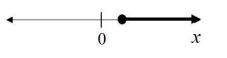
Solving the Inequality $2 – 5x \le \frac{6x-5}{3}$
To find the values of $x$ satisfying the inequality, follow these steps:
-
Start with the given inequality:
$2 – 5x \le \frac{6x-5}{3}$
-
Multiply both sides by 3 to clear the fraction. Since 3 is positive, the inequality direction remains unchanged:
$3(2 – 5x) \le 6x-5$
-
Distribute the 3 on the left side:
$6 – 15x \le 6x-5$
-
Gather the $x$ terms on one side and the constant terms on the other. Add $15x$ to both sides:
$6 \le 6x + 15x - 5$
$6 \le 21x - 5$
-
Add 5 to both sides:
$6 + 5 \le 21x$
$11 \le 21x$
-
Divide both sides by 21. Since 21 is positive, the inequality direction stays the same:
$\frac{11}{21} \le x$
-
Rewrite the inequality in the standard form:
$x \ge \frac{11}{21}$
Number Line Representation
The solution $x \ge \frac{11}{21}$ means $x$ can be any real number greater than or equal to $\frac{11}{21}$.
- On a number line, this is represented by a closed circle (or a bold dot) at $\frac{11}{21}$, indicating that this value is included in the solution set.
- The line segment extends to the right from $\frac{11}{21}$ towards positive infinity, showing all values greater than $\frac{11}{21}$ are included.
This representation matches the one shown in Option 3.
Important Questions from Mathematical Inequalities
- The range of values of x satisfying the inequality $x^2 -3x+2 < 0$ is
Consider the following inequalities.
(i) $3p - q < 4$
(ii) $3q - p < 12$
Which one of the following expressions below satisfies the above two inequalities?Consider the following inequalities
$p^2 - 4q < 4$
$3p + 2q < 6$where $p$ and $q$ are positive integers.
The value of $(p + q)$ is __________
- The number of solutions for the following system of inequalities is
$X_1 \ge 0$
$X_2 \ge 0$
$X_1+ X_2 \le 10$
$2X_1+ 2X_2 \ge 22$ Consider the following inequalities.
(i) $2x - 1 > 7$
(ii) $2x - 9 < 1$
Which one of the following expressions below satisfies the above two inequalities?


