
Question
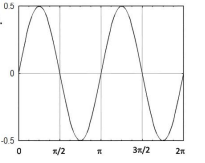
Which one of the following graphs represents $f(x) = \sin x \cos x$?
The correct answer is
Identify the Function
The given function is $f(x) = \sin x \cos x$.
Rewrite the Function using Trigonometric Identity
We can simplify this expression using the double angle identity for sine: $ \sin(2x) = 2 \sin x \cos x $ Rearranging this, we get: $ \sin x \cos x = \frac{1}{2} \sin(2x) $ Therefore, the function can be written as: $ f(x) = \frac{1}{2} \sin(2x) $
Analyze Key Features of $f(x) = \frac{1}{2} \sin(2x)$
- Amplitude: The amplitude is the coefficient of the sine function, which is $\frac{1}{2}$. The graph will oscillate between $-\frac{1}{2}$ and $\frac{1}{2}$.
- Period: The period of $\sin(kx)$ is $\frac{2\pi}{|k|}$. For $f(x) = \frac{1}{2} \sin(2x)$, $k=2$, so the period is $\frac{2\pi}{2} = \pi$. This means the function completes one full cycle over an interval of length $\pi$.
- Zeros: The function equals zero when $\sin(2x) = 0$. This occurs when $2x = n\pi$, where $n$ is an integer. Solving for $x$, we get $x = \frac{n\pi}{2}$. The zeros are located at $..., -\pi, -\frac{\pi}{2}, 0, \frac{\pi}{2}, \pi, ...$.
Compare Features with Graph Option B
Let's examine the graph corresponding to Option B:
- The graph's highest points are at $y = \frac{1}{2}$ and the lowest points are at $y = -\frac{1}{2}$, matching the amplitude of $\frac{1}{2}$.
- One complete cycle of the wave occurs between $x=0$ and $x=\pi$, confirming the period of $\pi$.
- The graph crosses the x-axis at $x=0, \frac{\pi}{2}, \pi$, and subsequent intervals, matching the zeros at $x = \frac{n\pi}{2}$.
Based on these characteristics, the graph in Option B accurately represents the function $f(x) = \sin x \cos x$.
Was this answer helpful?
Important Questions from Trigonometry (Notes)
- If $\tan \frac{20\pi}{21} - \tan \frac{2\pi}{7} + \sqrt{3}\tan \frac{2\pi}{7} \tan \frac{20\pi}{21} = ?$
- A man, standing in an open ground near an airport, notices that a plane flying at a constant height of $100\sqrt{3}$ m took 4 seconds to travel such that the angle of elevation is changed from $60^\circ$ to $30^\circ$ when flying away from him. What is the speed of the plane in m/sec?
- $\tan \frac{20\pi}{21} - \tan \frac{2\pi}{7} + \sqrt{3}\tan \frac{2\pi}{7} \tan \frac{20\pi}{21} = ?$
- For which values of $A$ and $B$ is $\sin A = \cot B$?
- Which of the following best approximates $\sin(0.5^\circ)$?
Need Expert Advice?


