
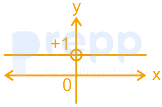
Which one of the following graph represents the function \({\rm{f}}\left( {\rm{x}} \right) = \frac{{\rm{x}}}{{\rm{x}}},{\rm{\;x}} \ne 0?\)
Calculation:
Here, f(x) = y = x/x and x ≠ 0
Now, at y = 1, x ≠ 0
But at x = 0, we get 0/0 (indeterminate form)
So, f(x) = x/x = 1 for all point except x = 0
Hence, option (3) is correct.Similar Questions
A function f: A → R is defined by the equation f(x) = x 2– 4x + 5 where A = (1, 4). What is the range of the function?
The domain of the function \(f\left( x \right) = \sqrt {\left( {2 - x} \right)\left( {x - 3} \right)} \) is
If f(x) \(= \frac{{\sqrt {x - 1} }}{{x - 4}}\) defines a function on R, then what is its domain?
What is the period of the function f(x) = sin x?
What is the domain of the function \(f\left( x \right) = \frac{1}{{\sqrt {\left| x \right| - x} }}?\)
Which one of the following is correct in respect of the graph of \(\rm y = \dfrac{1}{x-1} ?\)
If f : R → S defined by f(x) = 4 sin x – 3 cos x + 1 is onto, then what is S equal to?
The inverse of the function y = 5 In x is
What is the greatest value of the function?
What is the domain of the function?
Important Questions from Domain of a Function
A function f: A → R is defined by the equation f(x) = x 2– 4x + 5 where A = (1, 4). What is the range of the function?
The domain of the function \(f\left( x \right) = \sqrt {\left( {2 - x} \right)\left( {x - 3} \right)} \) is
If f(x) \(= \frac{{\sqrt {x - 1} }}{{x - 4}}\) defines a function on R, then what is its domain?
What is the period of the function f(x) = sin x?
What is the domain of the function \(f\left( x \right) = \frac{1}{{\sqrt {\left| x \right| - x} }}?\)



