
Which one is the correct representation of 4-variable Karnaugh map (K-map)?
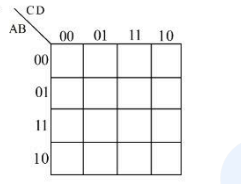
Karnaugh Map Layout for 4 Variables
A Karnaugh map (K-map) is a graphical method used for simplifying Boolean algebra expressions. A 4-variable K-map requires a grid of 16 cells, arranged as a 4x4 matrix.
Key Characteristics:
- The grid represents all 16 possible minterms for four variables (e.g., A, B, C, D).
- Two variables are typically assigned to the rows (e.g., AB) and two to the columns (e.g., CD).
- The labeling of rows and columns must follow the **Gray code sequence** (00, 01, 11, 10). This ensures that adjacent cells, including those at the edges (wrap-around), differ by only one variable.
- This Gray code ordering is essential for the grouping of adjacent cells containing '1's during the minimization process.
The correct representation uses this 4x4 grid structure with the specified Gray code labeling for rows and columns.
Correct Representation:
Important Questions from Karnaugh Maps
The minimized sum of products expression for f(a,b,c,d) = Ʃm(0,1,5,6,7,8,9) with don’t care Ʃm(10,11,12,13,14,15) is ___________.
A problem detector system produces an alarm in the factory when one of the three conditions occurs. The system is designed as such tha only one condition can occur at a time. If the three conditions are defined as q, r, and s respectively, the output logic for the system is given as
The Boolean expression \({\rm{F}}\left( {{\rm{x}},{\rm{y}},{\rm{z}}} \right) = {\rm{\;\bar xy\;\bar z}} + {\rm{\;x\;\bar y\bar z}} + {\rm{\;x\;y\;\bar z}} + {\rm{\;x\;y\;z}}\) is converted into the canonical product of sum (POS) form is
A 3 - input majority gate is defined by the logic function \({\rm{M}}\left( {{\rm{a}},{\rm{b}},{\rm{c}}} \right) = {\rm{\;ab\;}} + {\rm{\;bc\;}} + {\rm{\;ac}}\) . Which one of the following gate is represented by the function \({\rm{M}}\left( {\overline {{\rm{M}}\left( {{\rm{a}},{\rm{b}},{\rm{c}}} \right)} ,{\rm{\;M}}\left( {{\rm{a}},{\rm{b}},\overline {{\rm{c\;}}} } \right),{\rm{c}}} \right)?\)
In the sum of products function f (X, Y, Z) = ∑ (2, 3, 4, 5) , the prime implicants are


