Which of the following triangles are well conditioned and may be suitable for control establishment using triangulation?Triangle Interior Angles I $90^\circ$, $45^\circ$, $45^\circ$ II $130^\circ$, $25^\circ$, $25^\circ$ III $110^\circ$, $35^\circ$, $35^\circ$ IV $110^\circ$, $45^\circ$, $25^\circ$
Criteria for Well-Conditioned Triangles
For establishing control points using triangulation, well-conditioned triangles are essential. These triangles minimize errors in calculations. Generally, triangles are considered well-conditioned if their interior angles avoid extreme values:
- Avoid very small angles (typically less than $25^\circ$ to $30^\circ$). Small angles lead to large uncertainties in side length calculations when angles are measured with limited precision.
- Avoid very large angles (typically greater than $110^\circ$ to $120^\circ$). Large angles can also reduce the geometric strength of the triangulation network.
Angle Analysis for Triangulation Suitability
Let's analyze the angles of each triangle provided:
| Triangle | Interior Angles | Analysis |
|---|---|---|
| I | $90^\circ, 45^\circ, 45^\circ$ | All angles are within the ideal range. This is a well-conditioned triangle. |
| II | $130^\circ, 25^\circ, 25^\circ$ | Includes a very large angle ($130^\circ$) and small angles ($25^\circ$). This is poorly conditioned. |
| III | $110^\circ, 35^\circ, 35^\circ$ | The smallest angle ($35^\circ$) is acceptable. The largest angle ($110^\circ$) is large but often considered usable. This triangle is conditioned. |
| IV | $110^\circ, 45^\circ, 25^\circ$ | Includes a small angle ($25^\circ$). This makes the triangle less suitable compared to one without such acute angles. |
Conclusion on Suitable Triangles
Based on the analysis, Triangles I and III are the most suitable for control establishment using triangulation. They avoid the excessively small angles found in Triangles II and IV, which compromise accuracy.
Important Questions from Triangulation
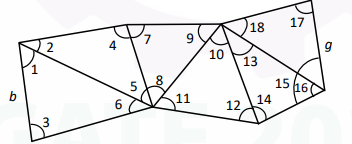
In the triangulation network shown in the figure, $b$ and $g$ are the observed lengths of the baselines, while 1 to 18 are the observed interior angles. The number of redundant observations is __________ (Answer in integer).
- In a triangulation exercise, the horizontal distance between two points P and Q was found to be 12380.56 m. The average elevation along the line PQ was 748.82 m above the reference ellipsoid. The reduced horizontal distance between P and Q over the reference ellipsoid is _______ m (Rounded off to two decimal places).
Consider the radius of Earth to be 6378 km. - Which of the following statements is/are CORRECT?
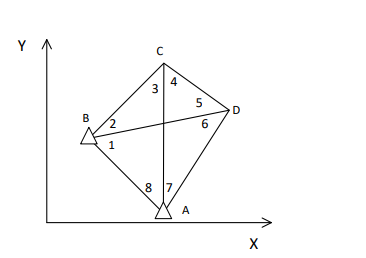
In the following figure, A and B are fixed points with known plane rectangular coordinates. C and D are the new points in the control survey whose coordinates are to be determined. For this network, the surveyor has measured all 8 internal angles (1 to 8) and 5 sides BC, CD, DA, AC and BD. The value of redundancy (r) for the given figure will be equal to ____________ (In integer).