
Accuracy Differences: Triangulation vs Trilateration
The fundamental difference between these surveying methods lies in the measurements emphasized for precision:
- Triangulation primarily relies on the accurate measurement of angles. The positions are calculated using trigonometric principles based on these angles and a known baseline.
- Trilateration depends on the accurate measurement of distances (sides). Positions are determined by measuring the lengths of the sides of the triangles formed by the points.
This directly supports the correctness of the statement: "In triangulation, the angles are measured with greater accuracy, while in trilateration, sides are measured with greater accuracy."
Terrain Suitability: Triangulation vs Trilateration
The practical application of each method is often influenced by the geographical terrain:
- Triangulation is often preferred in hilly or obstructed terrain. Measuring angles is generally more practical than measuring precise distances across challenging landscapes.
- Trilateration is typically more suitable for plain or open terrain. Measuring distances is more straightforward and can be achieved with high accuracy using instruments like EDM or GPS in such areas.
This supports the correctness of the statement: "Triangulation is preferred in hilly areas, whereas trilateration is preferred in plain areas."
Correct Statements Summary
Based on the analysis of measurement accuracy and terrain suitability, the following statements are identified as correct:
- Triangulation is preferred in hilly areas, whereas trilateration is preferred in plain areas.
- In triangulation, the angles are measured with greater accuracy, while in trilateration, sides are measured with greater accuracy.
Important Questions from Triangulation
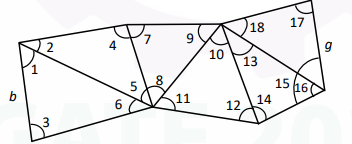
In the triangulation network shown in the figure, $b$ and $g$ are the observed lengths of the baselines, while 1 to 18 are the observed interior angles. The number of redundant observations is __________ (Answer in integer).
- In a triangulation exercise, the horizontal distance between two points P and Q was found to be 12380.56 m. The average elevation along the line PQ was 748.82 m above the reference ellipsoid. The reduced horizontal distance between P and Q over the reference ellipsoid is _______ m (Rounded off to two decimal places).
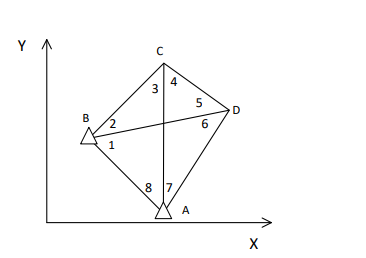
Consider the radius of Earth to be 6378 km. In the following figure, A and B are fixed points with known plane rectangular coordinates. C and D are the new points in the control survey whose coordinates are to be determined. For this network, the surveyor has measured all 8 internal angles (1 to 8) and 5 sides BC, CD, DA, AC and BD. The value of redundancy (r) for the given figure will be equal to ____________ (In integer).
Which of the following triangles are well conditioned and may be suitable for control establishment using triangulation?
Triangle Interior Angles I $90^\circ$, $45^\circ$, $45^\circ$ II $130^\circ$, $25^\circ$, $25^\circ$ III $110^\circ$, $35^\circ$, $35^\circ$ IV $110^\circ$, $45^\circ$, $25^\circ$


