
Which of the following statements are correct? Choose the correct answer from the options given below:
A, C, E only
Understanding the Photoelectric Effect
The photoelectric effect is a phenomenon where electrons are emitted from a material, typically a metal, when light shines on it. These emitted electrons are called photoelectrons. The effect demonstrates the particle nature of light, where light energy is carried in discrete packets called photons.
Several factors influence the photoelectric current, including the intensity and frequency of the incident light, and the potential difference applied between the metal plate (emitter) and the collector plate.
Analyzing the Statements on Saturation Current and Photoemission
Statement A Analysis: Saturation Current vs. Frequency
Statement A says: "The saturation current is constant with collector plate potential for different frequencies of incident radiation."
Let's break this down. For any given frequency of light (above the threshold frequency) and a fixed intensity, as the positive collector plate potential increases, more and more emitted photoelectrons reach the collector, and the current increases. Eventually, a point is reached where all emitted photoelectrons are collected, and the current becomes constant. This constant current is called the saturation current. So, for a fixed frequency, the current becomes constant (saturation current) with increasing potential after a certain point. This part of the statement is true for any frequency above threshold.
The statement also mentions "for different frequencies". This implies comparing the saturation current under different frequencies of incident radiation, while usually keeping the intensity constant for such comparisons. The saturation current is proportional to the number of photoelectrons emitted per second. The number of emitted photoelectrons is proportional to the number of photons incident per second (assuming each photon above threshold can potentially eject an electron), which in turn is proportional to the intensity of the incident light. The energy of individual photons ($\text{h}\nu$) depends on frequency, but the number of photons per second in a beam of given intensity depends on the intensity, not the frequency (although the power is intensity times area, and power is the number of photons per second times the energy per photon, so for constant intensity, a higher frequency means fewer photons per second. However, saturation current depends on the number of *emitted* electrons, which is proportional to the number of *absorbed* photons above threshold. For a constant intensity, the number of incident photons decreases with increasing frequency ($\text{I} \propto \text{N}\nu$). But if the efficiency of electron ejection per photon is constant above threshold, the saturation current proportional to N might seem to decrease with frequency for constant intensity. This interpretation makes A incorrect. Let's revisit the standard graph. The I-V graph shows that for different frequencies at the *same intensity*, the saturation current is indeed the same. This means the number of emitted electrons per second is independent of frequency for a given intensity. This happens because while photon energy increases with frequency, the number of photons per second decreases at constant intensity such that the total number of electrons emitted remains constant. Therefore, statement A is correct in the sense that the saturation current value is constant for different frequencies at the same intensity.
Statement A is correct.
Statement B Analysis: Saturation Current vs. Frequency (Different)
Statement B says: "The saturation current is different with collector plate potential for different frequencies of incident radiation."
This statement is the opposite of statement A. As discussed above, the saturation current value is the same for different frequencies (at constant intensity). Also, the saturation current is constant with potential *after* reaching saturation, regardless of frequency. Therefore, statement B is incorrect.
Statement B is incorrect.
Statement C Analysis: Saturation Current vs. Intensity
Statement C says: "The saturation current is different with collector plate potential for different intensity of incident radiation."
This statement means that the saturation current value changes when the intensity of incident radiation changes. The number of photoelectrons emitted per second is directly proportional to the intensity of the incident radiation (for frequency above threshold). Higher intensity means more photons incident per second, which leads to more photoelectrons being emitted per second. Since saturation current is the maximum rate at which photoelectrons are collected, it is directly proportional to the intensity of light. Thus, for different intensities, the saturation current will be different. It is higher for higher intensity and lower for lower intensity.
Statement C is correct.
Statement D Analysis: Saturation Current vs. Intensity (Constant)
Statement D says: "The saturation current is constant with collector plate potential for different intensity of incident radiation."
This statement is the opposite of statement C. As discussed above, the saturation current value is different for different intensities. It is proportional to intensity. Therefore, statement D is incorrect.
Statement D is incorrect.
Statement E Analysis: Photoemission Below Threshold Frequency
Statement E says: "Below threshold frequency, no photoelectrons are emitted."
This is a fundamental observation of the photoelectric effect. For every metal, there exists a minimum frequency of incident light, called the threshold frequency ($\nu_0$), below which no photoelectrons are emitted, no matter how high the intensity of the light is or how long the light shines. This is because the energy of a single photon ($\text{h}\nu$) must be at least equal to the work function ($\phi_0$) of the metal ($\text{h}\nu_0 = \phi_0$) to eject an electron. If the frequency $\nu$ is less than $\nu_0$, the photon energy $\text{h}\nu$ is less than $\phi_0$, and a single photon does not have enough energy to overcome the binding energy of the electron to the metal lattice. The emission is a single-photon process.
Statement E is correct.
Summary of Statement Correctness
| Statement | Description | Correctness |
|---|---|---|
| A | Saturation current constant for different frequencies (at same intensity) | Correct |
| B | Saturation current different for different frequencies | Incorrect |
| C | Saturation current different for different intensities | Correct |
| D | Saturation current constant for different intensities | Incorrect |
| E | No photoelectrons below threshold frequency | Correct |
Identifying the Correct Option
Based on our analysis, the correct statements are A, C, and E. We need to find the option that lists only these statements.
Option 1: A, B, E only (B is incorrect)
Option 2: A, B, C, D, E only (B and D are incorrect)
Option 3: A, C, E only (A, C, and E are correct)
Option 4: C, D, E only (D is incorrect)
Therefore, the option listing A, C, and E is the correct one.
Revision Table: Photoelectric Effect Concepts
| Concept | Definition/Relation |
|---|---|
| Photoelectric Effect | Emission of electrons from a metal surface when light falls on it. |
| Photoelectron | Electron emitted during the photoelectric effect. |
| Saturation Current | Maximum current achieved when all emitted photoelectrons reach the collector plate. Proportional to intensity. Independent of frequency (above threshold, at constant intensity). |
| Threshold Frequency ($\nu_0$) | Minimum frequency of incident light required to cause photoemission. Depends on the material's work function ($\phi_0$). |
| Work Function ($\phi_0$) | Minimum energy required for an electron to escape from the surface of a metal. $\phi_0 = \text{h}\nu_0$. |
| Stopping Potential ($V_0$) | Minimum negative potential applied to the collector plate required to stop the most energetic photoelectrons from reaching it, reducing the current to zero. Related to maximum kinetic energy: $e V_0 = \text{K}_{\text{max}}$. |
| Intensity of Light | Power of light per unit area. Related to the number of photons per second. |
| Frequency of Light ($\nu$) | Number of oscillations per second. Related to the energy of a photon ($\text{h}\nu$). |
| Collector Plate Potential | Potential difference between the collector plate and the emitter plate. Affects how many emitted electrons reach the collector. |
Additional Information: Deeper Dive into Photoelectric Effect
The photoelectric effect is a crucial experiment that supported the quantum theory of light. Key aspects include:
- The emission of photoelectrons is instantaneous, provided the incident light frequency is above the threshold frequency. There is no time lag, even at very low intensities. This contradicts the wave theory of light, which predicts that electrons should accumulate energy over time and be emitted eventually.
- The kinetic energy of the emitted photoelectrons depends on the frequency of the incident light. As frequency increases (above threshold), the maximum kinetic energy of the photoelectrons increases linearly. This relationship is given by Einstein's photoelectric equation: $\text{h}\nu = \text{K}_{\text{max}} + \phi_0$, where $\text{h}$ is Planck's constant, $\nu$ is the frequency of incident light, $\text{K}_{\text{max}}$ is the maximum kinetic energy of emitted photoelectrons, and $\phi_0$ is the work function of the metal.
- The number of photoelectrons emitted per second (and thus the saturation current) is directly proportional to the intensity of the incident light, provided the frequency is above the threshold frequency. Increasing intensity increases the number of photons, which in turn increases the number of emitted electrons. However, intensity does not affect the maximum kinetic energy of the individual photoelectrons; that is determined by the frequency.
- The existence of a threshold frequency is a direct consequence of the work function. Each photon must have enough energy to overcome the minimum energy required for an electron to escape.
Important Questions from Ray Optics and Optical Instruments
A Convex mirror produces the magnification 1/3 and 1/4 when the object is placed at the points P and Q in front of the mirror.
For insulators and semiconductors, the resistance decreases with an increase in temperature because:
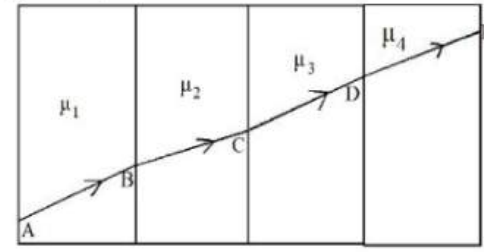
A ray of light passes through four transparent media with refractive index μ1, μ2, μ3, and μ4 as shown in the figure. The surfaces of all media are parallel. If BC and DE are parallel, we must have:
Light of uniform intensity shines perpendicularly on a totally absorbing surface, fully illuminating the surface. If the area of the surface is decreased, what is the effect on radiation pressure?
A ray of light passes through an equilateral glass prism in such a manner that the angle of incidence is equal to the angle of emergence, and each of these angles is equal to (3/4)th of the angle of the prism. The angle of deviation is:


