
A ray of light passes through an equilateral glass prism in such a manner that the angle of incidence is equal to the angle of emergence, and each of these angles is equal to (3/4)th of the angle of the prism. The angle of deviation is:
30°
Calculating Angle of Deviation in a Prism
Understanding how light behaves when it passes through a prism is a fundamental concept in optics. This problem involves calculating the angle of deviation for a ray of light passing through an equilateral glass prism under specific conditions.
Let's break down the given information:
- The prism is an equilateral glass prism. This means all angles of the prism are equal to 60°. So, the angle of the prism, $A = 60^\circ$.
- The angle of incidence ($i$) is equal to the angle of emergence ($e$). This condition is important as it often relates to minimum deviation, although we will use the general formula here.
- Each of these angles ($i$ and $e$) is equal to (3/4)th of the angle of the prism. So, $i = e = \frac{3}{4} A$.
First, let's calculate the value of the angle of incidence ($i$) and the angle of emergence ($e$).
Given $A = 60^\circ$, we have:
$$i = e = \frac{3}{4} \times 60^\circ$$
$$i = e = 3 \times \frac{60^\circ}{4}$$
$$i = e = 3 \times 15^\circ$$
$$i = e = 45^\circ$$
So, the angle of incidence and the angle of emergence are both 45°.
Now, we need to find the angle of deviation ($\delta$). The general formula relating the angle of deviation, angle of incidence, angle of emergence, and angle of the prism is:
$$\delta = i + e - A$$
Substitute the calculated values of $i$, $e$, and $A$ into this formula:
$$\delta = 45^\circ + 45^\circ - 60^\circ$$
$$\delta = 90^\circ - 60^\circ$$
$$\delta = 30^\circ$$
Thus, the angle of deviation is 30°.
Key Concepts for Prism Deviation
Let's recap the key terms used in this problem:
- Angle of Prism ($A$): The angle between the two refracting surfaces of the prism. For an equilateral prism, $A = 60^\circ$.
- Angle of Incidence ($i$): The angle between the incident ray and the normal to the first refracting surface.
- Angle of Refraction at first surface ($r_1$): The angle between the refracted ray inside the prism and the normal to the first surface.
- Angle of Incidence at second surface ($r_2$): The angle between the ray inside the prism and the normal to the second refracting surface.
- Angle of Emergence ($e$): The angle between the emergent ray and the normal to the second refracting surface.
- Angle of Deviation ($\delta$): The angle between the direction of the incident ray and the direction of the emergent ray.
There is also a relationship between the angles inside the prism and the angle of the prism:
$$A = r_1 + r_2$$
And as used above, the angle of deviation is given by:
$$\delta = i + e - A$$
Special Case: Minimum Deviation
The condition where the angle of incidence is equal to the angle of emergence ($i=e$) corresponds to the condition of minimum deviation ($\delta_{min}$). When a prism is at minimum deviation, the ray inside the prism is parallel to the base of the prism, and the angles of refraction are also equal ($r_1 = r_2$).
In our problem, $i=e$, which suggests this is a minimum deviation case. Let's check if $r_1=r_2$. At minimum deviation, $r_1 = r_2 = A/2$. For $A=60^\circ$, $r_1 = r_2 = 60^\circ/2 = 30^\circ$.
We can also use Snell's Law at the first surface: $n_1 \sin(i) = n_2 \sin(r_1)$, where $n_1$ is the refractive index of the medium outside (usually air, $n_1 \approx 1$) and $n_2$ is the refractive index of the prism glass ($n_2$).
Using our calculated values: $i=45^\circ$ and $r_1=30^\circ$ (assuming minimum deviation):
$$1 \times \sin(45^\circ) = n_2 \times \sin(30^\circ)$$
$$\frac{\sqrt{2}}{2} = n_2 \times \frac{1}{2}$$
$$n_2 = \sqrt{2} \approx 1.414$$
This refractive index is reasonable for glass. This confirms that the given conditions ($i=e = \frac{3}{4}A$) indeed correspond to the case of minimum deviation for a glass prism with refractive index $\sqrt{2}$. However, calculating the refractive index was not required to find the angle of deviation, as the formula $\delta = i + e - A$ directly uses the given information.
| Parameter | Symbol | Value (Given/Calculated) |
|---|---|---|
| Angle of Prism | $A$ | $60^\circ$ (Equilateral) |
| Relation $i, e$ to $A$ | $i=e$ | $i = e = \frac{3}{4}A$ |
| Angle of Incidence | $i$ | $45^\circ$ |
| Angle of Emergence | $e$ | $45^\circ$ |
| Angle of Deviation | $\delta$ | $30^\circ$ |
Revision Table: Prism Formulas
| Concept | Formula |
|---|---|
| Angle of Deviation | $\delta = i + e - A$ |
| Relationship of internal angles to Prism Angle | $A = r_1 + r_2$ |
| Snell's Law at first surface | $n_1 \sin i = n_2 \sin r_1$ |
| Snell's Law at second surface | $n_2 \sin r_2 = n_1 \sin e$ |
| Minimum Deviation Condition | $i = e$ and $r_1 = r_2 = A/2$ |
| Angle of Minimum Deviation ($\delta_{min}$) | $\delta_{min} = 2i_{min} - A$ (where $i_{min}$ is angle of incidence at min deviation) |
| Refractive Index ($n_2$) at Minimum Deviation | $n_2 = \frac{\sin((A + \delta_{min})/2)}{\sin(A/2)}$ |
Additional Information on Prism Optics
Prisms are optical elements used to refract light. The amount by which light is deviated depends on several factors:
- The angle of the prism ($A$).
- The material of the prism (its refractive index, $n$). A higher refractive index generally causes more deviation.
- The wavelength of the light (due to dispersion, the refractive index is slightly different for different colors, causing white light to split into its constituent colors). This problem assumes monochromatic light or we are calculating the deviation for a specific color.
- The angle of incidence ($i$). As the angle of incidence changes, the angle of deviation also changes. There is usually a minimum deviation angle for a given prism and wavelength.
The ray diagram for light passing through a prism shows the path of the light ray, bending towards the normal when entering the denser medium (glass) and away from the normal when exiting into the rarer medium (air).
Important Questions from Ray Optics and Optical Instruments
A Convex mirror produces the magnification 1/3 and 1/4 when the object is placed at the points P and Q in front of the mirror.
Which of the following statements are correct?
- A. The saturation current is constant with collector plate potential for different frequencies of incident radiation.
- B. The saturation current is different with collector plate potential for different frequencies of incident radiation.
- C. The saturation current is different with collector plate potential for different intensity of incident radiation.
- D. The saturation current is constant with collector plate potential for different intensity of incident radiation.
- E. Below threshold frequency, no photoelectrons are emitted.
Choose the correct answer from the options given below:
For insulators and semiconductors, the resistance decreases with an increase in temperature because:
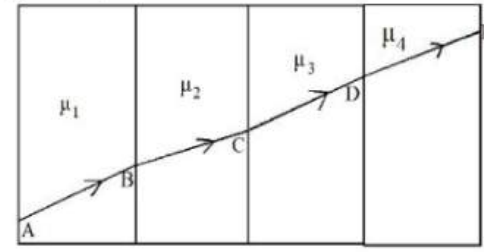
A ray of light passes through four transparent media with refractive index μ1, μ2, μ3, and μ4 as shown in the figure. The surfaces of all media are parallel. If BC and DE are parallel, we must have:
Light of uniform intensity shines perpendicularly on a totally absorbing surface, fully illuminating the surface. If the area of the surface is decreased, what is the effect on radiation pressure?


