
Which of the following is the largest?
$2^{50}, 3^{40}, 4^{30}, 5^{20}$
Comparing Exponential Numbers
To determine the largest number among $2^{50}, 3^{40}, 4^{30}, 5^{20}$, we can simplify the comparison by rewriting each term with a common exponent.
Notice that the exponents (50, 40, 30, 20) share a greatest common divisor of 10. We can rewrite each term using the exponent 10:
- $2^{50} = (2^5)^{10}$
- $3^{40} = (3^4)^{10}$
- $4^{30} = (4^3)^{10}$
- $5^{20} = (5^2)^{10}$
Calculating Bases
Now, calculate the value inside the parentheses (the new base) for each term:
- $2^5 = 32$
- $3^4 = 81$
- $4^3 = 64$
- $5^2 = 25$
So, the original numbers can be expressed as:
- $2^{50} = 32^{10}$
- $3^{40} = 81^{10}$
- $4^{30} = 64^{10}$
- $5^{20} = 25^{10}$
Identifying the Largest Value
Since all terms now have the same exponent (10), the term with the largest base will be the largest number overall.
Comparing the bases:
- $32$
- $81$
- $64$
- $25$
The largest base is $81$. Therefore, the largest number is $81^{10}$, which corresponds to the original term $3^{40}$.
Important Questions from Simplification (Notes)
- In the Delhi zoo, there are some ducks and rabbits. If the heads are counted there are 160, while the legs are 450. What will be number of ducks in the zoo ?
Identify the number that will replace the question mark in the second equation based on the relationship represented in the first equation.
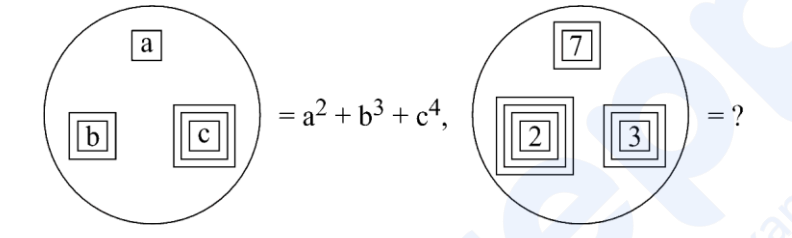
What value should come in the place of question mark (?) in the following equation?
$(0.008\div?) + (0.006 \div 0.03) + (0.008 \div 0.04) =0.5$If 'I' stands for '+', 'J' stands for 'x', 'K' stands for '÷', and 'L' stands for '-', then what will come in place of the question mark (?) in the following equation?
6 K 2 J 4 L 3 I 9 = ?If 'A' stands for '$\div $', 'B' stands for 'x', 'C' stands for '+' and 'D' stands for '-', then what will come in place of the question mark (?) in the following equation?
33 A 3 C 4 B 2 D 4 A 2 = ?


