
If 'I' stands for '+', 'J' stands for 'x', 'K' stands for '÷', and 'L' stands for '-', then what will come in place of the question mark (?) in the following equation?
6 K 2 J 4 L 3 I 9 = ?
Solving the Symbol Substitution Math Puzzle
This problem requires us to substitute given symbols with mathematical operators and then solve the resulting arithmetic expression using the correct order of operations.
1. Understanding the Symbol Mapping
First, let's clearly define the substitution rules provided:
- 'I' represents addition (+)
- 'J' represents multiplication (x)
- 'K' represents division (÷)
- 'L' represents subtraction (-)
2. Substituting Symbols in the Equation
The given equation is: $6 K 2 J 4 L 3 I 9 = ?$
Now, we replace each symbol with its corresponding operator:
- Replace 'K' with '÷'
- Replace 'J' with 'x'
- Replace 'L' with '-'
- Replace 'I' with '+'
The equation becomes: $6 ÷ 2 x 4 - 3 + 9 = ?$
3. Applying the Order of Operations (BODMAS/PEMDAS)
To solve the expression $6 ÷ 2 x 4 - 3 + 9$ correctly, we must follow the order of operations. BODMAS (Brackets, Orders, Division/Multiplication, Addition/Subtraction) or PEMDAS (Parentheses, Exponents, Multiplication/Division, Addition/Subtraction) rule helps us determine the sequence.
According to the rule, we perform Division and Multiplication from left to right, followed by Addition and Subtraction from left to right.
4. Step-by-Step Calculation
- Division: Perform the division first as it appears on the left.
$ 6 \div 2 = 3 $
The expression now is: $3 x 4 - 3 + 9$
- Multiplication: Next, perform the multiplication.
$ 3 \times 4 = 12 $
The expression now is: $12 - 3 + 9$
- Subtraction: Perform the subtraction next, moving from left to right.
$ 12 - 3 = 9 $
The expression now is: $9 + 9$
- Addition: Finally, perform the addition.
$ 9 + 9 = 18 $
5. Final Result
The value that comes in place of the question mark (?) is 18.
Important Questions from Simplification (Notes)
- In the Delhi zoo, there are some ducks and rabbits. If the heads are counted there are 160, while the legs are 450. What will be number of ducks in the zoo ?
Identify the number that will replace the question mark in the second equation based on the relationship represented in the first equation.
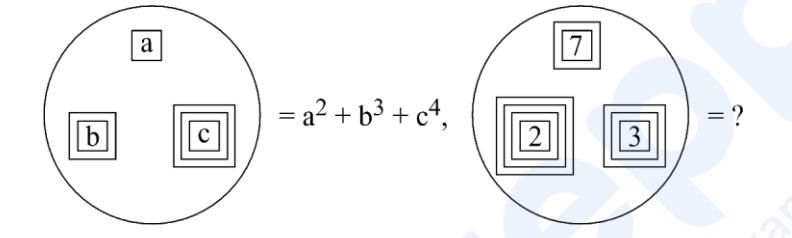
What value should come in the place of question mark (?) in the following equation?
$(0.008\div?) + (0.006 \div 0.03) + (0.008 \div 0.04) =0.5$If 'A' stands for '$\div $', 'B' stands for 'x', 'C' stands for '+' and 'D' stands for '-', then what will come in place of the question mark (?) in the following equation?
33 A 3 C 4 B 2 D 4 A 2 = ?
- Find the value of $\frac{\sqrt{0.01}}{\sqrt{0.0025}}$


