
Which of the following is not the property of β⁻ ray?
It is made of positively charged particles.
Understanding Beta Minus ($\beta^-$) Ray Properties
Beta minus ($\beta^-$) decay is a type of radioactive decay in which a neutron in an atomic nucleus is converted into a proton, and in the process, an electron and an electron antineutrino are emitted. The emitted electron is called a beta particle (specifically, a $\beta^-$ particle or $\beta^-$ ray).
We need to identify the statement that is NOT a property of $\beta^-$ rays by examining each option.
Analyzing Each Property Option of $\beta^-$ Rays
Option 1: Ionising Power
The statement says the ionising power is less than that of $\alpha$-particles. $\alpha$-particles are helium nuclei ($^4_2\text{He}^{2+}$) and are heavy and highly charged. They interact strongly with matter, causing significant ionization. $\beta^-$ particles are electrons, which are much lighter and faster than $\alpha$-particles. They interact less intensely with atoms along their path. Therefore, $\beta^-$ rays cause less ionization per unit path length compared to $\alpha$-particles. This statement is a true property of $\beta^-$ rays.
Option 2: Penetrating Power
The statement says the penetrating power is greater than that of $\alpha$-particles. Because $\beta^-$ particles are lighter and faster, they lose energy more slowly than $\alpha$-particles. This allows them to travel further into materials before being stopped. While $\alpha$-particles can be stopped by a sheet of paper or a few centimeters of air, $\beta^-$ particles can penetrate a few millimeters of aluminum. Thus, their penetrating power is indeed greater than $\alpha$-particles. This statement is a true property of $\beta^-$ rays.
Option 3: Composition (Charged Particles)
The statement says it is made of positively charged particles. As explained earlier, $\beta^-$ decay results in the emission of an electron. Electrons are fundamental particles that carry a negative electric charge, equal to $-1e$. Therefore, $\beta^-$ rays are composed of negatively charged particles, not positively charged particles. This statement is NOT a true property of $\beta^-$ rays.
Note: There is also beta plus ($\beta^+$) decay, where a proton converts to a neutron, emitting a positron (the antiparticle of the electron, which is positively charged) and an electron neutrino. However, the question specifically refers to "$\beta^-$ ray", indicating beta minus decay particles.
Option 4: Deflection in Fields
The statement says it is deflected by an electric as well as by a magnetic field. Since $\beta^-$ particles are negatively charged electrons, they experience a force when moving through electric or magnetic fields. This force causes them to change direction, or deflect. The direction of deflection depends on the charge of the particle and the direction of the field. Positively charged particles ($\alpha$-particles, or $\beta^+$ particles/positrons) would deflect in the opposite direction compared to $\beta^-$ particles in the same field. Because $\beta^-$ particles are charged, they are indeed deflected by both electric and magnetic fields. This statement is a true property of $\beta^-$ rays.
Summary of Beta Ray Properties
Let's summarize the properties discussed:
- Ionising power: Less than $\alpha$. (True for $\beta^-$)
- Penetrating power: Greater than $\alpha$. (True for $\beta^-$)
- Composition: Made of negatively charged electrons. (False for statement claiming positive charge)
- Deflection in fields: Deflected by electric and magnetic fields. (True for $\beta^-$)
Identifying the Incorrect Property
Based on our analysis, the statement that is NOT a property of $\beta^-$ rays is that it is made of positively charged particles. $\beta^-$ rays are made of negatively charged electrons.
| Property | $\alpha$-particle | $\beta^-$-particle | $\gamma$-ray |
|---|---|---|---|
| Composition | Helium nucleus ($^4_2\text{He}^{2+}$) | Electron ($e^-$ or $\beta^-$) | Electromagnetic radiation (photon) |
| Charge | $+2e$ (positive) | $-1e$ (negative) | Neutral (0) |
| Mass | Relatively large | Very small ($\approx 1/7300$ of $\alpha$ mass) | Zero |
| Ionising Power | Highest | Moderate (less than $\alpha$) | Lowest |
| Penetrating Power | Lowest (stopped by paper) | Moderate (stopped by $\approx$ mm Al) | Highest (stopped by thick Pb/concrete) |
| Deflection in Fields | Yes (towards negative plate in E field) | Yes (towards positive plate in E field) | No |
Revision Table: Radioactive Decay Properties
This table reinforces the key characteristics of different types of radiation from radioactive decay, which is useful for exam preparation.
| Radiation Type | Nature | Charge | Penetrating Power | Ionizing Power |
|---|---|---|---|---|
| $\alpha$ | Particle (Helium nucleus) | $+2$ | Low | High |
| $\beta^-$ | Particle (Electron) | $-1$ | Medium | Medium (Lower than $\alpha$) |
| $\gamma$ | Wave (Photon) | $0$ | High | Low |
Additional Information: Beta Decay Process
Beta decay is a fundamental process in nuclear physics where an unstable nucleus transforms into a more stable one. There are two main types of beta decay:
- Beta Minus ($\beta^-$) Decay: Occurs in neutron-rich nuclei. A neutron ($n$) transforms into a proton ($p$), an electron ($e^-$ or $\beta^-$), and an electron antineutrino ($\bar{\nu}_e$). The electron and antineutrino are emitted from the nucleus. The atomic number increases by one, while the mass number remains the same. Example: $^{14}_6\text{C} \rightarrow ^{14}_7\text{N} + e^- + \bar{\nu}_e$.
- Beta Plus ($\beta^+$) Decay: Occurs in proton-rich nuclei. A proton ($p$) transforms into a neutron ($n$), a positron ($e^+$ or $\beta^+$), and an electron neutrino ($\nu_e$). The positron and neutrino are emitted. The atomic number decreases by one, while the mass number remains the same. Example: $^{11}_6\text{C} \rightarrow ^{11}_5\text{B} + e^+ + \nu_e$.
Gamma ($\gamma$) rays are high-energy photons emitted by an atomic nucleus when it transitions from an excited state to a lower energy state, often following alpha or beta decay. Unlike alpha and beta radiation, gamma rays are electromagnetic waves, not particles, and carry no charge.
Important Questions from Dual Nature of Radiation and Matter
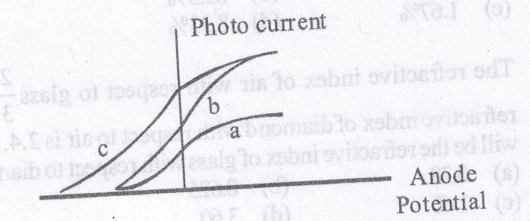
The figure shows the variation of photo current with anode potential for a photo-sensitive surface for three different radiations. Let \( I_a \), \( I_b \), and \( I_c \) be the intensities, and \( y_a \), \( y_b \), and \( y_c \) be the frequencies for the curves a, b, and c, respectively. Choose the correct statement.
The wavelength of light from the spectral emission line of sodium is 662 nm. The kinetic energy at which an electron would have the same de Broglie wavelength would be: (h=6.62×10⁻³⁴J⋅s,me=9×10⁻³¹kg)
Energy of a photon corresponding to a wavelength of 600 nm is 2.08 eV. The energy of a photon of wavelength 400 nm will be:
A particle moves three times as fast as an electron. The ratio of the de Broglie wavelength of the particle to that of the electron is 1.813 × 10⁻⁴. The mass of the particle is:
According to Einstein’s photoelectric equation, the plot of the Kinetic Energy of the emitted photoelectrons from a metal versus the frequency of the incident radiation gives a straight line whose slope:


