
The figure shows the variation of photo current with anode potential for a photo-sensitive surface for three different radiations. Let \( I_a \), \( I_b \), and \( I_c \) be the intensities, and \( y_a \), \( y_b \), and \( y_c \) be the frequencies for the curves a, b, and c, respectively. Choose the correct statement.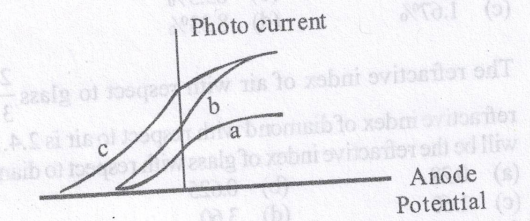
y_a = y_b; I_b = I_c
Photoelectric current is proportional to intensity, while the stopping potential depends on frequency. Since curves a and b have the same stopping potential, their frequencies are equal (\( y_a = y_b \)). Additionally, the saturation current for curves b and c is the same, meaning \( I_b = I_c \).
Important Questions from Dual Nature of Radiation and Matter
The work function for an Aluminium surface is 4.2 eV. Find the threshold wavelength for the photoelectric emission.
A potentiometer wire of length L and a resistance r are connected in series with a battery of emf E0 and a resistance r1. An unknown emf E is balanced at a length l of the potentiometer wire. The emf E will be:
The time taken by light to travel normally through a glass plate of thickness 1 mm would be:
(Take refractive index of glass = 1.5)
Energy of a photon corresponding to a wavelength of 600 nm is 2.08 eV. The energy of a photon of wavelength 400 nm will be:
A particle moves three times as fast as an electron. The ratio of the de Broglie wavelength of the particle to that of the electron is 1.813 × 10⁻⁴. The mass of the particle is:


