
Reinforced Concrete Bond Resistance Mechanisms
The bond resistance in reinforced concrete is crucial for ensuring that reinforcing steel bars (rebar) and the surrounding concrete act together effectively. It prevents slippage between the rebar and concrete under load.
Identifying Bond Resistance Mechanisms
Several mechanisms contribute to the bond between reinforcing steel and concrete:
- Chemical Adhesion: An initial bond formed by the chemical interaction between the cement paste surface and the steel surface.
- Friction: Resistance to sliding generated by the roughness of the steel surface and the pressure exerted by the surrounding concrete onto the bar.
- Mechanical Interlock: Primarily occurs with deformed bars (rebar with ribs). The concrete bears against the deformations (ribs) on the steel surface, creating a strong physical grip that resists pull-out.
Distinguishing Aggregate Interlock
Aggregate interlock is a mechanism related to the shear strength of cracked concrete. It describes how aggregate particles on opposite sides of a crack engage with each other, transferring shear forces across the crack face. This mechanism is significant for the overall structural integrity of cracked concrete elements but is not considered a primary mechanism responsible for the bond between the steel reinforcement and the concrete matrix itself.
Therefore, aggregate interlock is not a direct mechanism of bond resistance between steel and concrete.
The mechanism that is NOT a primary mechanism of bond resistance in reinforced concrete among the given options is Aggregate interlock.
Important Questions from Design of Structural Elements
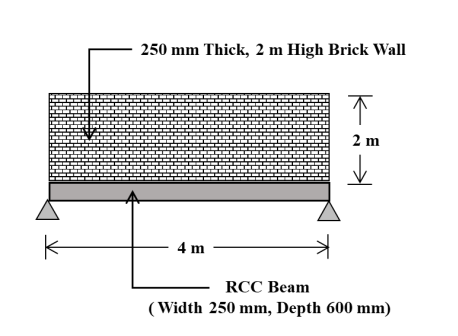
A simply supported RCC beam of span 4 m is supporting a brick wall over its entire span. The brick wall is 250 mm thick and 2 m high. The RCC beam has a depth of 600 mm and width of 250 mm. The density of brick masonry and RCC can be assumed as 18 KN/m³ and 25 KN/m³ respectively. Considering the load of the wall and self-weight of the RCC beam, the maximum bending moment in the beam (in KN-m) will be ____________ [rounded off to two decimal places].
A simply supported beam having effective span of 5 meter is carrying a centrally concentrated load of 16 kN. The maximum bending moment in the beam in kN-m is _______________
Area of tensile steel per meter width of a reinforced concrete slab is 335 sq mm. If 8 mm rods are used as reinforcement, then centre to centre spacing of the reinforcement in mm is _______________
- The maximum bending moment ($kNm$) in a simply supported beam of 8 $m$ span subjected to a uniformly distributed load of 20 $kN/m$ (inclusive of its self-weight) over the entire span is
A single span simply supported reinforced concrete beam ($250 \text{ mm}$ wide and $480 \text{ mm}$ effective depth) is subjected to a concentrated load of $120 \text{ kN}$ at its mid-span. Neglecting self-weight of the beam, the nominal shear stress (MPa) at the support section is __________


