
Which of the following is correct about first and second derivatives at points P, Q and R for $f(x) = \sin(x)$ shown below?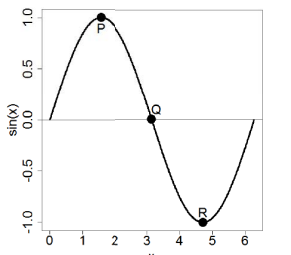
$ \frac{d^2f}{dx^2}|_P < 0; \frac{d^2f}{dx^2}|_Q = 0; \frac{d^2f}{dx^2}|_R > 0$
To solve this problem, we need to analyze the behavior of the first and second derivatives of the function \(f(x) = \sin(x)\) at the points P, Q, and R in the given plot.
Let's break down the problem step by step:
- Consider the first and second derivatives of \(f(x) = \sin(x)\):
- The first derivative is \(\frac{df}{dx} = \cos(x)\).
- The second derivative is \(\frac{d^2f}{dx^2} = -\sin(x)\).
- Evaluate the derivatives at point P (maximum point):
- At a maximum point, the first derivative \(\frac{df}{dx} = 0\) (since the slope is horizontal).
- The second derivative is negative, \(\frac{d^2f}{dx^2} < 0\), indicating a local maximum. This is consistent with option (C).
- Evaluate the derivatives at point Q (inflection point):
- At point Q, the second derivative \(\frac{d^2f}{dx^2} = -\sin(x) = 0\), indicating an inflection point where the concavity changes. This matches option (C).
- Evaluate the derivatives at point R (minimum point):
- At a minimum point, the first derivative \(\frac{df}{dx} = 0\) (slope is again horizontal).
- The second derivative is positive, \(\frac{d^2f}{dx^2} > 0\), indicating a local minimum. This aligns with option (C).
Based on the analysis above, we conclude that the correct answer is option (C), which states:
\(\frac{d^2f}{dx^2}|_P < 0; \frac{d^2f}{dx^2}|_Q = 0; \frac{d^2f}{dx^2}|_R > 0\)
Important Questions from Calculus
The ratio of volume to surface area of solid semi sphere is related to its radius through
The value of \(\int^2_0\int^x_0y\ dy\ dx\)
Find the slope of normal to the curve y = x2 + 7x at (1, 8).
Find the equation of normal to the curve y = 4x - 3x2 at (2, -4).
- \(\mathop {\lim }\limits_{\theta \to \frac{\pi }{2}} \frac{{\log \left( {\theta - \frac{\pi }{2}} \right)}}{{\tan \theta }}\)


