
Natural Selection Conditions Explained
Evolution by natural selection requires specific conditions to occur. Let's break down the necessary components:
- Variation: Individuals within a population must exhibit differences in their traits. Without variation, there's nothing for selection to act upon.
- Heritability: The traits that vary must be heritable, meaning they can be passed down genetically from parents to offspring.
- Differential Fitness: Individuals with certain heritable traits must have a higher survival rate or reproductive success (fitness) compared to those with other variations of the trait. This is the core of "selection".
Analyzing the Options
Based on the principles above, let's evaluate the given options:
- 1. Variation in a trait: This is essential. Natural selection cannot operate without variation.
- 2. Heritability of the trait: This is also essential. If traits aren't passed on, advantageous variations won't accumulate over generations.
- 4. Differential fitness related to the trait: Crucial. This differential success is what drives changes in trait frequency within the population.
- 3. Change in the environment: While environmental changes often create new selective pressures and drive significant evolutionary shifts, they are NOT strictly necessary for natural selection to occur. Natural selection can operate even in a stable environment, favoring traits that provide even a slight advantage or disfavoring those with disadvantages. The process acts on the *current* relationship between traits and fitness in the *existing* environment.
Therefore, a change in the environment is not a mandatory condition for the mechanism of natural selection itself to function.
Important Questions from Natural selection
- Which one or more of the following is/are NOT essential for evolution by natural selection to take place in a population?
- Two bacterial variants are growing together in the same flask. At any relative frequency of the two variants, the population growth rate of the rarer variant is higher. The above is an example of ________.
There are two species, X and Y, with abundances $x$ and $y$, respectively. Species X has growth rate $\alpha$, and species Y has growth rate $\beta$. Assume that the sum of the species abundances is constant over time, i.e., $x + y = 1$. Let $x$ and $y$ follow the rate equations:
$$\frac{dx}{dt} = \alpha x - \varphi x,$$
$$\frac{dy}{dt} = \beta y - \varphi y,$$ where $\varphi$ is the average species fitness.
Which one of the following options correctly represents the expression for $\varphi$?The figure illustrates the soil zinc tolerance of the grass species Anthoxanthum along a transect from inside a mine to the middle of a pasture outside the mine.
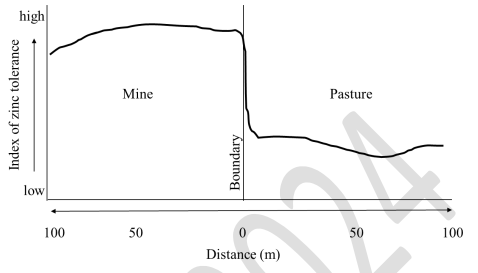
Which one or more of the following processes explain(s) the observed pattern of zinc tolerance in this grass species?From an original population \(P\) of a butterfly species, two experimental populations \(X\) and \(Y\) were established. In \(X\), males and females were maintained in standard conditions, and females were allowed to mate and lay eggs. Only eggs from females laying small clutches (i.e., \(S\) eggs or fewer) were allowed to hatch and the rest were not utilized. In \(Y\), males and females were maintained in standard conditions and females were allowed to mate and lay eggs. From each female, \(S\) eggs were randomly selected and allowed to hatch, and the rest were not utilized. After 20 generations of these experimental conditions, relative to the original population \(P\), and assuming that clutch size is under genetic control, we expect clutch size to be ______________________in \(X\) and ___________________ in \(Y\).


