Fourier Series Expansion Analysis
A Fourier series represents a periodic signal as a sum of sinusoidal components at integer multiples of a fundamental frequency. The general form is:
$x(t) = a_0 + \sum_{n=1}^{\infty} [a_n \cos(n \omega_0 t) + b_n \sin(n \omega_0 t)]$
For a function to be a valid Fourier series expansion, all the sinusoidal frequencies present must be integer multiples of a single fundamental frequency, $\omega_0$. This means if the signal contains frequencies $f_1, f_2, ..., f_k$, then there must exist a fundamental frequency $\omega_0$ such that each $f_i = n_i \omega_0$ for some integer $n_i$. Consequently, the ratio of any two frequencies present in the series must be a rational number ($\frac{f_i}{f_j} = \frac{n_i}{n_j}$).
Evaluating Option B
The question asks which signal *cannot* be represented by a Fourier series. Let's examine Option B:
Option B: $x(t) = 2 cos $\pi$t + 7 cos t$
This expression contains two cosine terms with frequencies:
- $f_1 = \pi$ rad/s
- $f_2 = 1$ rad/s
For this to be a valid Fourier series, there must exist a fundamental frequency $\omega_0$ such that:
- $\pi = n_1 \omega_0$
- $1 = n_2 \omega_0$
where $n_1$ and $n_2$ are integers.
Dividing the first equation by the second gives:
$\frac{\pi}{1} = \frac{n_1 \omega_0}{n_2 \omega_0} \implies \pi = \frac{n_1}{n_2}$
Since $\pi$ is an irrational number, it cannot be expressed as the ratio of two integers ($\frac{n_1}{n_2}$). Therefore, these two frequencies ($\pi$ and 1) cannot originate from a single fundamental frequency $\omega_0$. This signal cannot be represented by a Fourier series.
Analyzing Other Options
Let's briefly check why the other options *can* be valid Fourier series expansions:
- Option 1: $x(t) = 2 cos t + 3 cos 3t$. Frequencies are 1 and 3. Ratio $\frac{3}{1} = 3$ (rational). We can choose $\omega_0 = 1$.
- Option 3: $x(t) = cos t + 0.5$. Frequencies are 1 and 0 (DC component). Ratio $\frac{1}{0}$ is undefined, but this is allowed. We can choose $\omega_0 = 1$.
- Option 4: $x(t) = 2 cos 1.5 $\pi$t + sin 3.5 $\pi$t$. Frequencies are $1.5\pi$ and $3.5\pi$. Ratio $\frac{3.5\pi}{1.5\pi} = \frac{3.5}{1.5} = \frac{7}{3}$ (rational). We can choose $\omega_0 = 0.5\pi$ ($n_1=3, n_2=7$).
Final Conclusion
Option B is the only expression where the frequencies ($\pi$ and 1) have an irrational ratio, preventing representation by a common fundamental frequency. Hence, it cannot be a Fourier series expansion.
Important Questions from Properties of Fourier Series - Teaching
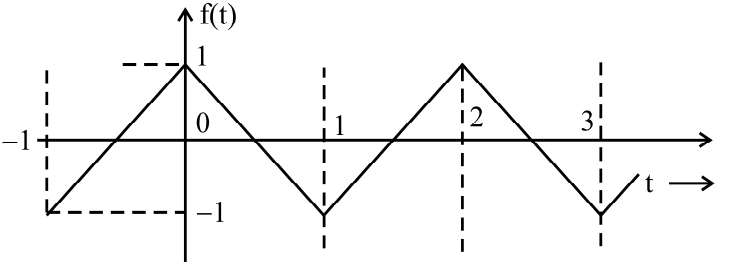
The fourier series of the following figure is