
The fourier series of the following figure is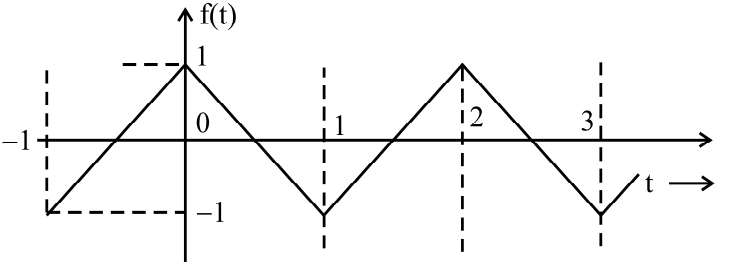
To determine the Fourier series of the given periodic signal, we need to identify its characteristics and follow the appropriate Fourier analysis approach.
First, observe the given waveform:
The signal shown appears to be a triangular wave, which is symmetric around the x-axis and has a period of 2 units.
The general Fourier series for a function \( f(t) \) with period \( T \) can be represented as:
\(f(t) = \frac{a_0}{2} + \sum_{n=1}^{\infty} [a_n \cos(n \omega_0 t) + b_n \sin(n \omega_0 t)]\)
Where:
- \( \omega_0 = \frac{2\pi}{T} \) is the fundamental angular frequency.
- \( a_0, a_n, \) and \( b_n \) are the Fourier coefficients determined by:
- \( a_0 = \frac{2}{T} \int_{0}^{T} f(t) \, dt \)
- \( a_n = \frac{2}{T} \int_{0}^{T} f(t) \cos(n \omega_0 t) \, dt \)
- \( b_n = \frac{2}{T} \int_{0}^{T} f(t) \sin(n \omega_0 t) \, dt \)
For an odd function (which this triangular wave is), the cosine terms (\( a_n \)) will be zero, leaving only sine terms. Due to symmetry properties, only odd harmonics will be present.
The series is determined by evaluating these integrals. For a triangular wave, the Fourier series becomes:
\(f(t) = \frac{8}{\pi^2} \left[ \cos(\pi t) - \frac{1}{9}\sin(3\pi t) + \frac{1}{25}\cos(5\pi t) + \dots \right]\)
This matches with the given correct answer:
\(\frac{8}{\pi^2} \left[ \cos(\pi t) - \frac{1}{9}\sin(3\pi t) + \frac{1}{25}\cos(5\pi t) + \dots \right]\)
Thus, the Fourier series representation is correctly identified based on the option provided.
Important Questions from Properties of Fourier Series - Teaching
- Which of the following cannot be the Fourier series expansion of a periodic signal ?


