
When the voltage across a battery is measured using a d.c. potentiometer, the reading shows 1.08 V. But when the same voltage is measured using a Permanent Magnet Moving Coil (PMMC) voltmeter, the voltmeter reading shows 0.99 V. If the resistance of the voltmeter is 1100 Ω, the internal resistance of the battery, in Ω, is _________.
Given that, battery reading while measured by using potentiometer = 1.08 V
Open circuit voltage (Voc) = 1.08 V
Reading while measured by using voltmeter = 0.99 V
Resistance of voltmeter = 1100 Ω (Rm)
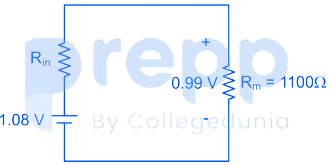
By using voltage division
\(0.99 = 1.08\left( {\frac{{{R_m}}}{{{R_{in}} + {R_m}}}} \right)\)
\(\Rightarrow 0.99 = 1.08 = \left( {\frac{{1100}}{{{R_{in}} + 1000}}} \right)\)
\(\Rightarrow \frac{{11}}{{12}} = \frac{{1100}}{{{R_{in}} + 1100}}\)
⇒ Rin = 100 ΩImportant Questions from PMMC Instrument
Which of the following types of damping is used in a permanent magnet moving coil instrument?
- Which meter has the highest accuracy?
- Which of the following is NOT a valid advantage of PMMC instruments?
Where are MC type instruments used?
Which of the following materials is preferred for permanent magnet mostly used in instruments?


