
A periodic voltage waveform observed on an oscilloscope across a load is shown. A permanent magnet moving coil (PMMC) meter connected across the same load reads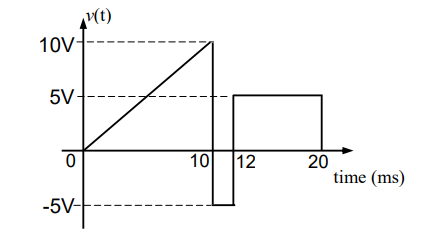
To solve this problem, we need to determine what a Permanent Magnet Moving Coil (PMMC) meter reads when connected across a load with the given waveform. A PMMC meter is a type of analog electromechanical instrument that measures the average value of the input voltage.
The waveform shown is a periodic waveform consisting of a rise from 0 V to 10 V over 10 ms, a drop from 10 V to -5 V for 2 ms, and then a steady value at 5 V for the next 8 ms.
PMMC meters read the average value of DC components. Thus, we need to calculate the average voltage over one complete cycle (20 ms).
Calculation of the Average Voltage:
- From 0 ms to 10 ms: The voltage linearly rises from 0 V to 10 V. This forms a triangle with a base of 10 ms and a height of 10 V. \text{Average voltage from 0 to 10 ms} = \frac{1}{2} \cdot 10 \text{ V} = 5 \text{ V}.
- From 10 ms to 12 ms: The voltage instantaneously drops from 10 V to -5 V, maintaining -5 V for 2 ms. \text{Average voltage from 10 to 12 ms} = -5 \text{ V}.
- From 12 ms to 20 ms: The voltage is constant at 5 V. \text{Average voltage from 12 to 20 ms} = 5 \text{ V}.
Now, calculate the overall average voltage for the full 20 ms cycle:
\text{V}_{\text{avg}} = \frac{1}{20}\left((5 \times 10) + (-5 \times 2) + (5 \times 8)\right)
\text{V}_{\text{avg}} = \frac{1}{20} \times (50 - 10 + 40)
\text{V}_{\text{avg}} = \frac{80}{20} = 4 \text{ V}
Conclusion: The reading on the PMMC meter will be 4 V, as it measures the average value of the voltage over one complete cycle.
Important Questions from PMMC Instrument
Which of the following types of damping is used in a permanent magnet moving coil instrument?
- Which meter has the highest accuracy?
- Which of the following is NOT a valid advantage of PMMC instruments?
Where are MC type instruments used?
Which of the following materials is preferred for permanent magnet mostly used in instruments?


