
When light is reflected from an optically rarer medium
both its phase and frequency remain unchanged
Frequency is set by the source and never changes on reflection or refraction, so any statement with a frequency increase or decrease is false.
A phase change of \(\pi\) occurs only when light travelling in a rarer medium is reflected from a denser medium. A phase change of \(\pi/2\) does not occur on simple reflection.
When light is reflected from an optically rarer medium (light in the denser medium meeting a rarer one), there is no phase change.
So both the phase and the frequency remain unchanged.
Hence, the answer is both its phase and frequency remain unchanged.
Similar Questions
A particle of mass 40 g executes simple harmonic motion of amplitude 2.0 cm. If the time period of oscillation is \(\pi/20\) s, then the total mechanical energy of the system is :
A string of length L is fixed at both ends and vibrates in its fundamental mode. If the speed of waves on the string is v, then the angular wave number of the standing wave is:
Ratio between the frequencies of the third harmonics in the closed organ pipe and open organ pipe of same length is
A tuning fork vibrating at 300 Hz, initially in air, is then placed in a trough of water. The ratio of the wavelength of the sound waves produced in air to that in water is (Given that the velocity of sound in water and in air at that place are \(1500\ \mathrm{ms^{-1}}\) and \(350\ \mathrm{ms^{-1}}\) respectively)
A particle is executing linear simple harmonic oscillation with an amplitude of A. If the total energy of oscillation is \(E\), then its kinetic energy at a distance of 0.707 A from the mean position is
The equation of a stationary wave is given by
\(y = 5\sin\frac{\pi x}{2}\cos 10\pi t\ \ \mathrm{cm}\)
The distance between two consecutive nodes (in cm) is
The graph drawn between the velocity of sound in a gas and pressure of the gas at a given temperature is
Which one of the following motions is not simple harmonic motion?
For a particle executing simple harmonic motion with amplitude \(A\) and time period \(T\) along \(x\)-axis, the time taken by the particle to move from \(x=0\) to \(x=A\) is
With Laplace correction in Newton's formula for the velocity of sound in gases, the velocity of sound in monoatomic gas at STP is
Important Questions from Oscillations and Waves
- Two tuning forks $A$ and $B$ are sounded together giving rise to $8$ beats in $2\text{ s}$. When fork $A$ is loaded with wax, the beat frequency is reduced to $4$ beats in $2\text{ s}$. If the original frequency of tuning fork $B$ is $380\text{ Hz}$ then original frequency of tuning fork $A$ is _________ $\text{Hz}$.
- 5 beats/second are heard when a turning fork is sounded with a sonometer wire under tension, when the length of the sonometer wire is either 0.95 m or 1 m. The frequency of the fork will be
The angle between the particle velocity and wave velocity in a transverse wave is [except when the particle passes through the mean position]
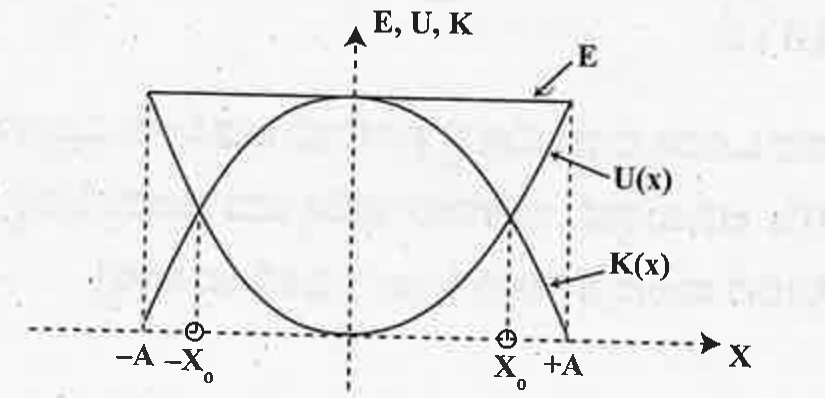
The variations of kinetic energy K(x), potential energy U(x) and total energy as a function of displacement of a particle in SHM is as shown in the figure. The value of |x0| is
A source of frequency ν gives 6 beats/second when sounded with a source of frequency 200 Hz. The second Harmonic of frequency 2 ν of the source gives 8 beats/second when sounded with a source of frequency 420 Hz. The value of ν is


