
What is the minimum number of moves required to transform figure 1 to figure 2? A move is defined as removing a coin and placing it such that it touches two other coins in its new position.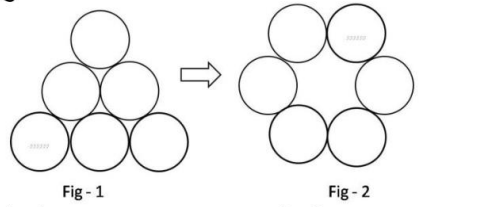
To solve this problem, we need to determine the minimum number of moves required to transform Figure 1 into Figure 2. A single move is defined as removing a coin and placing it such that it touches two other coins in its new position.
Let's analyze both figures:
- Figure 1 is a triangular arrangement with 6 coins.
- Figure 2 is a circular arrangement with 6 coins.
To achieve the transition from Figure 1 to Figure 2:
- Move 1: Take the topmost coin from Figure 1 and place it in a position such that it touches the coins at the base of Figure 2. This will start forming the circular shape.
- Move 2: Now, take one of the bottom coins from the triangular base in Figure 1 and place it on the opposite side of the previously moved coin. This completes the circular configuration required for Figure 2.
Thus, by making just 2 moves, we can transform Figure 1 into Figure 2.
Conclusion: The minimum number of moves required is \(2\).
Important Questions from Puzzle (Notes)
- Seven boxes S, F, G, H, T and U are kept one over the other but not necessarily in the same order. Only two boxes are kept below S. Only one box is kept above U. Only one box is kept between U and B. G is kept immediately above F. T is kept at some place below H.
How many boxes are kept between H and G? - Seven boxes E, F, G, H, S, T and U are kept one over the other but not necessarily in the same order. H is kept immediately above E. T is kept immediately above U. Only F is kept above S. Only two boxes are kept above H. T is not kept at third position from the bottom.
How many boxes are kept between G and F? - Seven boxes E, F, G, H, S, T and U are kept one over the other but not necessarily in the same order. Only H is kept above E. Only T is kept between E and S. Only F is kept below U.
How many boxes are kept between G and F? Seven boxes E, F, G, H, S, T and U are kept one over the other but not necessarily in the same order. Only four boxes are kept between H and E. Only S is kept above H. Only two boxes are kept between F and U. T is kept immediately above G. U is not kept immediately above T. Which box is kept fourth from the top?
- Seven boxes E, F, G, H, S, T and U are kept one over the other but not necessarily in the same order. Only H is kept above E. Only T is kept between E and S. Only F is kept below U.
How many boxes are kept between G and F?


