Two tiles are missing in Panel I. Which one of the options in Panel II is the appropriate choice for the missing tiles?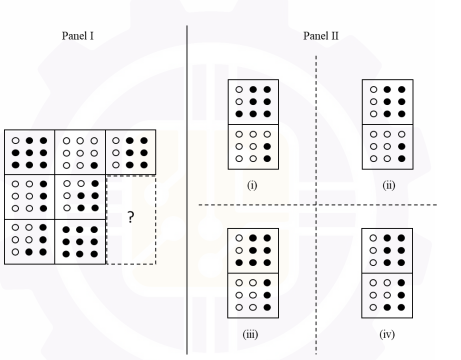
To solve the spatial aptitude problem, let's analyze the pattern in Panel I and determine which option from Panel II fits as the missing tile. We will follow these steps:
- Observe the arrangement and pattern of dots in each tile of Panel I.
- Identify any consistent patterns or sequences across the rows or columns.
- Match the identified pattern to one of the options provided in Panel II.
Let's start with an observation:
In Panel I, rows and columns display a certain symmetry or transformation. Observing the top and bottom rows:
- The first tile in both rows has nine filled dots.
- The second tile in both rows has nine empty dots.
The pattern alternates between all filled and all empty tiles. The third column tiles suggest a similar filling pattern starting at the bottom, implying that the missing tile should be one that completes this symmetrical pattern.
Matching this understanding with the options in Panel II, we observe:
- Option (i): Matches the alternating pattern with dots filled and empty, fitting perfectly into the sequence.
- Options (ii), (iii), and (iv): Do not maintain the alternating symmetrical pattern derived from the rest of the tiles in Panel I.
Thus, the correct missing tile is Option (i), which completes the sequence accurately.
In conclusion, the appropriate choice for the missing tiles is Option (i), as it aligns with the pattern established in Panel I.
Important Questions from Shape Completion
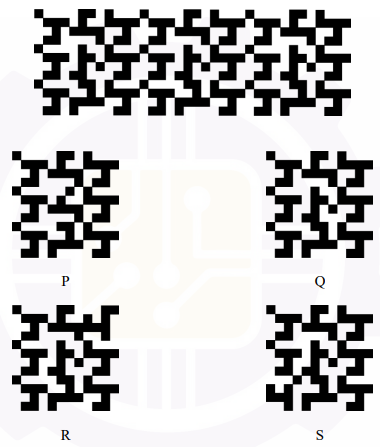
Which one of the patterns labelled P, Q, R, and S is used to generate the following figure?
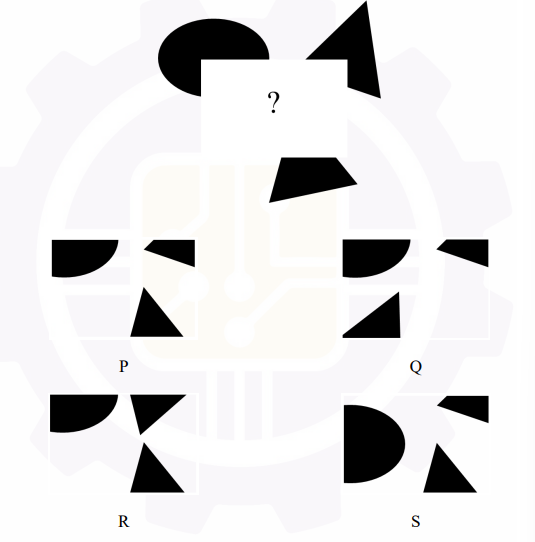
The figure below is supposed to show three non-overlapping shapes – one oval and two triangles. Which one of the following figures P, Q, R, or S fits the missing portion indicated by ‘?’ and completes the oval and the two triangles?
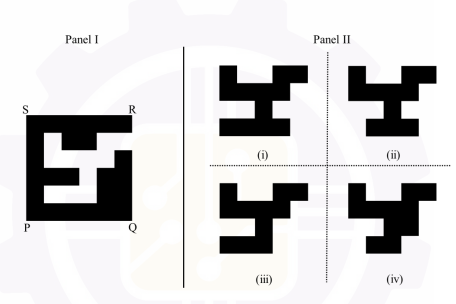
A black square PQRS has been cut into two parts. One part of it is shown in Panel I. Which one of the shapes in Panel II is the other part?
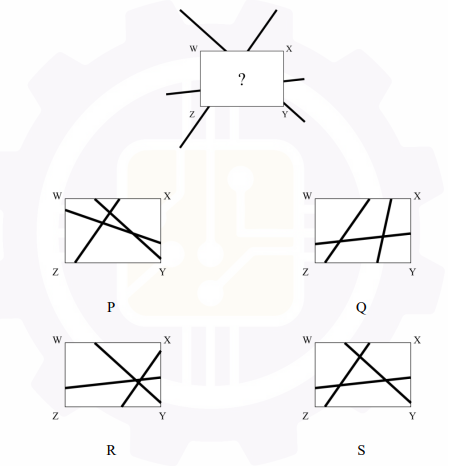
The figure below has exactly three intersecting line segments with a rectangular portion WXYZ missing. Which one of the following options P, Q, R, and S is the missing portion WXYZ?