A black square PQRS has been cut into two parts. One part of it is shown in Panel I. Which one of the shapes in Panel II is the other part?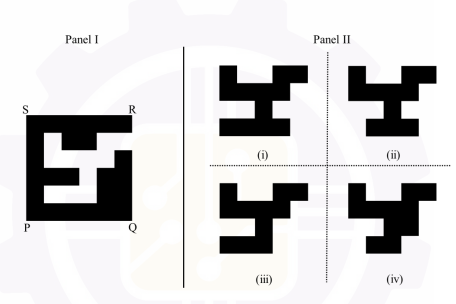
To solve this problem, we need to determine which of the shapes in Panel II can be combined with the shape in Panel I to form a complete square.
First, let's examine the shape given in Panel I. It is an irregular shape cut out from a square. We need to identify the complementary shape from Panel II that completes this to form a whole square.
Now, let's look at each option in Panel II:
- Option (i): This shape does not match as it does not fill in the gaps left by the shape in Panel I.
- Option (ii): Although similar, this shape also does not match the pattern necessary to complete the square.
- Option (iii): This shape is the perfect match. It fills in all the spaces left by the shape in Panel I, completing the square without any overlap or gaps.
- Option (iv): This option leaves some parts unfilled or causes overlapping when combined with the shape in Panel I.
Through elimination, we find that Option (iii) is the correct choice as it precisely completes the shape in Panel I, making a perfect square.
Important Questions from Shape Completion
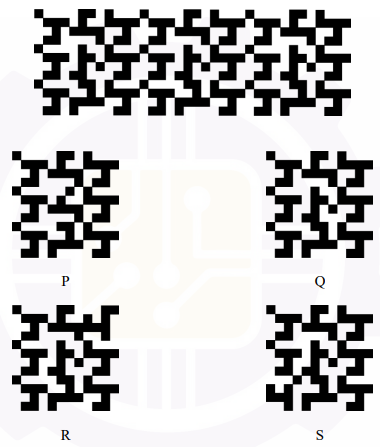
Which one of the patterns labelled P, Q, R, and S is used to generate the following figure?
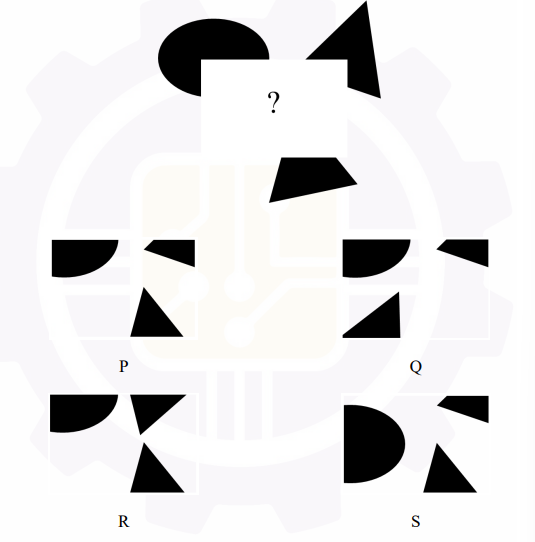
The figure below is supposed to show three non-overlapping shapes – one oval and two triangles. Which one of the following figures P, Q, R, or S fits the missing portion indicated by ‘?’ and completes the oval and the two triangles?
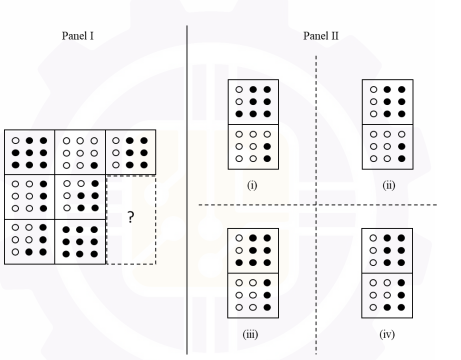
Two tiles are missing in Panel I. Which one of the options in Panel II is the appropriate choice for the missing tiles?
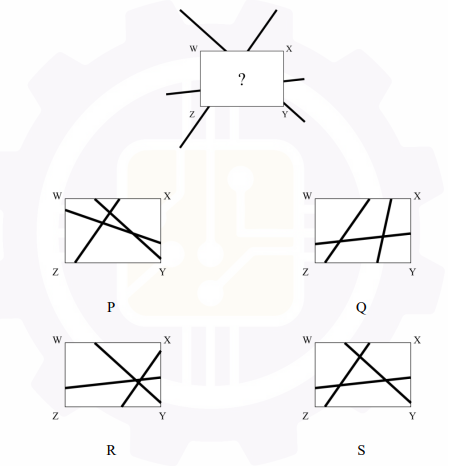
The figure below has exactly three intersecting line segments with a rectangular portion WXYZ missing. Which one of the following options P, Q, R, and S is the missing portion WXYZ?