
Two statements are given about the galvanic cell shown below Statement I: Current flows from Cu electrode to Zn electrode Statement II: With increase in time the mass of Zn electrode increases and mass of Cu electrode decreases Correct answer is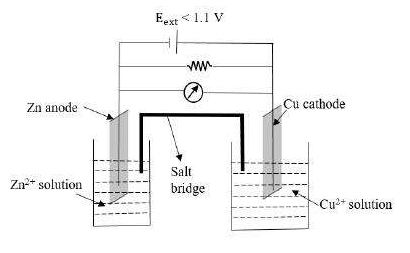
Statement I is correct and statement II is not correct
The figure is a Daniell cell (standard emf 1.1 V) opposed by an external voltage \(E_{ext}\lt 1.1\) V. As long as the opposing voltage is smaller than the cell emf, the cell keeps working as a galvanic cell.
Anode: \(\mathrm{Zn\rightarrow Zn^{2+}+2e^-}\); cathode: \(\mathrm{Cu^{2+}+2e^-\rightarrow Cu}\). Electrons travel through the external wire from Zn to Cu, so conventional current flows from the Cu electrode to the Zn electrode. Statement I is correct.
Zinc atoms leave the rod as \(\mathrm{Zn^{2+}}\) ions, so the Zn electrode loses mass, while copper is deposited on the Cu electrode, which gains mass. Statement II states the reverse, so it is not correct.
The masses would change the other way only if \(E_{ext}\gt 1.1\) V, when the cell is driven as an electrolytic cell.
Hence, Statement I is correct and statement II is not correct.
Similar Questions
At T(K), a gas is adsorbed on the surface of a solid. The signs of \(\Delta H\) and \(\Delta S\) are respectively
The following equation is obtained for a first order reaction
\(\log k=14-\dfrac{1.25\times 10^{4}\,\mathrm{K}}{T}\)
The \(E_a\) (in \(\mathrm{kJ\,mol^{-1}}\)) and frequency factor, \(A\) (in \(\mathrm{s^{-1}}\)) of the reaction are respectively (\(R=8.3\ \mathrm{J\,mol^{-1}\,K^{-1}}\))
The following reaction takes place in a cell at \(298\ \mathrm{K}\)
\(2\mathrm{M^{3+}}(aq)+2\mathrm{I^-}(aq)\rightarrow 2\mathrm{M^{2+}}(aq)+\mathrm{I_2}(s)\)
What is the value of \(\log K_c\) for this reaction?
(Given: \(E^\circ_{cell}=0.235\ \mathrm{V}\), \(F=96500\ \mathrm{C\,mol^{-1}}\), \(R=8.3\ \mathrm{J\,mol^{-1}\,K^{-1}}\))
Observe the following reaction
\(2\mathrm{N_2O_5}(g)\rightarrow 4\mathrm{NO_2}(g)+\mathrm{O_2}(g)\)
At \(T(\mathrm{K})\), the concentration of \(\mathrm{N_2O_5}(g)\) changed from \(2\ \mathrm{mol\,L^{-1}}\) to \(1.5\ \mathrm{mol\,L^{-1}}\) in 100 min. What is the average rate (in \(\mathrm{mol\,L^{-1}\,min^{-1}}\)) of this reaction?
A solid solute is dissolved in water. The mole fraction of solute is 0.02. What is the molality of the solution?
Metals A and B crystallize in “simple cubic” and “face centered cubic” lattice respectively. The number of metal atoms A and B per unit cell are respectively
The pH of a 0.1 M solution of a weak monobasic organic acid is 4.0. What is the dissociation constant of the acid?
At T(K), the \(K_c\) values for the reactions (I) and (II) given below are \(2.4\times10^{30}\) and 1.4 respectively.
I. \(\mathrm{2\,NO(g)\rightleftharpoons N_2(g)+O_2(g)}\)
II. \(\mathrm{NO(g)+\frac{1}{2}Br_2(g)\rightleftharpoons NOBr(g)}\)
What is the \(K_c\) value for the given reaction using the above data?
\(\mathrm{\frac{1}{2}\,N_2(g)+\frac{1}{2}\,O_2(g)+\frac{1}{2}\,Br_2(g)\rightleftharpoons NOBr(g)}\)
What is \(\Delta_rH^{\ominus}\) (in \(\mathrm{kJ\,mol^{-1}}\)) for the following reaction at 298 K?
\(\mathrm{C_3H_8(g)+5\,O_2(g)\rightarrow 3\,CO_2(g)+4\,H_2O(l)}\)
(Given: \(\Delta_fH^{\ominus}\) of \(\mathrm{C_3H_8(g)}\), \(\mathrm{CO_2(g)}\) and \(\mathrm{H_2O(l)}\) is \(-104,-393\) and \(-285\ \mathrm{kJ\,mol^{-1}}\) respectively)
Consider the following reaction
\(A(g)+B(g)\rightleftharpoons C(g)+D(g)\)
Which one of the following is zero for this reaction at 298 K?
Important Questions from Physical Chemistry
- Consider two Group IV metal ions $\text{X}^{2+}$ and $\text{Y}^{2+}$.
A solution containing 0.01 M $\text{X}^{2+}$ and 0.01 M $\text{Y}^{2+}$ is saturated with $\text{H}_2\text{S}$. The pH at which the metal sulphide YS will form as a precipitate is ______. (Nearest integer)
(Given: $\text{K}_{sp}(\text{XS}) = 1 \times 10^{-22}$ at $25^\circ\text{C}$, $\text{K}_{sp}(\text{YS}) = 4 \times 10^{-16}$ at $25^\circ\text{C}$, $[\text{H}_2\text{S}] = 0.1\text{M}$ in solution, $\text{K}_{a1} \times \text{K}_{a2}(\text{H}_2\text{S}) = 1.0 \times 10^{-21}$, $\log 2 = 0.30$, $\log 3 = 0.48$, $\log 5 = 0.70$) - The half-life of ${}^{65}\text{Zn}$ is 245 days. After x days, 75% of original activity remained. The value of $x$ in days is _______. (Nearest integer)
(Given: $\log 3 = 0.4771$ and $\log 2 = 0.3010$) - Molar conductivity of a weak acid HQ of concentration $0.18 \text{ M}$ was found to be $1/30$ of the molar conductivity of another weak acid HZ with concentration of $0.02 \text{ M}$. If $\lambda^\circ_{Q^-}$ happened to be equal with $\lambda^\circ_{Z^-}$, then the difference of the $\text{pK}_a$ values of the two weak acids ($\text{pK}_a\text{(HQ)} - \text{pK}_a\text{(HZ)}$) is _______ (Nearest integer).
[Given: degree of dissociation ($\alpha$) < < 1 for both weak acids, $\lambda^\circ$ : limiting molar conductivity of ions] - The first and second ionization constants of $\text{H}_2\text{X}$ are $2.5 \times 10^{-8}$ and $1.0 \times 10^{-13}$ respectively. The concentration of $\text{X}^{2-}$ in $0.1\text{ M}$ $\text{H}_2\text{X}$ solution is __________ $\times 10^{-15}\text{ M}$. (Nearest Integer)
- The osmotic pressure of a living cell is $12\text{ atm}$ at $300\text{ K}$. The strength of sodium chloride solution that is isotonic with the living cell at this temperature is __________ $\text{g L}^{-1}$. (Nearest integer)
Given : $\text{R} = 0.08\text{ L atm K}^{-1}\text{ mol}^{-1}$
Assume complete dissociation of $\text{NaCl}$
(Given : Molar mass of $\text{Na}$ and $\text{Cl}$ are $23$ and $35.5\text{ g mol}^{-1}$ respectively.)


