
Two identical circular wires P and Q each of radius R and carrying current I are kept in perpendicular planes such that they have a common centre as shown in the figure. Find the magnitude and direction of the net magnetic field at the common centre of the two coils.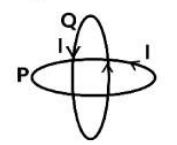
\(\frac{\mu_0 I}{\sqrt{2} R}, \beta = 45^\circ\)
The magnetic field at the centre of a circular current-carrying loop is given by \( B = \frac{\mu_0 I}{2R} \). Since the two coils are perpendicular to each other, their magnetic fields add vectorially.
Using the Pythagorean theorem:
\[ B_{\text{net}} = \sqrt{B_P^2 + B_Q^2} = \sqrt{\left(\frac{\mu_0 I}{2R}\right)^2 + \left(\frac{\mu_0 I}{2R}\right)^2} \]
\[ B_{\text{net}} = \frac{\mu_0 I}{\sqrt{2} R} \]
The angle \( \beta \) of the resultant field with respect to one of the coils is:
\[ \beta = 45^\circ \]
Thus, the correct answer is option 3.
Important Questions from Moving Charge and Magnetism
A square loop with each side 1 cm, carrying a current of 10 A, is placed in a magnetic field of 0.2 T. The direction of magnetic field is parallel to the plane of the loop. The torque experienced by the loop is:
A long straight wire of circular cross-section with radius ' a ' carries a steady current ' I ' which is uniformly distributed across the cross-section. The magnetic field in the region r < a and r > a is represented by:
A 300-turn rectangular coil of length 20cm and breadth 12cm carries a current of 12A in a magnetic field of 6T. The plane of the coil makes an angle of 60∘ with the magnetic field. What is the torque acting on the coil?
An alpha-particle moves with a speed of 5×10⁵m/s. It enters a region where there is a magnetic field of magnitude 4 T, directed at an angle of 45° to the X-axis and lying in the XY plane. The magnitude of the magnetic force on the alpha-particle is:
An electron moves around the nucleus in a hydrogen atom of radius 0.05nm with a velocity of 2×10⁶m/s. The magnetic field produced at the center of the nucleus is:


