
A long straight wire of circular cross-section with radius ' a ' carries a steady current ' I ' which is uniformly distributed across the cross-section. The magnetic field in the region r < a and r > a is represented by:
Understanding the Magnetic Field of a Current-Carrying Wire
We are asked to determine how the magnetic field strength varies with distance from the axis of a long straight wire carrying a steady current. The wire has a circular cross-section of radius 'a', and the current 'I' is distributed uniformly across this cross-section. We need to analyze the magnetic field in two regions: inside the wire (where the radial distance 'r' is less than 'a') and outside the wire (where 'r' is greater than 'a').
Applying Ampere's Circuital Law
Ampere's Circuital Law is a fundamental principle used to calculate the magnetic field produced by a current distribution that has sufficient symmetry. It states that the line integral of the magnetic field \(\vec{B}\) around any closed loop (called an Amperian loop) is equal to \(\mu_0\) times the net current \(I_{enclosed}\) passing through the area enclosed by the loop:
\[ \oint \vec{B} \cdot d\vec{l} = \mu_0 I_{enclosed} \]For a long straight wire with uniform current distribution, the magnetic field lines are concentric circles around the wire's axis. The magnitude of the magnetic field is constant along any such circular loop. Therefore, for a circular Amperian loop of radius 'r' concentric with the wire, \(\oint \vec{B} \cdot d\vec{l} = B(2\pi r)\).
Magnetic Field Inside the Wire (r < a)
Consider a circular Amperian loop of radius 'r' inside the wire, where \(r < a\). The current is uniformly distributed over the wire's cross-sectional area \(\pi a^2\). The current density \(J\) is constant and given by:
\[ J = \frac{I}{\pi a^2} \]The current \(I_{enclosed}\) passing through the area of the Amperian loop (\(\pi r^2\)) is:
\[ I_{enclosed} = J \times (\pi r^2) = \frac{I}{\pi a^2} \times \pi r^2 = I \frac{r^2}{a^2} \]Applying Ampere's Law for \(r < a\):
\[ B_{inside}(2\pi r) = \mu_0 I_{enclosed} \] \[ B_{inside}(2\pi r) = \mu_0 I \frac{r^2}{a^2} \]Solving for \(B_{inside}\):
\[ B_{inside}(r) = \frac{\mu_0 I}{2\pi a^2} r \]This formula shows that inside the wire, the magnetic field strength is directly proportional to the distance 'r' from the axis. It starts from 0 at r=0 and increases linearly.
Magnetic Field Outside the Wire (r > a)
Now, consider a circular Amperian loop of radius 'r' outside the wire, where \(r > a\). The entire current 'I' of the wire passes through the area enclosed by this loop. So, \(I_{enclosed} = I\).
Applying Ampere's Law for \(r > a\):
\[ B_{outside}(2\pi r) = \mu_0 I_{enclosed} \] \[ B_{outside}(2\pi r) = \mu_0 I \]Solving for \(B_{outside}\):
\[ B_{outside}(r) = \frac{\mu_0 I}{2\pi r} \]This formula shows that outside the wire, the magnetic field strength is inversely proportional to the distance 'r' from the axis. It decreases as 'r' increases.
Magnetic Field at the Surface (r = a)
Let's check the value of the magnetic field at the surface of the wire (r = a) using both formulas:
From the inside formula:
\[ B_{inside}(a) = \frac{\mu_0 I}{2\pi a^2} a = \frac{\mu_0 I}{2\pi a} \]From the outside formula:
\[ B_{outside}(a) = \frac{\mu_0 I}{2\pi a} \]The magnetic field is continuous at \(r = a\), and its value is maximum at the surface of the wire.
Representing the Magnetic Field Graphically
Based on our calculations, the graph of magnetic field strength B versus radial distance r should have the following characteristics:
- For \(0 \le r \le a\), B increases linearly with r, starting from \(B=0\) at \(r=0\).
- For \(r > a\), B decreases with r, following an inverse proportionality \(B \propto 1/r\).
- The graph should be smooth and continuous at \(r = a\).
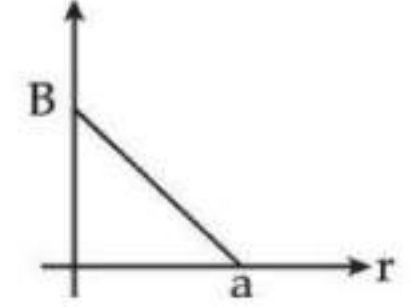
We are given options as images representing graphs of B vs r. We need to identify the graph that shows a linear increase from r=0 to r=a and then a decrease proportional to 1/r for r > a.
The graph representing the magnetic field should start from zero at r=0, increase linearly up to r=a, reach a peak at r=a, and then decrease asymptotically towards zero as r approaches infinity following a curve. The image corresponding to this description is the correct representation.
Revision Table: Magnetic Field Formulas
| Region | Distance from axis (r) | Magnetic Field (B) |
|---|---|---|
| Inside the wire | \(r < a\) | \(B_{inside}(r) = \frac{\mu_0 I}{2\pi a^2} r\) |
| Outside the wire | \(r > a\) | \(B_{outside}(r) = \frac{\mu_0 I}{2\pi r}\) |
| At the surface | \(r = a\) | \(B(a) = \frac{\mu_0 I}{2\pi a}\) |
Additional Information: Related Concepts
Understanding the magnetic field around current-carrying wires is crucial in electromagnetism. Here are some related concepts:
- Magnetic Field Lines: These lines represent the direction of the magnetic field. For a long straight wire, they are concentric circles around the wire, indicating that the field is tangential.
- Biot-Savart Law: While Ampere's Law is useful for symmetric cases, the Biot-Savart Law is more general and can be used to calculate the magnetic field produced by any current distribution.
- Solenoids and Toroids: Ampere's Law is also very effective in calculating the magnetic fields inside ideal solenoids and toroids due to their high degree of symmetry.
- Magnetic Permeability (\(\mu_0\)): This is the permeability of free space, a fundamental constant that relates the magnetic field to the electric current producing it in vacuum. Inside a material, the permeability might be different (\(\mu = \mu_r \mu_0\)).
The distribution of the magnetic field described here is a classic result in electromagnetism, demonstrating the transition from a field dependent on enclosed current within a uniform distribution to a field dependent on the total current from an external perspective.
Important Questions from Moving Charge and Magnetism
A square loop with each side 1 cm, carrying a current of 10 A, is placed in a magnetic field of 0.2 T. The direction of magnetic field is parallel to the plane of the loop. The torque experienced by the loop is:
A 300-turn rectangular coil of length 20cm and breadth 12cm carries a current of 12A in a magnetic field of 6T. The plane of the coil makes an angle of 60∘ with the magnetic field. What is the torque acting on the coil?
An alpha-particle moves with a speed of 5×10⁵m/s. It enters a region where there is a magnetic field of magnitude 4 T, directed at an angle of 45° to the X-axis and lying in the XY plane. The magnitude of the magnetic force on the alpha-particle is:
An electron moves around the nucleus in a hydrogen atom of radius 0.05nm with a velocity of 2×10⁶m/s. The magnetic field produced at the center of the nucleus is:
Match List - I with List - II.
List - I List - II (A) ∮s\(\vec{B} \)⋅\(\vec{ds}\)=0 (I) Magnetic field lines (B) Directional property of freely suspended magnet (II) Circulating ions (C) Never intersect each other (III) Torque on magnetic dipole (D) Magnetic field of earth (IV) Monopoles in magnetism do not exist Choose the correct answer from the options given below:


