
To find the pressure difference between the two points in the pipe connected by a differential mercury manometer, we should first understand how the pressure difference relates to the height difference in the manometer. The difference in manometer levels is due to the pressure difference, and it can be calculated using the following formula:
\(P = \Delta h \cdot g \cdot (\rho_{\text{mercury}} - \rho_{\text{oil}})\)
- Understand the given data:
- The difference in mercury level, \(\Delta h\) = 20 cm = 0.2 m
- Specific gravity of oil = 0.8
- Specific gravity of mercury = 13.6
- Density of water at 4°C, \(\rho_{\text{water}}\) = 1000 kg/m3
- Acceleration due to gravity, \(g\) = 9.81 m/s2
- Find densities:
- Density of oil, \(\rho_{\text{oil}} = 0.8 \times 1000 = 800 \text{ kg/m}^3\)
- Density of mercury, \(\rho_{\text{mercury}} = 13.6 \times 1000 = 13600 \text{ kg/m}^3\)
- Calculate pressure difference using the formula:
Insert values into the pressure difference formula:
\(P = 0.2 \cdot 9.81 \cdot (13600 - 800)\)
Calculate the expression within the bracket:
\(\Rightarrow P = 0.2 \cdot 9.81 \cdot (13600 - 800) = 0.2 \cdot 9.81 \cdot 12800\)
Now calculate the final pressure difference:
\(\Rightarrow P = 0.2 \cdot 9.81 \cdot 12800 = 25113.60 \text{ N/m}^2\)
Thus, the difference of pressure between the two points in the pipe is 25113.60 N/m2.
The correct answer is 25113.60.
Important Questions from Hydrostatic Pressure
A cylindrical roller gate of diameter 6.0 m and length 10.0 m is placed on a dam to store water behind it, as shown in figure.
The magnitude of the resultant force due to water acting on that gate when the water is about to spill is _______ $\times 10^6$ N (rounded off to two decimal places).
Consider acceleration due to gravity ($g$) = 9.81 m/s$^2$;
density of water ($\rho$) = 1000 kg/m$^3$; and $\pi$ = 3.14.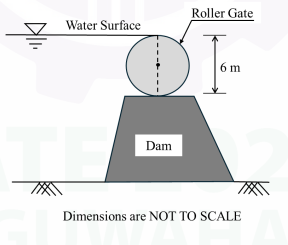
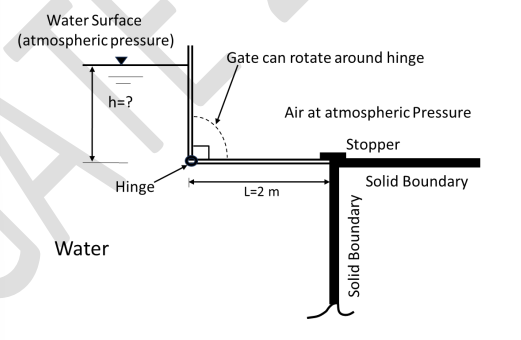
With reference to the gate shown in the figure, the gate will start opening automatically when the water level ‘h' above the hinge is _________ m (rounded off to 2 decimal places).
A plunger weighing 314 kN is balanced in a cylindrical vessel of diameter 1.5 m and filled with an oil (specific gravity 0.9) as shown in the following figure (not to the scale).
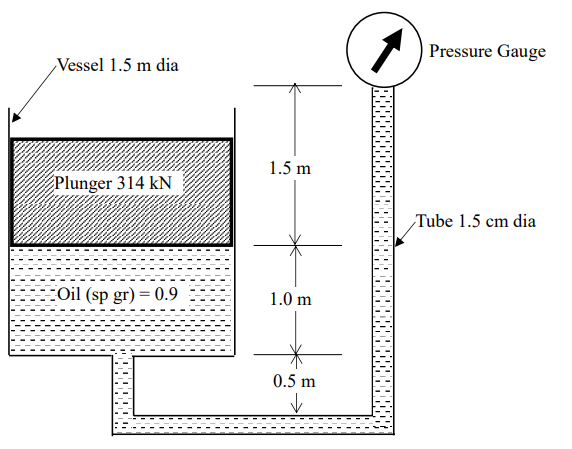
If a pressure gauge is connected with the vessel using 1.5 cm diameter tube, the reading of the gauge will be ________ (in kPa, rounded off to two decimal places).- Consider the following statements regarding the pressure measured at a point in a fluid.
S1: Absolute pressure is gauge pressure plus atmospheric pressure.
S2: Gauge pressure is measured by considering absolute zero pressure as datum.
S3: Absolute pressure is measured by considering atmospheric pressure as datum.
S4: Vacuum pressure is negative pressure obtained by subtracting absolute pressure from atmospheric pressure.
Which ONE of the following options lists all the TRUE statements?


