
A cylindrical roller gate of diameter 6.0 m and length 10.0 m is placed on a dam to store water behind it, as shown in figure.
The magnitude of the resultant force due to water acting on that gate when the water is about to spill is _______ $\times 10^6$ N (rounded off to two decimal places).
Consider acceleration due to gravity ($g$) = 9.81 m/s$^2$;
density of water ($\rho$) = 1000 kg/m$^3$; and $\pi$ = 3.14.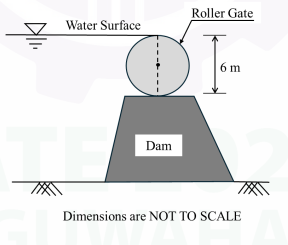
Summary Solution
The resultant force acting on a submerged curved surface is the vector sum of its horizontal and vertical components. Since the water surface is at the top of the cylindrical roller gate, the gate is half-submerged on one side.
1. Given Data
- Diameter of the gate, \( D = 6.0 \text{ m} \) (Radius \( R = 3.0 \text{ m} \))
- Length of the gate, \( L = 10.0 \text{ m} \)
- Density of water, \( \rho = 1000 \text{ kg/m}^3 \)
- Acceleration due to gravity, \( g = 9.81 \text{ m/s}^2 \)
- Constant, \( \pi = 3.14 \)
2. Horizontal Force Component (\( F_x \))
The horizontal force is the hydrostatic force acting on the vertical projection of the submerged surface. For a cylinder of diameter \( D \) and length \( L \):
- Area of vertical projection, \( A_{proj} = D \times L = 6.0 \times 10.0 = 60 \text{ m}^2 \)
- Depth of the centroid of the projection, \( \bar{h} = \frac{D}{2} = 3.0 \text{ m} \)
$$ F_x = \rho \cdot g \cdot \bar{h} \cdot A_{proj} $$ $$ F_x = 1000 \times 9.81 \times 3.0 \times 60 = 1,765,800 \text{ N} = 1.7658 \times 10^6 \text{ N} $$
3. Vertical Force Component (\( F_y \))
The vertical force is equal to the weight of the water displaced by the submerged portion of the cylinder. Since the water acts on one side up to the top, the submerged profile is a semicircle.
- Area of the semicircle, \( A_{semi} = \frac{\pi R^2}{2} = \frac{3.14 \times 3.0^2}{2} = 14.13 \text{ m}^2 \)
- Volume of displaced water, \( V = A_{semi} \times L = 14.13 \times 10.0 = 141.3 \text{ m}^3 \)
$$ F_y = \text{Weight of displaced water} = \rho \cdot g \cdot V $$ $$ F_y = 1000 \times 9.81 \times 141.3 = 1,386,153 \text{ N} = 1.386153 \times 10^6 \text{ N} $$
4. Magnitude of the Resultant Force (\( F_R \))
The resultant force is calculated using the Pythagorean theorem:
$$ F_R = \sqrt{F_x^2 + F_y^2} $$ $$ F_R = 10^6 \times \sqrt{(1.7658)^2 + (1.386153)^2} $$ $$ F_R = 10^6 \times \sqrt{3.11805 + 1.92142} $$ $$ F_R = 10^6 \times \sqrt{5.03947} \approx 2.24487 \times 10^6 \text{ N} $$
Final Answer: Rounded off to two decimal places, the magnitude of the resultant force is 2.24 \( \times 10^6 \text{ N} \).
Important Questions from Hydrostatic Pressure
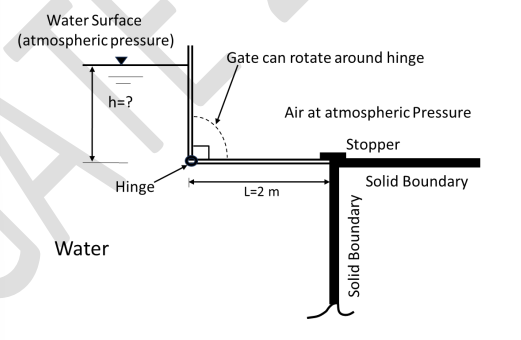
With reference to the gate shown in the figure, the gate will start opening automatically when the water level ‘h' above the hinge is _________ m (rounded off to 2 decimal places).
- Two ends of a differential mercury manometer are connected at two points on a pipe carrying oil. The manometer shows difference in mercury level of $20$ cm. The specific gravity of oil and mercury are $0.8$ and $13.6$, respectively. The density of water is $1000$ kg m$^{-3}$ at $4$ °C and acceleration due to gravity (g) is $9.81$ m s$^{-2}$. At the same two points in pipe, the difference of pressure in N m$^{-2}$ is
A plunger weighing 314 kN is balanced in a cylindrical vessel of diameter 1.5 m and filled with an oil (specific gravity 0.9) as shown in the following figure (not to the scale).
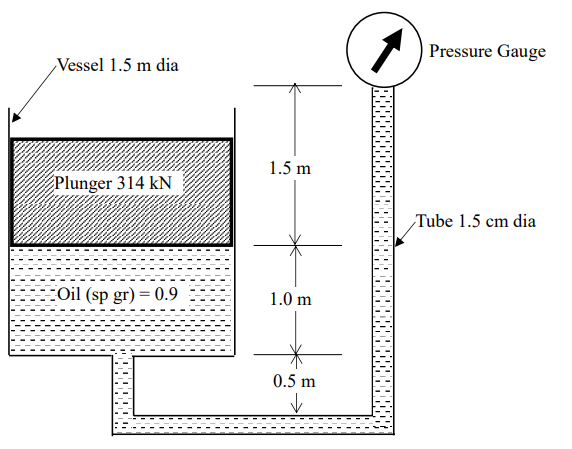
If a pressure gauge is connected with the vessel using 1.5 cm diameter tube, the reading of the gauge will be ________ (in kPa, rounded off to two decimal places).- Consider the following statements regarding the pressure measured at a point in a fluid.
S1: Absolute pressure is gauge pressure plus atmospheric pressure.
S2: Gauge pressure is measured by considering absolute zero pressure as datum.
S3: Absolute pressure is measured by considering atmospheric pressure as datum.
S4: Vacuum pressure is negative pressure obtained by subtracting absolute pressure from atmospheric pressure.
Which ONE of the following options lists all the TRUE statements?


