Two different positions of the same dice are shown having colours- Red, Blue, Pink, Green, white and black. Find the colour on the face opposite to the face showing 'Red'.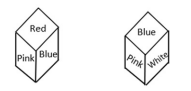
To solve the problem of determining the color on the face opposite to 'Red' on a dice, we need to use the concept of opposite faces in dice configurations. Given two positions of the same dice, let's identify the pattern:
From the first dice configuration:
- Visible colors are: Red, Pink, Blue.
From the second dice configuration:
- Visible colors are: Blue, Pink, White.
In both configurations, the common visible colors are Blue and Pink. This implies that Blue and Pink are adjacent to each other on the dice, and thus cannot be opposite to 'Red'.
Now, since Blue and Pink are adjacent to each other, and both configurations show different third colors (Red in the first and White in the second), it implies that:
- White must be opposite to Red, as this is the only configuration where a third color appears in two different visible settings alongside consistent colors.
Therefore, the color opposite to 'Red' is White.
Conclusion: The correct answer is White.
Important Questions from Cube and Dice
A cube of side 4 cm is painted green on all its faces and then divided into smaller cubes of side 2 cm each. How many small cubes have been obtained?
Two adjacent faces of a solid cube are painted with black colour. The faces opposite to the black faces is painted with blue colour while the remaining faces are painted with yellow colour. After painting, this cube has been divided into 125 equal cubes. How many cubes have no faces painted?
A cube, whose two adjacent faces are coloured, is cut into 64 identical small cubes. How many of these small cubes are not coloured at all?
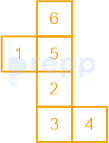
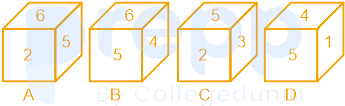
Select the dice that can be formed by folding the given sheet along the lines.
Two different positions of the same dice are shown, the six faces of which are marked with the letters A to F. Select the letter that will be on the face opposite to the one having A.