
The structures below represent two interpretations of the compound noun ‘Greek history teacher'. Which of the following statements is/are CORRECT? 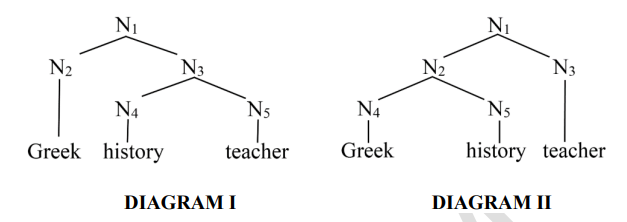
To analyze the compound noun "Greek history teacher" and the provided tree diagrams, we need to understand the hierarchy and structure of noun phrases.
The compound noun can be interpreted in different ways based on how the words are grouped together.
- Diagram I Analysis:
- $N_1$ combines "Greek" and a further noun phrase $N_3$.
- $N_3$ is a noun phrase combining "history" ($N_4$) and "teacher" ($N_5$).
- In this interpretation, "teacher" is the head of both $N_3$ and the entire phrase $N_1$ which indicates a "teacher of Greek history."
- Diagram II Analysis:
- $N_1$ is formed by combining $N_2$ (which itself consists of "Greek" and "history") and "teacher" ($N_3$).
- Here, "history" serves as the head of $N_2$, and "teacher" is the head of $N_1$.
- This structure suggests a "teacher of history who is Greek."
Now, let's evaluate the given options to determine their correctness:
- In diagram (I), ‘teacher’ is the head of both $N_1$ and $N_3$. — Correct. Explanation provided above confirms this.
- In diagram (II), ‘history’ is the head of $N_2$, and ‘teacher’ is the head of $N_1$. — Correct. The analysis confirms this interpretation as well.
- In diagram (I), ‘Greek’ is the head of $N_1$, and ‘teacher’ is the head of $N_3$. — Incorrect. "Teacher" is the head of $N_1$ in diagram (I).
- In diagram (II), ‘teacher’ is the head of both $N_1$ and $N_2$. — Incorrect. In diagram (II), "teacher" is not the head of $N_2$ ("history" is).
Conclusion: Options 1 and 2 are the correct statements. Both diagrams provide different interpretations of the same compound noun based on the hierarchical structure.
Important Questions from Ambiguous Sentences
Consider the following sentences:
(i) Everybody in the class is prepared for the exam.
(ii) Babu invited Danish to his home because he enjoys playing chess.
Which of the following is the CORRECT observation about the above two sentences?
Consider the following sentence:
The historian will put the paintings in his house on the wall in the museum.
Which interpretation is NOT possible among the following?
- Which of the following terms does not form a part of seven types of ambiguities propounded by William Empson?
- If 'Aam Aadmi' is translated as 'Mango Man', which type of ambiguity does the translation demonstrate?
- "I look forward to visiting teachers". What does this sentence demonstrate?


