
Sentence Ambiguity Analysis
The sentence "I look forward to visiting teachers" presents ambiguity because the phrase "visiting teachers" can be interpreted in multiple ways.
Syntactic Ambiguity Explanation
This type of ambiguity arises from the sentence's grammatical structure.
- Interpretation 1: "visiting" acts as a gerund, making "visiting teachers" the object of the preposition "to". This means the speaker ("I") intends to perform the action of visiting the teachers. The structure is: $I look forward to [the act of visiting teachers]$.
- Interpretation 2: "visiting" acts as a participle adjective modifying "teachers". This means the speaker ("I") is looking forward to meeting or seeing teachers who are currently visiting (or whose purpose is visiting). The structure is: $I look forward to [teachers who are visiting]$.
Because the grammatical structure allows for these two distinct interpretations, the sentence exhibits syntactic ambiguity.
Semantic Role Ambiguity Explanation
Semantic role ambiguity occurs when the grammatical structure makes it unclear who is performing an action and who is receiving it. In this sentence:
- In Interpretation 1, "I" is the agent (the visitor) and "teachers" are the patient (the visited).
- In Interpretation 2, "teachers" are the agent (the visitors) and "I" (or the place the speaker is at) is implicitly the patient or the recipient of the visit.
The syntactic ambiguity directly leads to uncertainty about the semantic roles of "I" and "teachers", hence demonstrating semantic role ambiguity.
Lexical Ambiguity Check
Lexical ambiguity involves a single word having multiple meanings (e.g., "bank"). The words in "I look forward to visiting teachers" have clear meanings in this context. The ambiguity stems from the structure and combination of words, not from a single word's multiple dictionary definitions.
Conclusion
The sentence contains structural ambiguity that leads to unclear participant roles. Therefore, both Syntactic ambiguity and Semantic role ambiguity are demonstrated.
Important Questions from Ambiguous Sentences
Consider the following sentences:
(i) Everybody in the class is prepared for the exam.
(ii) Babu invited Danish to his home because he enjoys playing chess.
Which of the following is the CORRECT observation about the above two sentences?
Consider the following sentence:
The historian will put the paintings in his house on the wall in the museum.
Which interpretation is NOT possible among the following?
The structures below represent two interpretations of the compound noun ‘Greek history teacher'. Which of the following statements is/are CORRECT?
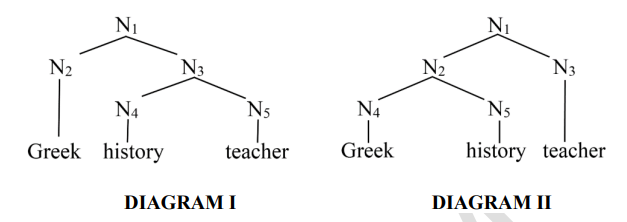
- Which of the following terms does not form a part of seven types of ambiguities propounded by William Empson?
- If 'Aam Aadmi' is translated as 'Mango Man', which type of ambiguity does the translation demonstrate?


