
The strongest band observed in the IR spectrum of the final product of the following reaction appears, approximately, at ____________ $\times 100 \text{ cm}^{-1}$. (Up to one decimal place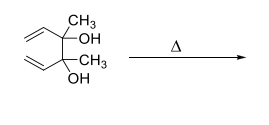
On heating ($\Delta$), the given vicinal diol undergoes a pinacol–pinacolone rearrangement, resulting in the formation of a ketone.
Step 2: Identify the dominant functional group in the final product
The rearranged product contains a carbonyl group ($C=O$), which gives the strongest IR absorption.
Step 3: Recall characteristic IR absorption
The $C=O$ stretching vibration appears strongly at approximately
$1700\ \text{cm}^{-1}$.
Step 4: Convert into the required format
Since the answer is asked in $\times 100\ \text{cm}^{-1}$,
$1700\ \text{cm}^{-1} = 17.0 \times 100\ \text{cm}^{-1}$.
Final Answer
$\boxed{17.0}$
Important Questions from IR Spectroscopy
In an IR spectra of 1-octyne and 4-octyne, the IR-spectra of 4-octyne does not have C ≡ C stretch absorption peak. The reason for this observation is that _________.
An IR-spectra is found to have a medium adsorption peak near 3400cm-1. This corresponds to which organic compound?
The number of CO bands for isomers from sets (i) and (ii) in their IR spectra
Set (i): Trigonal bipyramidal isomers, axial‐Fe(CO)4L (A)and equatorial‐Fe(CO) 4 L(B)
Set (ii): Octahedral isomers, fac‐Mo(CO)3L3 (C) and mer‐Mo(CO)3L3(D)
are
Match List I with List II
List I
List II
functional groups
respective approximate symmetric and asymmetric stretching frequencies
A.
N - H bonds of R - NH2
I.
1790 and 1810
B.
N - O bonds of R - NO2
II.
3300 and 3400
C.
C = O bonds of anhydride
III.
1350 and 1550
Choose the correct answer from the options given below:
The molecule that can absorb in the infra-red among the following is


