
The simplified form of the Boolean function $F(A, B, C, D) = A\bar{B}C+ B+ B\bar{D} +AB\bar{D}+\bar{A}C$ is
To simplify the given Boolean function \( F(A, B, C, D) = A\bar{B}C + B + B\bar{D} + AB\bar{D} + \bar{A}C \), we'll follow these steps:
- Identify and apply Boolean algebra rules to simplify the expression.
- Use the consensus theorem and absorption laws where applicable.
Simplification Process:
- Start with the expression: F = A\bar{B}C + B + B\bar{D} + AB\bar{D} + \bar{A}C
- Notice that B is present by itself in the expression, which implies that any terms ORed with B remain B due to absorption law: X + X = X and X + 1 = 1. Therefore, the expression simplifies to: F = B + \bar{A}C
- Examine if any further simplifications can be made: We see that \bar{A}C is not absorbed by B. Therefore, it simplifies to: B + C.
Conclusion:
The simplified form of the given Boolean function is B + C. Therefore, the correct answer is:
Important Questions from Logic Gates and Boolean Algebra
The digital circuit shown has 3 inputs ($x$, $y$, and $z$).
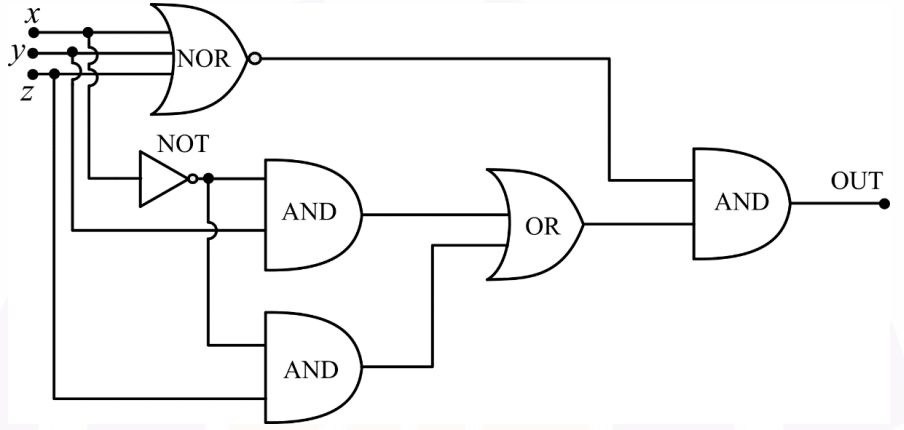
The simplified logical expression for the output (OUT) is:
The MOSFET switches shown in the circuit are ideal.
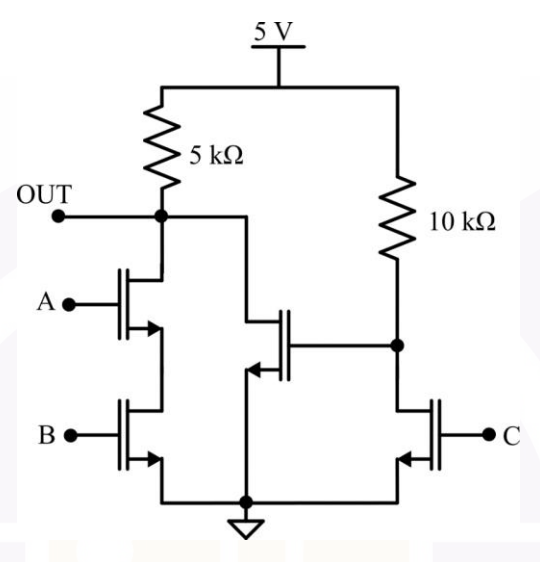
Which of the following is the correct option for Boolean logical expression of the output (OUT), and the maximum possible power (P) consumed by the circuit?
The Boolean expression \(AC+B\bar{C}\) is equivalent to :
Consider the following expressions :
(a) Y = f(A, B, C, D) = Σ (1, 2, 4, 7, 8, 11, 13, 14)
(b) Y = f(A, B, C, D) = Σ (3, 5, 7, 10, 11, 12, 13, 14)
(c) Y = f(A, B, C, D) = Π (0, 3, 5, 6, 9, 10, 12, 15)
(d) Y = f(A, B, C, D) = Π (0, 1, 2, 4, 5, 8, 9, 15)Which of the above expressions are equivalent to the expression Y = A⊕B⊕C⊕D ?
- Match the Exclusive-OR (XOR) operations (i) to (iv) with the results (p) to (s), where X is a Boolean input.
(i) $X \oplus X$ (p) 1 (ii) $X \oplus \bar{X}$ (q) 0 (iii) $X \oplus 0$ (r) $\bar{X}$ (iv) $X \oplus 1$ (s) X


