
The potential energy (PE) versus reaction coordinate diagrams for electron transfer reactions with rate constants $k_1$, $k_2$ and $k_3$, are given below. The increasing order of the rate constants is 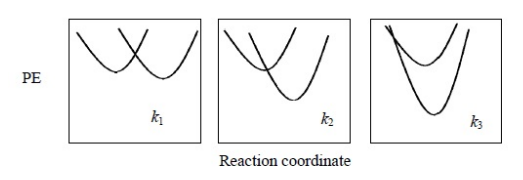
To determine the increasing order of the rate constants $k_1$, $k_2$, and $k_3$ from the potential energy versus reaction coordinate diagrams, we need to consider the transition state theory and the concept of activation energy (the energy difference between reactants and the highest point on the potential energy curve).
The rate constant of a reaction is inversely related to the activation energy: higher activation energy implies a slower reaction rate.
We analyze the given diagrams:
- For $k_1$: The activation energy is moderate.
- For $k_2$: The activation energy is the lowest, indicating the fastest rate.
- For $k_3$: The activation energy is the highest, indicating the slowest rate.
This means the rates are ordered as follows: $k_3$ has the slowest rate, followed by $k_1$, with $k_2$ having the fastest rate. Therefore, the increasing order of the rate constants is:
\(k_3 \lt k_1 \lt k_2\)
Thus, the correct answer is \(k_3 \lt k_1 \lt k_2\).
Important Questions from Electron Transfer Reactions
Consider the following statements for the self‐exchange electron transfer reaction in [Cr(H2O)6]2+/3+
a. σ* orbitals are only involved in electron transfer
b. It involves large inner‐sphere reorganization energy
c. It involves no change in M–L bond lengths
d. Rate of self‐exchange electron transfer is fast
The correct statements are
In 3‐iron ferredoxins, the number of sulfide bridges and cysteinyl ligands, respectively, are:
The second order rate constants for the outer sphere self- exchange electron transfer reactions for [Ru(NH3)6]2+/[Ru(NH3)6]3+ and [Co(NH3)6]2+/[Co(NH3)6]3+ are 9.2 × 10² M-1 sec-1 and ≤ 10-9 M-1 sec-1, respectively.
The correct rationale for the above data is
In the following electron transfer reactions, the one in which the bridging ligand comes from the reductant is
Of the following assertions regarding the mechanism of electron transfer,
A. An outer-sphere mechanism involves electron transfer from the reductant to the oxidant, with the coordination shells or spheres of each staying intact.
B. In the inner-sphere mechanism, the reductant and oxidant share a ligand in their inner or primary coordination sphere which assists in electrons being transferred.
C. In the inner-sphere mechanism, an oxidant possesses at least one ligand capable of binding simultaneously to two metal ions.
D. In the inner-sphere mechanism, ligands of reductant are substitutionally inert.
The correct statements are


