
Question
The Miller indices of the crystal plane which cut through the crystal axes at (2a, -3b, -3c) is :
The correct answer is
($ 2 \bar{2} \bar{2}$)
To find the Miller indices of a crystal plane that intersects the crystal axes at given points, follow these steps:
- Given intercepts on the axes are: \(2a, -3b, -3c\).
- Express these intercepts in terms of the crystallographic axes: \( (h, k, l) \) where \( h, k, \) and \( l \) are the reciprocals of the intercepts, avoiding fractions.
- Calculate the reciprocals of these intercepts:
- \(x = \frac{1}{2a} \to \frac{1}{2}\)
- \(y = \frac{1}{-3b} \to -\frac{1}{3}\)
- \(z = \frac{1}{-3c} \to -\frac{1}{3}\)
- Clear these fractions by multiplying through by the smallest common denominator, which is 6:
- \(6 \times \frac{1}{2} = 3\)
- \(6 \times \left(-\frac{1}{3}\right) = -2\)
- \(6 \times \left(-\frac{1}{3}\right) = -2\)
- The Miller indices are therefore represented as \((3, -2, -2)\), which is equivalent to the option \((2, \bar{2}, \bar{2})\).
The \( \bar{\ } \) symbol denotes the negative of the index in Miller indices notation.
Therefore, the correct answer is \((2, \bar{2}, \bar{2})\).
Was this answer helpful?
Important Questions from Solid State
- The correct statement(s) about the structure of metal oxides is(are)
- The compound(s) which show(s) the perovskite structure in solid state is (are)
- For an inverse spinel, $AB_2O_4$, the A and B, respectively, can be
- When crystals of sodium chloride are heated in the presence of sodium vapor, they turn yellow. This is due to the formation of
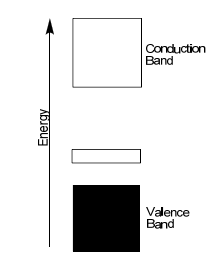
The band structure given below represents a
Need Expert Advice?


