Structure of [X] from NMR
The provided NMR data ($^1$H NMR: $\delta$ 1.17 (d, 6H), 3.02 (m, 1H), 4.10 (s, 2H); $^{13}$C NMR: $\delta$ 17, 37, 39, 210) and molecular formula C$_5$H$_9$BrO suggest that compound [X] is 1-bromo-3-methylbutan-2-one, with the structure (CH$_3$)$_2$CH-CO-CH$_2$Br.
Reaction of [X] with NaOMe
The reaction of an alpha-haloketone like [X] with sodium methoxide (NaOMe) in methanol (MeOH) typically proceeds via the Favorskii rearrangement.
Based on the structure derived from NMR (1-bromo-3-methylbutan-2-one), the expected Favorskii product would be Methyl 3-methylbutanoate.
Identifying the Major Product [Y]
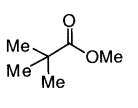
According to the provided options and correct answer, the major product [Y] is Methyl 3,3-dimethylbutanoate, corresponding to Option B.
This specific product arises from the Favorskii rearrangement of 1-bromo-3,3-dimethylbutan-2-one, (CH$_3$)$_3$C-CO-CH$_2$Br.
Reaction pathway leading to Product [Y]:
- Base (methoxide ion) abstracts a proton from the alpha-carbon (-CH$_2$Br group):
$(CH_3)_3C-CO-CH_2Br + MeO^- \rightarrow (CH_3)_3C-CO-CH^-Br + MeOH$
- Intramolecular attack by the carbanion forms a cyclopropanone intermediate.
- Nucleophilic attack by methoxide and subsequent ring opening yields the ester product.
The resulting ester is (CH$_3$)$_3$C-CH$_2$-COOCH$_3$, which is Methyl 3,3-dimethylbutanoate.
Final Answer: The final answer is $\boxed{B}$
Important Questions from Organic Synthesis
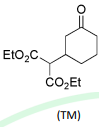
For an unambiguous single step synthesis of the following target molecule (TM), the best bond disconnection in its retrosynthetic analysis is
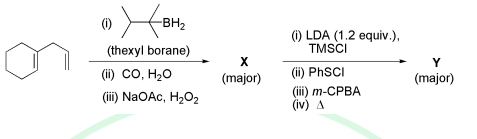
The major products X and Y formed in the following reaction sequences are
For the following reaction, the possible product(s) is/are
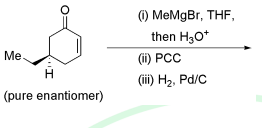
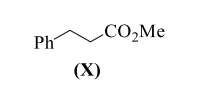
The reaction(s) that yield(s) X as the major product is (are)
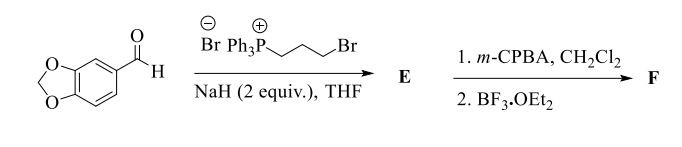
The major products E and F in the following reaction sequence are