
The major product (A) is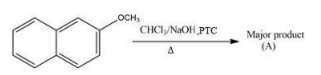
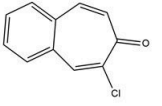
The given reaction involves a combination of methoxy naphthalene with chloroform and sodium hydroxide in the presence of a phase transfer catalyst (PTC) under heating. This is a typical setup for a Reimer-Tiemann reaction, which is used for the formylation of phenolic compounds.
Step-by-step Explanation:
-
The reactant is methoxy naphthalene. In the presence of sodium hydroxide, it can form a phenoxide ion by deprotonation (which would be the active form in reactions involving phenols).
-
Chloroform reacts with the base NaOH to generate dichlorocarbene (\text{CCl}_2). This is an electrophile in the Reimer-Tiemann reaction.
-
Dichlorocarbene preferentially attacks the ortho position relative to the methoxy group on the naphthalene ring, due to the ortho-para directing effects of the methoxy group and the stabilization provided by resonance. However, based on steric factors and the usual outcome in similar reactions, the ortho position gets substituted by a formyl group after further hydrolysis.
-
This leads to the formation of an -CHO group (formyl group) at the ortho position relative to the methoxy group on the naphthalene ring.
Therefore, the major product (A) is a modified naphthalene where the methoxy and formyl groups are ortho to each other.
Conclusion:
Considering the reaction mechanism and the conditions given, the major product is the one with the formyl group ortho to the methoxy group on the naphthalene ring.
Important Questions from Chemistry (CUET PG) Mixed
- Arrange the following coal types in the increasing order of their heat content (KJ/kg)
(A). Peat
(B). Lignite
(C). Anthracite
(D). Bituminous
(E) Sub-bituminous
Choose the correct answer from the options given below: - In which of the following layers of atmosphere, does the temperature decrease with the increase in height from the earth's surafce?
(A). Troposphere
(B). Mesosphere
(C). Thermosphere
(D). Stratosphere
Choose the correct answer from the options given below: Choose the correct statement from the following:
(A). Water has highest density at 4°C
(B). Freezing point of water is 0°C
(C) An Ice cube does not completely dip in water, rather floats on water in a glass.
(D). Addition of common salt reduces freezing point of water.
Choose the correct answer from the options given below:- The number of atoms per unit cell of SCC are:
Which of the following statements are correct:
A. In SC structure $a =2r$
B. In SC structure $a =r/2$
C. In BCC structure $a = 4r/\sqrt{3}$.
D. In FCC structure $a = 2\sqrt{2} r$
Where $a$ is a lattice parameter and $r$ is the atomic radius.


