Calculating Acetic Acid Ionization Degree in Buffer
The ionization of acetic acid ($ CH_3COOH $) is an equilibrium process:
$ CH_3COOH \rightleftharpoons H^+ + CH_3COO^- $
The acid dissociation constant ($ K_a $) expression is:
$ K_a = \frac{[H^+][CH_3COO^-]}{[CH_3COOH]} $
We are given:
- Initial concentration of acetic acid: $ [CH_3COOH]_{initial} = 0.02 $ M
- Concentration of acetate ions from sodium acetate (common ion): $ [CH_3COO^-]_{initial} = 0.01 $ M
- $ K_a = 1.8 \times 10^{-5} $
Let $ \alpha $ be the degree of ionization. The concentration of $ H^+ $ produced from the ionization of acetic acid is $ x = [CH_3COOH]_{initial} \times \alpha $. At equilibrium:
- $ [CH_3COOH]_{eq} = [CH_3COOH]_{initial} - x = 0.02 - x $
- $ [CH_3COO^-]_{eq} = [CH_3COO^-]_{initial} + x = 0.01 + x $
- $ [H^+]_{eq} = x $
Substitute these equilibrium concentrations into the $ K_a $ expression:
$ 1.8 \times 10^{-5} = \frac{x(0.01 + x)}{0.02 - x} $
Since acetic acid is a weak acid and the presence of the common ion ($ CH_3COO^- $) suppresses further ionization, $ x $ is expected to be very small compared to $ 0.01 $ and $ 0.02 $. We can make the following approximations:
- $ 0.01 + x \approx 0.01 $
- $ 0.02 - x \approx 0.02 $
The equation simplifies to:
$ 1.8 \times 10^{-5} \approx \frac{x(0.01)}{0.02} $
Solving for $ x $ (which represents $ [H^+]_{eq} $):
$ x \approx (1.8 \times 10^{-5}) \times \frac{0.02}{0.01} $
$ x \approx (1.8 \times 10^{-5}) \times 2 $
$ x \approx 3.6 \times 10^{-5} \text{ M} $
The degree of ionization ($ \alpha $) is calculated using the definition:
$ \alpha = \frac{x}{[CH_3COOH]_{initial}} $
$ \alpha = \frac{3.6 \times 10^{-5}}{0.02} $
$ \alpha = \frac{3.6 \times 10^{-5}}{2 \times 10^{-2}} $
$ \alpha = 1.8 \times 10^{-3} $
The degree of ionization of 0.02 M acetic acid containing 0.01 M sodium acetate is $ 1.8 \times 10^{-3} $.
Similar Questions
- An electric current of 0.50A from a 12V supply is passed for 300 sec through a resistance in thermal contact with water and the water is allowed to boil under a pressure of 1.0 atm. The value of enthalpy change during the process, if 0.798 gm of water is vaporised, will be :
- The integrated rate law and half-life equation for an first order reaction would be :
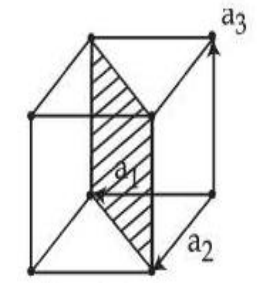
The Miller indices of the shown lattice plane in a simple cubic Bravais lattice are :
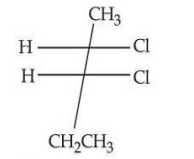
The R/S configuration of C - 2 and C - 3 in the given molecule will be :
- Given below are two statements : one is labelled as Assertion (A) and the other is labelled as Reason (R).
Assertion (A) : A gas is confined by a piston at pressure 'P' and the external pressure is $P_{ex}$. If the $P_{ex}$ is measurably greater then internal pressure, then decreasing $P_{ex}$ infinitesimally will not decrease it below the pressure of the gas and will not change the direction of the process.
Reason (R) : The system is in mechanical equilibrium with its surrounding and the compression is thermodynamically reversible.
In the light of the above statements, choose the most appropriate answer from the options given below : - Given below are two statements : one is labelled as Assertion (A) and the other is labelled as Reason (R).
Assertion (A) : Diastereomers are achiral molecules have superposable mirror images.
Reason (R) : Diastereomers are compounds have different physical properties.
In the light of the above statements, choose the most appropriate answer from the options given below : - Given below are two statements : one is labelled as Assertion (A) and the other is labelled as Reason (R).
Assertion (A) : Boiling point of cis isomers is higher than trans isomers.
Reason (R) : The Dipole moment of cis isomers is higher than trans isomers.
In the light of the above statements, choose the most appropriate answer from the options given below : - Choose the correct sequence on the basis of number of unpaired electrons present in the given field :
A. $\text{Cr (+ II)}$ in weak field
B. $\text{Co (+ II)}$ in strong field
C. $\text{Ni (+ II)}$ in strong field
D. $\text{Pt (+ II)}$ in weak field
E. $\text{Ag (+ II)}$ in strong field
Choose the correct answer from the options given below : - Choose the correct sequence of the elements arranged in their increasing order of atomic numbers:
A. Pu
B. Po
C. Pm
D. Pt
E. Pa
Choose the correct answer from the options given below : Arrange the Hydrogen of the following compounds from most acidic to least acidic :
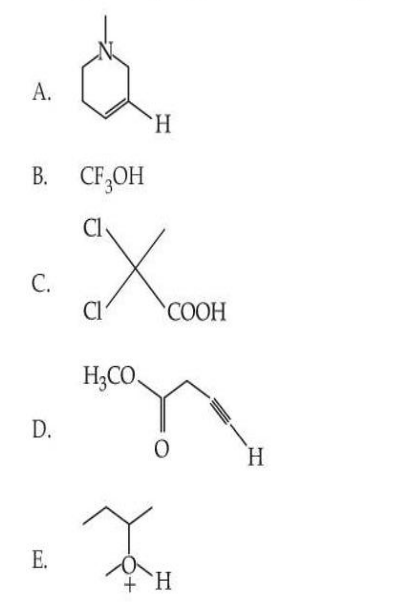
Choose the correct answer from the options given below :
Important Questions from Miscellaneous
- Which of the following relationships is/are not true?
(A). Most probable velocity = $\sqrt{\frac{2RT}{M}}$
(B). PV = $\frac{3}{2}kT$
(C). Compressibility factor Z = $\frac{pV}{nRT}$
(D). Average kinetic energy of gas = $\frac{1}{2}kT$
Choose the correct answer from the options given below - Match List-I with List-II
List-I List-II Electronic Configuration First Ionisation energy (kJ mol$^{-1}$) (A). ns$^2$ (I). 2100 (B). ns$^2$np$^1$ (II). 1400 (C). ns$^2$np$^3$ (III). 800 (D). ns$^2$np$^6$ (IV). 900
Choose the correct answer from the options given below: - The shielding constant of a 2p electron (calculated using Slater's rules) is
- Match List-I with List-II
List-I List-II Spectroscopy Property (A). Raman (I). Polarizability (B). FTIR (II). Dipole Moment (C). UV-Visible (III). Absorbance (D). NMR (IV). Spin
Choose the correct answer from the options given below: - The structure of protein comprises of:
(A). Primary structure of protein is associated with amino acids
(B). Secondary structure of protein is associated to peptides
(C). Tertiary structure of protein is associated with polypeptide chains
(D). Quaternary structure of protein is associated with polypeptide chains
Choose the correct answer from the options given below: