
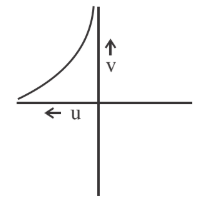
The graph correctly representing the variation of image distance v for a convex lens of focal length f versus object distance u is:
Understanding the Relationship Between Object and Image Distance in a Convex Lens
The relationship between the object distance (u), image distance (v), and focal length (f) of a lens is described by the lens formula. For a convex lens, this formula is given by:
\(\frac{1}{f} = \frac{1}{v} - \frac{1}{u}\)
Here, f is the focal length of the lens. For a convex lens, the focal length f is considered positive.
Sign Conventions for Lens Calculations
To correctly use the lens formula and plot graphs, it's important to follow standard sign conventions. We typically place the object to the left of the lens. Light travels from left to right.
- Object distance (u): Measured from the optical center to the object. It is negative if the object is on the left (real object) and positive if the object is on the right (virtual object). For the standard case of a real object, u is negative.
- Image distance (v): Measured from the optical center to the image. It is positive if the image is on the right (real image) and negative if the image is on the left (virtual image).
- Focal length (f): For a convex lens, f is positive.
Let's rearrange the lens formula to express v in terms of u and f:
\(\frac{1}{v} = \frac{1}{f} + \frac{1}{u}\)
\(v = \frac{1}{\frac{1}{f} + \frac{1}{u}} = \frac{fu}{f+u}\)
Analyzing the u-v Relationship for a Convex Lens (Real Object: u < 0)
We need to consider how the image distance v changes as the object distance u changes, keeping in mind that for a real object, u is negative. Let's analyze different ranges of negative u values:
- Object at infinity (u \(\rightarrow -\infty\)): As u becomes very large and negative, \(\frac{1}{u} \rightarrow 0\). The formula becomes \(\frac{1}{v} \approx \frac{1}{f}\), which means \(v \approx f\). The image forms at the principal focus on the other side (real and inverted).
- Object between infinity and 2f (u between \(-\infty\) and \(-2f\)): As the object moves closer from infinity towards -2f, the real image moves from f towards 2f on the other side. Both u and v are negative and positive respectively.
- Object at 2f (u = \(-2f\)): \(\frac{1}{v} = \frac{1}{f} + \frac{1}{-2f} = \frac{2-1}{2f} = \frac{1}{2f}\). This gives \(v = 2f\). The image forms at 2f on the other side (real and inverted, same size).
- Object between f and 2f (u between \(-2f\) and \(-f\)): As the object moves from -2f towards -f, the real image moves from 2f towards infinity on the other side. v becomes larger and larger positive.
- Object at f (u = \(-f\)): \(\frac{1}{v} = \frac{1}{f} + \frac{1}{-f} = \frac{1}{f} - \frac{1}{f} = 0\). This means \(v \rightarrow \infty\). The image forms at infinity (real and inverted).
- Object between the optical center and f (u between \(-f\) and \(0\)): In this range, \(|u| < f\). Since u is negative, \(\frac{1}{u}\) is negative and \(|\frac{1}{u}| > \frac{1}{f}\). So, \(\frac{1}{f} + \frac{1}{u}\) will be negative. This means \(\frac{1}{v}\) is negative, and therefore v is negative. The image is virtual and forms on the same side as the object. As u moves from -f towards 0, v moves from \(-\infty\) towards 0.
- Object at the optical center (u = \(0\)): \(\frac{1}{v} = \frac{1}{f} + \frac{1}{0}\), which is undefined directly from the formula. However, as u approaches 0, the rays pass undeviated, so the image forms at the optical center as well (\(v = 0\)). From the formula \(v = \frac{fu}{f+u}\), as \(u \rightarrow 0\), \(v \rightarrow \frac{0}{f} = 0\).
Summary of u-v relationship for Real Objects (u < 0)
| Object Distance (u) | Image Distance (v) | Nature of Image |
|---|---|---|
| \(-\infty < u < -2f\) | \(f < v < 2f\) | Real, Inverted, Diminished |
| \(u = -2f\) | \(v = 2f\) | Real, Inverted, Same Size |
| \(-2f < u < -f\) | \(v > 2f\) (towards \(+\infty\)) | Real, Inverted, Magnified |
| \(u = -f\) | \(v \rightarrow +\infty\) | Real, Inverted, Highly Magnified (at infinity) |
| \(-f < u < 0\) | \(-\infty < v < 0\) | Virtual, Erect, Magnified |
| \(u = 0\) | \(v = 0\) | Virtual, Erect, Same Size (point object at optical center) |
Analyzing the Graphs
The graphs plot image distance v on the y-axis against object distance u on the x-axis. We are considering the case of a convex lens with a real object, so the relevant range for u on the graph is the negative part of the x-axis (usually shown on the left). The y-axis represents v, with positive values for real images (on the right) and negative values for virtual images (on the left).
Based on our analysis:
- As u goes from \(-\infty\) towards \(-f\), v should increase from \(f\) towards \(+\infty\). This describes a curve in the second quadrant (u negative, v positive) that approaches the line \(u = -f\) as an asymptote from the left and the line \(v = f\) as an asymptote from below for large |u|.
- As u goes from \(-f\) towards \(0\), v should increase from \(-\infty\) towards \(0\). This describes a curve in the third quadrant (u negative, v negative) that approaches the line \(u = -f\) as an asymptote from the right and passes through the origin (0,0).
The graph of the equation \(v = \frac{fu}{u+f}\) is a hyperbola with asymptotes \(u = -f\) and \(v = f\).
Let's look at the options:
- Option 1: This graph shows a curve starting from v=f as u is very negative, increasing and approaching +infinity as u approaches -f from the left. It then shows a discontinuity at u=-f and continues with a curve starting from -infinity as u approaches -f from the right, increasing and approaching 0 as u approaches 0. This accurately represents the hyperbolic relationship \(v = \frac{fu}{u+f}\) for \(u < 0\) with asymptotes at u = -f and v = f.
- Option 2: This graph does not show the correct behavior. As u approaches -f, v does not go to infinity.
- Option 3: This appears to be a linear relationship or a different curve shape that doesn't match the lens formula.
- Option 4: This graph shows v decreasing as u becomes less negative, which is incorrect for parts of the range.
Therefore, the graph that correctly represents the variation of image distance v versus object distance u for a convex lens with a real object (u < 0) is the one shown in Option 1.
Revision Table: Key Concepts
| Concept | Description | Convex Lens (Real Object) |
|---|---|---|
| Lens Formula | \(\frac{1}{f} = \frac{1}{v} - \frac{1}{u}\) | f > 0. u < 0 for real object. |
| u-v Relation | \(v = \frac{fu}{f+u}\) | Hyperbolic relationship. |
| Asymptotes | Lines the graph approaches | \(u = -f\) and \(v = f\). |
| Real Image | v > 0 (forms on opposite side) | Forms when \(u < -f\). |
| Virtual Image | v < 0 (forms on same side) | Forms when \(-f < u < 0\). |
| Object at F (\(-f\)) | Image at Infinity (\(+\infty\) or \(-\infty\)) | Discontinuity in v. |
| Object at O (0) | Image at O (0) | Graph passes through origin. |
Additional Information: Exploring Lens Graphs and Ray Diagrams
Visualizing the u-v relationship can also be done by drawing ray diagrams for different object positions relative to the focal length (f) and 2f. Each point on the u-v graph corresponds to a specific ray diagram.
- When the object is very far away (\(u \rightarrow -\infty\)), rays are parallel to the principal axis, and after refraction, they converge at the focal point on the other side (\(v = f\)).
- When the object is between f and 2f (\(-2f < u < -f\)), the image is real, magnified, and forms beyond 2f (\(v > 2f\)). As the object moves towards f, the image moves towards infinity.
- When the object is between the optical center and f (\(-f < u < 0\)), the rays diverge after passing through the lens. When extended backward, they appear to meet on the same side as the object, forming a virtual, erect, and magnified image (\(v < 0\)). As the object moves towards the optical center, the virtual image also moves towards the optical center.
Understanding these cases with ray diagrams helps reinforce why the u-v graph has the shape it does, with a break at u = -f, where the image switches from being real at positive infinity to virtual at negative infinity.
Important Questions from Ray Optics and Optical Instruments
Two slits are made 0.1 mm apart, and the screen is placed 2 m away. The fringe separation when a light of wavelength 500 nm is used is:
Resolving power of a telescope can be increased by increasing:
Match List - I with List - II.
List - I List - II (A) Contracting of Eye ball (I) Myopia (B) Controls the shape of eye lens (II) Cornea (C) Elongation of eye ball (III) Ciliary Muscle (D) Control the light entering in eyes (IV) Hypermetropia Choose the correct answer from the options given below:
Four lenses of focal length ±5cm and ±200cm are available for making a telescope. To produce the largest magnification, the focal length of the eyepiece should be:
Which of the following statements are correct?
(A) When light rays undergo two internal reflections inside a raindrop, a secondary rainbow is formed.
(B) The angle between the emergent ray and the angle of the prism is called the angle of deviation.
(C) Light undergoes successive total internal reflections as it moves through an optical fiber.
(D) A telescope provides angular magnification of distant objects.
(E) A simple magnifier is a diverging lens of small focal length.
Choose the correct answer from the options given below:


