
The four pieces of a puzzle are shown in the figure below.
Which one of the figures labelled as P, Q, R, and S can be constructed by using each of the four pieces only once without overlaps?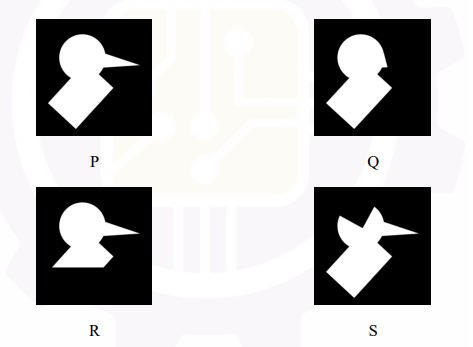
To solve this spatial aptitude puzzle, we need to determine which of the figures labelled P, Q, R, or S can be formed using the four pieces provided in the first image, without any overlaps and using each piece exactly once.
Let's analyze each option:
- Figure P: Observe the shapes and ensure they can be arranged without overlapping and covering all parts of this figure. The angles and profiles of the puzzle pieces match perfectly with figure P when arranged correctly.
- Figure Q: This is not directly formable as some of the shapes do not align correctly, given the sharp angles of some puzzle pieces.
- Figure R: Similar to Q, the arrangement of shapes will leave gaps, which means this cannot be successfully formed.
- Figure S: Attempting to arrange the pieces for this will lead to overlaps and misalignments.
Thus, through elimination and checking alignment, it is clear that figure P is the correct selection where all four pieces fit together perfectly, without overlaps, to form the given figure.
Hence, the correct answer is: P.
Important Questions from Assembling Shapes
- Which one of the following sets of pieces can be assembled to form a square with a single round hole near the center? Pieces cannot overlap.
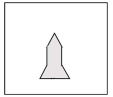
Which one of the groups given below can be assembled to get the shape that is shown above using each piece only once without overlapping with each other?
(rotation and translation operations may be used).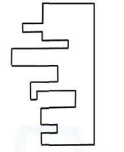
A jigsaw puzzle has 2 pieces. One of the pieces is shown above. Which one of the given options for the missing piece when assembled will form a rectangle? The piece can be moved, rotated or flipped to assemble with the above piece.
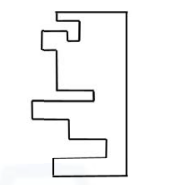
A jigsaw puzzle has 2 pieces. One of the pieces is shown above. Which one of the given options for the missing piece when assembled will form a rectangle? The piece can be moved, rotated or flipped to assemble with the above piece.
The figure shows two 4-tile patterns.

Either one or both of the patterns can be used any number of times and in any orientation to construct a new pattern. Which one of the options below cannot be constructed by using only these two 4-tile patterns assuming there are no overlaps among them?


