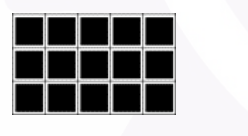
The figure shows two 4-tile patterns.

Either one or both of the patterns can be used any number of times and in any orientation to construct a new pattern. Which one of the options below cannot be constructed by using only these two 4-tile patterns assuming there are no overlaps among them?
The question involves constructing patterns using two given 4-tile patterns in any orientation. We need to determine which option cannot be constructed using these patterns. The two given patterns are:
There are four options to evaluate:
- Option 1:
- Option 2:
- Option 3:
- Option 4:
To solve this, consider that the first tile pattern is a block of 2x2 tiles, while the second is a vertical line of 4 tiles. Let's evaluate each option:
- Option 1: This can be formed by using two vertical line patterns without any overlap.
- Option 2: This can be formed by combining one 2x2 block pattern and a horizontal alignment of the vertical line pattern.
- Option 3: This pattern looks like a single vertical line of 5 tiles, which cannot be made using the given patterns since the vertical line pattern has only 4 tiles, and the 2x2 block cannot extend this vertical pattern.
- Option 4: Easily constructed using two 2x2 block patterns placed side by side.
Thus, Option 3 cannot be constructed using the given tile patterns. This confirms the answer.
Important Questions from Assembling Shapes
- Which one of the following sets of pieces can be assembled to form a square with a single round hole near the center? Pieces cannot overlap.
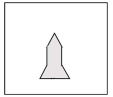
Which one of the groups given below can be assembled to get the shape that is shown above using each piece only once without overlapping with each other?
(rotation and translation operations may be used).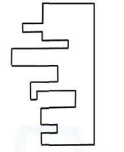
A jigsaw puzzle has 2 pieces. One of the pieces is shown above. Which one of the given options for the missing piece when assembled will form a rectangle? The piece can be moved, rotated or flipped to assemble with the above piece.
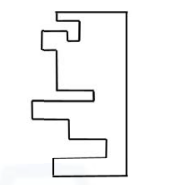
A jigsaw puzzle has 2 pieces. One of the pieces is shown above. Which one of the given options for the missing piece when assembled will form a rectangle? The piece can be moved, rotated or flipped to assemble with the above piece.
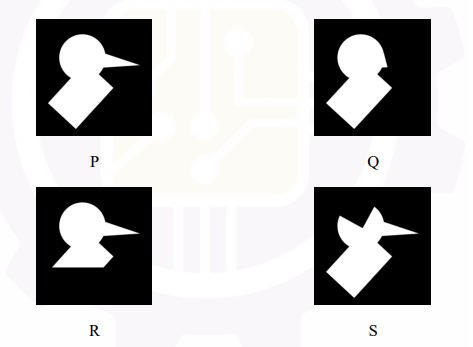
The four pieces of a puzzle are shown in the figure below.

Which one of the figures labelled as P, Q, R, and S can be constructed by using each of the four pieces only once without overlaps?