
The following program is stored in memory unit of the basic computer. What is the content of the accumulator after the execution of program? (All location numbers listed below are in hexadecimal). Location Instruction 210 CLA 211 ADD 217 212 INC 213 STA 217 214 LDA 218 215 CMA 216 AND 217 217 1234H 218 9CE2H
0215H
Analyzing the Basic Computer Program
The question asks for the final content of the accumulator (AC) after executing a small program stored in the memory of a basic computer. The program consists of several instructions, and we need to simulate their execution sequence. All memory locations and values are given in hexadecimal format.
Let's first list the program instructions and initial memory contents:
| Location (Hex) | Instruction/Content (Hex) | Instruction Type | Operand/Value |
|---|---|---|---|
| 210 | CLA | Memory Reference / Register Reference | Clear Accumulator |
| 211 | ADD 217 | Memory Reference | Add content of location 217H to AC |
| 212 | INC | Register Reference | Increment Accumulator |
| 213 | STA 217 | Memory Reference | Store content of AC into location 217H |
| 214 | LDA 218 | Memory Reference | Load content of location 218H into AC |
| 215 | CMA | Register Reference | Complement Accumulator |
| 216 | AND 217 | Memory Reference | Bitwise AND content of location 217H with AC |
| 217 | 1234H | Data | Initial value at 217H |
| 218 | 9CE2H | Data | Initial value at 218H |
Step-by-Step Program Execution
We will trace the execution of the program starting from location $210H$ and observe how the accumulator (AC) and relevant memory locations change. Assume the AC is initialized to an unknown state; the first instruction will handle its initial value.
| Step | Location (Hex) | Instruction | Operation | Accumulator (AC) Content (Hex) | Memory[217H] Content (Hex) |
|---|---|---|---|---|---|
| Start | - | - | Initial State (AC unknown) | ? | 1234 |
| 1 | 210 | CLA | Clear AC | 0000 | 1234 |
| 2 | 211 | ADD 217 | AC $\leftarrow$ AC + Memory[217H]. AC $\leftarrow$ $0000H + 1234H$ | 1234 | 1234 |
| 3 | 212 | INC | AC $\leftarrow$ AC + 1. AC $\leftarrow$ $1234H + 1H$ | 1235 | 1234 |
| 4 | 213 | STA 217 | Memory[217H] $\leftarrow$ AC. Memory[217H] $\leftarrow$ $1235H$ | 1235 | 1235 |
| 5 | 214 | LDA 218 | AC $\leftarrow$ Memory[218H]. AC $\leftarrow$ $9CE2H$ (Memory[218H] initially $9CE2H$) | 9CE2 | 1235 |
| 6 | 215 | CMA | AC $\leftarrow$ Complement of AC. Complement of $9CE2H$. $9CE2H = 1001\ 1100\ 1110\ 0010_2$ Complement = $0110\ 0011\ 0001\ 1101_2 = 631DH$ |
631D | 1235 |
| 7 | 216 | AND 217 | AC $\leftarrow$ AC AND Memory[217H]. AC $\leftarrow$ $631DH\ \text{AND}\ 1235H$. $631DH = 0110\ 0011\ 0001\ 1101_2$ $1235H = 0001\ 0010\ 0011\ 0101_2$ Bitwise AND: $0000\ 0010\ 0001\ 0101_2 = 0215H$ |
0215 | 1235 |
| End | - | - | Program finishes | 0215 | 1235 |
After executing the last instruction at location $216H$, the program halts (implicitly, as no further instructions are shown). The content of the accumulator at this point is $0215H$.
Revision Table: Basic Computer Instructions
Understanding the basic operations is crucial for tracing program execution. Here is a summary of the instructions used in this program:
| Instruction | Description | Effect on AC |
|---|---|---|
| CLA | Clear Accumulator | AC $\leftarrow$ 0 |
| ADD M | Add Memory to AC | AC $\leftarrow$ AC + Memory[M] |
| INC | Increment Accumulator | AC $\leftarrow$ AC + 1 |
| STA M | Store AC in Memory | Memory[M] $\leftarrow$ AC |
| LDA M | Load AC from Memory | AC $\leftarrow$ Memory[M] |
| CMA | Complement Accumulator | AC $\leftarrow$ Bitwise NOT of AC |
| AND M | AND Memory with AC | AC $\leftarrow$ AC AND Memory[M] (bitwise AND) |
Additional Information on Basic Computer Architecture
The basic computer, as described in many computer architecture textbooks, is a simplified model used to illustrate fundamental concepts. Key components include:
- Memory Unit: Stores instructions and data. Locations are addressed sequentially.
- Accumulator (AC): A general-purpose register used in most arithmetic and logic operations.
- Program Counter (PC): Holds the address of the next instruction to be executed. Initially loaded with the starting address of the program ($210H$ in this case).
- Instruction Register (IR): Holds the instruction currently being executed.
- Data Register (DR): Holds data read from or written to memory.
- Address Register (AR): Holds the address of the memory location being accessed.
Execution follows a fetch-decode-execute cycle for each instruction pointed to by the PC. Instructions are typically 16 bits long. The basic computer supports different instruction formats, including memory-reference instructions (like ADD, STA, LDA, AND), register-reference instructions (like CLA, INC, CMA), and input-output instructions. This program primarily uses memory-reference and register-reference instructions. Hexadecimal notation is commonly used to represent memory addresses and data for brevity.
Important Questions from Data-Path and Control Unit
Given below are two statements:
Statement I: Hardwired control unit can be optimized to produce fast mode of operation.
Statement II: Indirect addressing mode needs two memory reference to fetch the operand.
In the light of the above statements. choose the correct answer from the options given below
Which of the following statements with respect to multiprocessor system are true?
(A) Multiprocessor system is controlled by one operating system.
(B) In Multiprocessor system, multiple computers are connected by the means of communication lines.
(C) Multiprocessor system is classified as multiple instruction stream and multiple data stream system.
Choose the correct answer from the options given below:
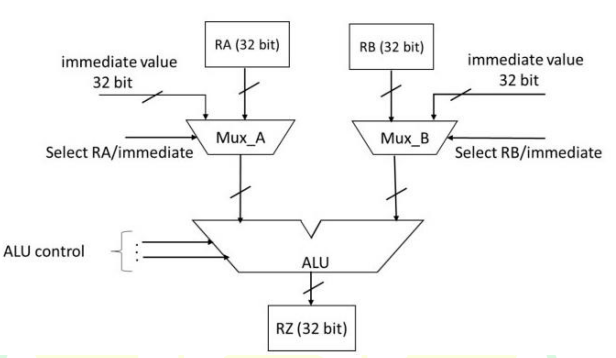
A partial data path of a processor is given in the figure, where RA, RB, and RZ are 32-bit registers. Which option(s) is/are CORRECT related to arithmetic operations using the data path as shown?
Given below are two statements: one is labelled as Assertion A and the other is labelled as Reason R
Assertion A: Instruction pipelining improves CPU throughput.
Reason R: Pipelining decreases the execution time of each individual instruction.
In the light of the above statements, choose the most appropriate answer from the options given below


